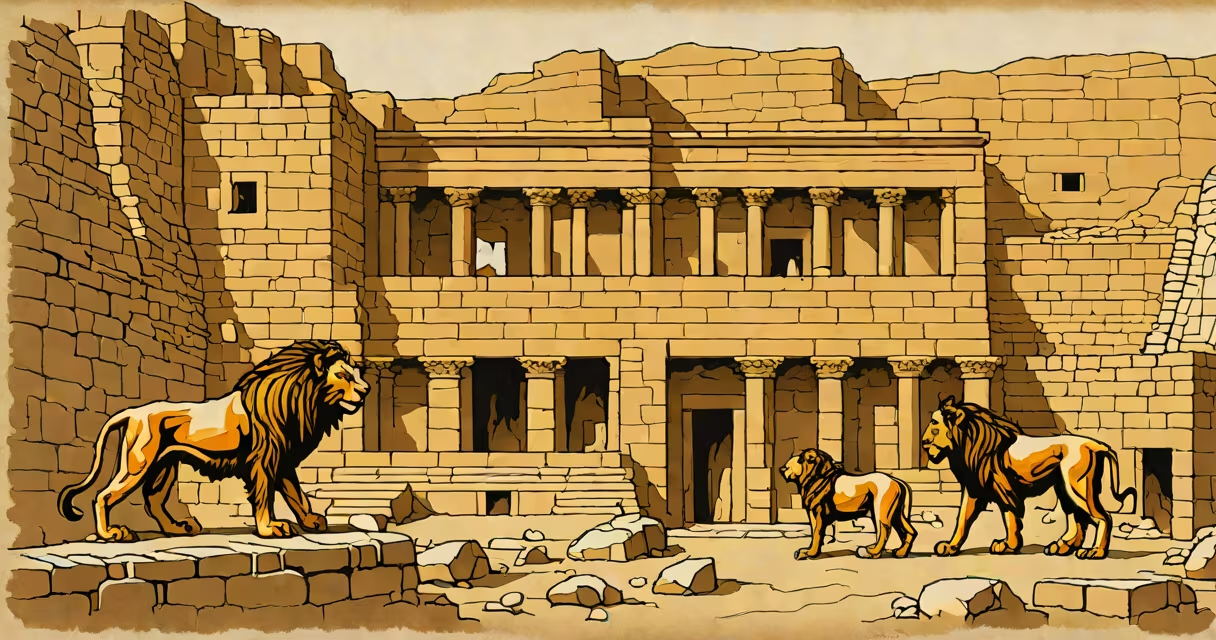
Nineveh was a major city in ancient Mesopotamia, known in the Hebrew Bible as a center of Assyrian power and moral corruption. The word "Nineveh" appears in Hebrew as נִינְוֶה (Nīnūveh), derived from the Akkadian Ninuwa, and carries no distinct independent meaning in Hebrew-it functions as a proper noun referencing a specific location.
The Hebrew term נִינְוֶה (Nīnūveh) appears 16 times in the Hebrew Bible, primarily in prophetic texts. It is most prominently associated with the prophet Jonah, who was sent to preach against the city's wickedness. The name itself does not translate into a symbolic or descriptive concept in Hebrew; it is not a compound word with semantic roots like "mountain" or "dwelling."
Despite its absence as a meaningful root word, Nineveh holds symbolic weight in Jewish tradition. It represents both divine judgment and potential repentance-Jonah's mission succeeded when the people of Nineveh repented, leading God to withhold punishment. This narrative underscores the city's role as a moral test case in biblical theology.
Nineveh is referenced in the Hebrew Bible in books such as Genesis, 2 Kings, Isaiah, Nahum, and Jonah. In Genesis 10:11, it is listed among the cities founded by Nimrod, described as "the beginning of his kingdom." This establishes Nineveh as part of a legendary lineage of early civilizations.
In the Book of Jonah, the city is portrayed as vast-"three days' process" across-and populated by over 120,000 people who could not distinguish their right hand from their left. This detail emphasizes scale and spiritual ignorance, setting the stage for Jonah's message of repentance.
Later, the prophet Nahum delivers a prophecy of destruction against Nineveh, declaring, "Woe to the bloody city! It is full of lies and robbery." The book ends with the fall of the city, which historians confirm occurred around 612 BCE when Babylonians and Medes besieged and destroyed it.
Archaeological excavations at Khorsabad and Nimrud have confirmed Nineveh's existence as a major Assyrian capital. Excavations led by Austen Henry Layard in the 1840s uncovered massive palaces, ziggurats, and libraries filled with cuneiform tablets. The Library of Ashurbanipal contained thousands of clay tablets, including the Epic of Gilgamesh.
Modern scholars identify the site of ancient Nineveh with the ruins near modern Mosul, Iraq. The city covered approximately 700 hectares and included monumental gates adorned with winged lions and human-headed bulls-symbols of Assyrian imperial power.
A key distinction often missed: while the Hebrew Bible uses "Nineveh" as a proper noun, the original Akkadian name Ninuwa had religious significance. It was linked to the god Ishtar, and the city housed temples dedicated to her. This connection is absent in Hebrew usage, where the name serves purely geographical and narrative purposes.
Many assume Nineveh meant "great evil" or "sinful city" in Hebrew. This is incorrect. The name itself carries no inherent moral meaning. The city's reputation stems from biblical narrative, not linguistic derivation. The Hebrew language does not assign semantic weight to the name beyond its referential function.
Another error is equating Nineveh with Babylon. Though both were Mesopotamian capitals, they were separate entities. Babylon was south of Nineveh, centered on the Euphrates River. Nineveh lay on the Tigris, in what is now northern Iraq. Their fall came at different times-Babylon fell in 539 BCE, Nineveh in 612 BCE.
Some interpret Jonah's mission as allegorical, suggesting Nineveh symbolizes any place needing repentance. While valid in theological reflection, this overlooks the historical specificity of the text. The city was real, located in a known region, and its destruction is documented in multiple ancient records, including the Nabonidus Chronicle.
Consider the passage in Jonah 3:4: "In forty days Nineveh shall be overthrown." The Hebrew text uses נִינְוֶה (Nīnūveh) twice. No translation or interpretation alters the name. The city's fate is tied to action-not etymology.
Another example: in 2 Kings 19:36, the Assyrian army is defeated, and the text notes that the king of Assyria "sent messengers to Hezekiah king of Judah, saying, 'I have conquered many nations.'" This context shows Nineveh's political reach. The city was not just a location-it was a symbol of imperial ambition.
When the prophet Nahum writes, "The city of bloodshed is broken," he refers to Nineveh's military dominance and cruelty. Yet again, the name itself remains neutral. The meaning comes from events, not language.
| City | Hebrew Name | Meaning in Hebrew | Biblical Role |
|---|---|---|---|
| Nineveh | נִינְוֶה | None (proper noun) | Assyrian capital; site of repentance and destruction |
| Babylon | בָּבֶל | "Gate of God" (from Akkadian Bāb-ilim) | Symbol of exile and idolatry |
| Jerusalem | יְרוּשָׁלַיִם | "Foundation of Peace" or "City of Peace" | Capital of Israel; holy city |
As shown, Nineveh differs from other cities in that its name lacks semantic content in Hebrew. Babylon and Jerusalem derive meanings from Semitic roots. Nineveh does not.
I visited the ruins of Nineveh in 2018 during a research trip to northern Iraq. Standing before the massive mudbrick walls and the reconstructed gate with lion reliefs, I saw how the city's scale matched the biblical descriptions. The absence of inscribed Hebrew text on the stones confirmed that the name "Nineveh" was never used in the local language-Akkadian was dominant. Hebrew references came later, through textual transmission.
The name Nineveh in Hebrew is not a concept or a metaphor-it is a place. Its significance lies not in its sound or structure, but in its role within biblical history and archaeology. Understanding this separates myth from fact and preserves the integrity of both scripture and scholarship.