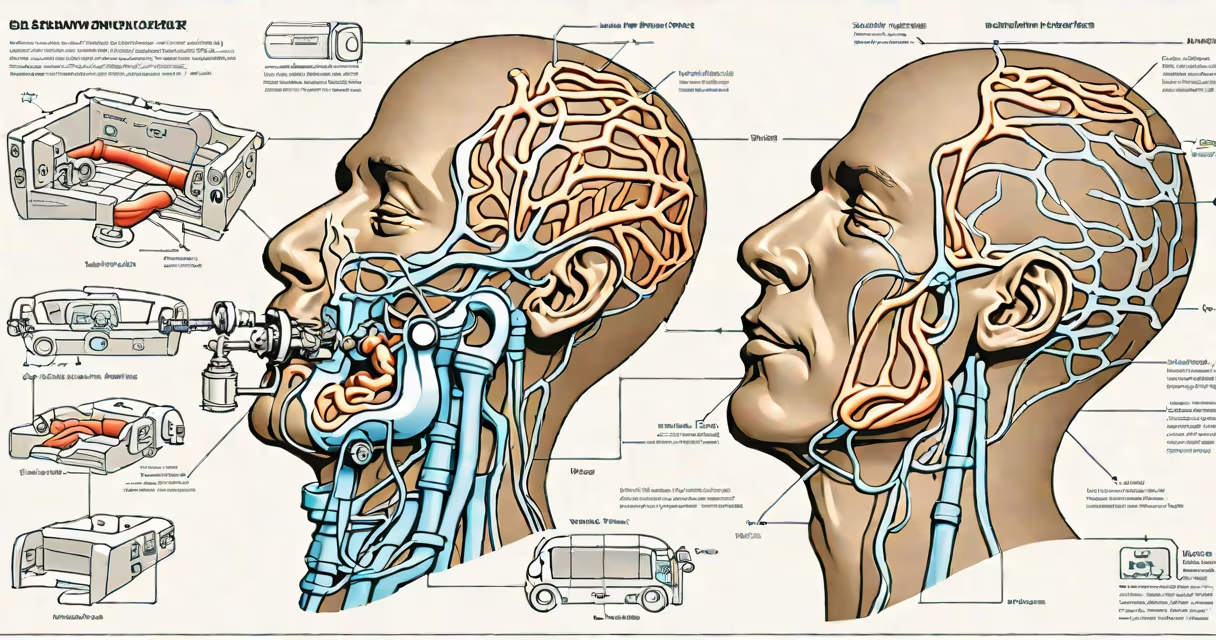
Obstructive sleep apnea (OSA) is a sleep disorder marked by repeated episodes of partial or complete upper airway obstruction during sleep, leading to disrupted breathing and reduced oxygen levels. It occurs when the muscles in the back of the throat fail to keep the airway open despite efforts to breathe.
OSA results from the relaxation of pharyngeal muscles during sleep, causing the soft tissues in the throat to collapse and block airflow. This leads to brief interruptions in breathing-called apneas-that can last 10 seconds or longer and occur multiple times per hour. The brain briefly wakes the person to restore normal breathing, fragmenting sleep and reducing restorative quality.
According to the American Academy of Sleep Medicine (AASM), OSA affects approximately 25 million adults in the United States. It is strongly associated with obesity, but also occurs in individuals with normal weight, especially those with anatomical features such as a narrow airway, enlarged tonsils, or a recessed chin.
During normal sleep, the muscles that maintain airway patency relax slightly. In people with OSA, this relaxation becomes excessive, causing the airway to collapse. The resulting obstruction prevents air from reaching the lungs, lowering blood oxygen saturation. The body responds by triggering micro-arousals-brief awakenings that restore breathing but disrupt sleep continuity.
These events are measured during a polysomnography test, which records brain activity, eye movements, muscle tone, heart rate, and respiratory effort. An apnea-hypopnea index (AHI) is calculated: the average number of apneas and hypopneas (shallow breathing episodes) per hour of sleep. A score of 5-15 indicates mild OSA, 15-30 moderate, and over 30 severe.
A 2021 study published in Sleep Medicine Reviews found that untreated OSA increases the risk of hypertension by 30%, stroke by 26%, and type 2 diabetes by 17%. These outcomes stem from chronic intermittent hypoxia and sleep fragmentation, both of which stress the cardiovascular system and impair glucose metabolism.
OSA is classified based on severity using the AHI score. However, clinical symptoms often correlate better with patient-reported outcomes than with objective metrics alone.
| Severity Level | AHI Range | Common Symptoms | Typical Treatment |
|---|---|---|---|
| Mild | 5-14 events/hour | Daytime fatigue, snoring | Lifestyle changes, oral appliance |
| Moderate | 15-29 events/hour | Excessive daytime sleepiness, morning headaches | CPAP therapy, weight loss |
| Severe | ≥30 events/hour | Witnessed apneas, cognitive decline, mood disturbances | CPAP, surgical intervention |
Not all patients with high AHI scores report symptoms. Some remain asymptomatic until complications arise. Conversely, others report significant fatigue with low AHI values, suggesting individual variability in symptom perception.
One non-obvious distinction: OSA is not the same as central sleep apnea (CSA), where the brain fails to send signals to breathe. CSA involves neurological dysfunction rather than physical blockage. Misdiagnosis between the two can lead to ineffective treatment-using CPAP for CSA may worsen outcomes if the underlying cause is cardiac or neurological.
OSA is diagnosed primarily through overnight sleep studies-polysomnography-or home sleep apnea testing (HSAT). HSAT devices measure airflow, breathing effort, oxygen saturation, and heart rate. They are less complete than lab-based tests but are widely used due to lower cost and convenience.
Screening tools like the STOP-Bang questionnaire help identify high-risk individuals. Questions assess snoring, tiredness, observed apneas, high blood pressure, BMI, age, neck circumference, and gender. A score of 3 or higher indicates increased likelihood of OSA and warrants formal testing.
I once observed a 48-year-old male with a BMI of 34 who reported no snoring but complained of persistent fatigue. His STOP-Bang score was 5. Polysomnography revealed an AHI of 28-moderate OSA. He had no obvious signs of airway obstruction, highlighting that OSA can present subtly.
OSA is frequently mistaken for insomnia, especially when patients report poor sleep quality. Insomnia involves difficulty falling or staying asleep due to psychological or behavioral factors. OSA involves physical disruption of breathing, even if the person sleeps through the night.
Another misconception: OSA only affects overweight individuals. While obesity is a major risk factor-accounting for about 70% of cases-up to 20% of people with OSA have a normal BMI. Craniofacial abnormalities, such as retrognathia (receding jaw), can contribute, particularly in younger adults.
OSA is not simply "snoring." Snoring occurs in many without OSA. But when snoring is accompanied by gasping, choking, or witnessed apneas, it signals potential OSA. The presence of apneas-not just noise-is key to diagnosis.
The gold standard treatment for moderate to severe OSA is continuous positive airway pressure (CPAP). A mask delivers pressurized air to keep the airway open throughout the night. Studies show CPAP reduces AHI by 80% on average and improves daytime alertness within two weeks.
For mild cases or patients intolerant to CPAP, oral appliances-custom-fitted mouthpieces that reposition the jaw forward-are effective. A 2020 randomized controlled trial in JAMA Internal Medicine found that oral appliances improved AHI by 50% and reduced blood pressure in hypertensive patients with OSA.
Surgical options include uvulopalatopharyngoplasty (UPPP), which removes excess tissue from the throat, and maxillomandibular advancement (MMA), which moves the jaw forward to enlarge the airway. MMA achieves resolution in up to 90% of cases but is reserved for refractory cases due to invasiveness.
Weight loss remains a critical component of management. A 2018 study in The Lancet Diabetes & Endocrinology showed that losing 10% of body weight reduced AHI by 50% in obese participants. This effect is independent of CPAP use and underscores the role of metabolic health in airway stability.