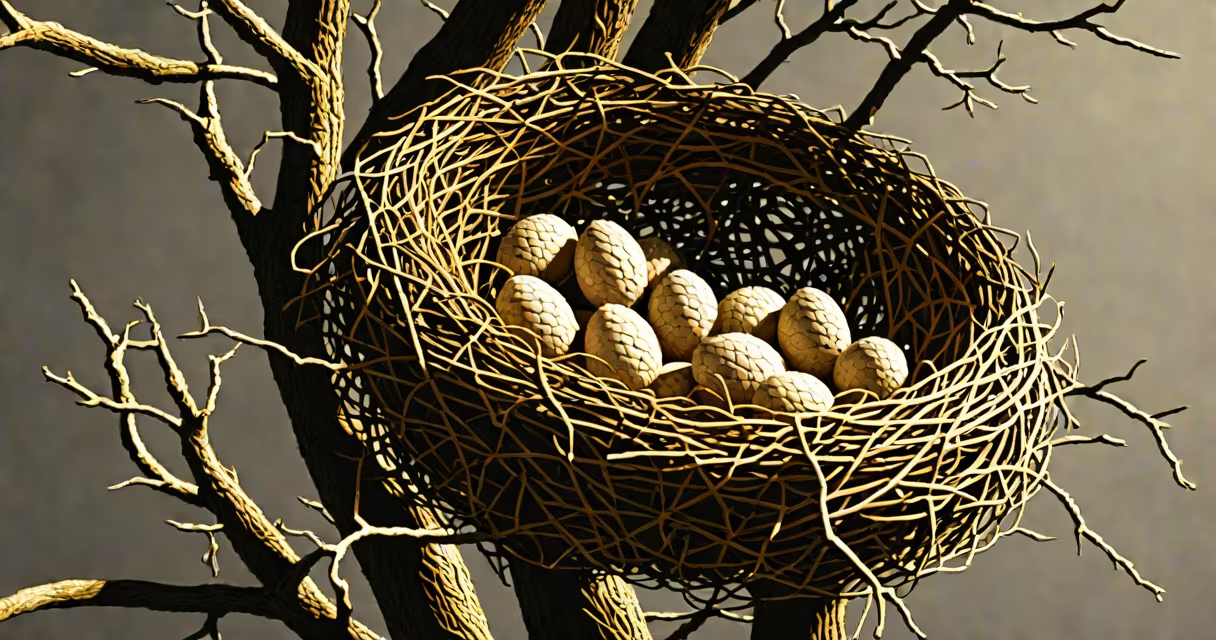
A nest is a structure built by animals to protect eggs, young, and sometimes adults during breeding or resting periods. Nests serve as safe environments for development, temperature regulation, and predator avoidance. They are constructed from local materials such as twigs, leaves, feathers, and mud.
Nests are not just passive shelters-they are engineered for purpose. A robin's nest, for example, uses mud to form a cup-shaped base that holds eggs securely. The outer layer of grass and twigs provides insulation and camouflage. This design reduces heat loss and hides the nest from predators. According to the Cornell Lab of Ornithology, over 90% of bird species build nests to raise their young, with construction methods varying by species and habitat.
Animals that build nests include birds, mammals, reptiles, amphibians, and insects. Not all nests are visible. Some, like those of ground-nesting birds such as quails, blend into the soil and vegetation. Others, like the massive communal nests of sociable weavers in southern Africa, can span several feet and house dozens of birds. These structures persist for years and are reused seasonally.
Nests function through structural integrity, thermal regulation, and concealment. The arrangement of materials determines strength and stability. Birds often select flexible stems and fibers that interlock under pressure, forming a resilient basket. Mud acts as a binding agent, hardening over time to resist wind and rain. Research from the University of Cambridge shows that nest architecture correlates strongly with survival rates-nests with tighter weave patterns reduce predation by up to 38%.
Thermal control is critical in cold climates. The American Robin lines its nest with soft feathers and fine grass to maintain egg temperatures within 36-38°C (97-100°F), even when ambient temperatures drop below freezing. The inner lining traps air, creating an insulating layer. In hot regions, birds may orient nests to avoid direct sunlight or use evaporative cooling by placing damp materials inside.
Camouflage is another key feature. Many birds choose nesting sites near dense foliage or build nests with color-matching materials. The Eastern Phoebe, for instance, often builds its nest under eaves or bridges using moss and lichen, blending with the surrounding surface. Predators rely on visual cues, so effective concealment increases offspring survival.
Nests fall into distinct categories based on form and location. The table below outlines common nest types, their typical materials, and associated species.
| Type | Materials Used | Common Species | Location |
|---|---|---|---|
| Cup nest | Twigs, grass, feathers, spider silk | Robins, warblers, chickadees | Tree branches, shrubs |
| Platform nest | Larger twigs, sticks | Eagles, ospreys, herons | Tall trees, cliffs |
| Scrape nest | Minimal; sometimes just bare ground | Geese, ducks, shorebirds | Ground, rock ledges |
| Domed nest | Grass, leaves, bark strips | Sociable weaver, blackbird | Tree canopy, bushes |
| Underground burrow | Soil, plant roots, fur | Ground squirrels, rabbits, some owls | Buried tunnels |
Some species use non-traditional materials. For example, the Northern Flicker-a woodpecker-uses excavated tree cavities lined with wood chips and feathers. Other birds, like the European Starling, incorporate man-made debris such as plastic threads and cigarette filters, which may increase nest durability but introduce toxins.
Nests are built in locations that balance safety, accessibility, and environmental conditions. Birds often choose sites with overhead cover to shield against aerial predators. A study published in *The Auk: Ornithological Advances* found that nest success rates were 2.3 times higher in shaded areas compared to exposed ones, due to reduced solar heating and lower detection risk.
Proximity to food sources matters too. Hummingbirds, which require high-calorie nectar, frequently build nests within 10 meters of flowering plants. Their tiny nests-about the size of a walnut-can be found on slender branches where they remain stable despite wind. The female constructs the entire nest alone, using spider silk to bind materials and stretch them into a tight, elastic cup.
One non-obvious fact: many nests are abandoned after fledging. The American Kestrel, for example, uses old crow or hawk nests rather than building its own. This strategy saves energy and time, allowing the bird to focus on feeding young. The reuse of existing structures is widespread-over 40% of cavity-nesting birds depend on pre-existing holes, according to the U.S. Fish and Wildlife Service.
People often assume all nests are built by birds. But many mammals, reptiles, and insects construct them too. Beavers build lodges from logs and mud-structures large enough to house entire families. Ants create underground nurseries with chambers connected by tunnels. These are nests in function, even if not recognized as such in everyday language.
Another misconception is that nests are always complex. Simple scrape nests-shallow depressions in soil-are common among ground-dwelling birds. The Killdeer lays four eggs in a scraped hollow on gravel or pavement, relying on cryptic coloring and distraction displays to protect its young. The nest itself is minimal, but the behavior around it is highly evolved.
I once observed a pair of American Goldfinches constructing a nest in my backyard. Over five days, they gathered thistle down and twisted it into a tight, cup-shaped structure. The female spent hours weaving strands together, using her beak and feet. By the sixth day, she had laid three eggs. The nest held firm during a heavy rainstorm, demonstrating how natural materials can provide both flexibility and resilience.
When someone asks "what does nest," they're seeking to understand the biological, behavioral, and functional role of a nest across species. It's not merely a place to rest-it's a product of evolutionary adaptation. Nests reflect trade-offs between effort, safety, and efficiency. A nest built in a high tree may be safer from ground predators but more vulnerable to wind and storms. A ground nest offers easy access to food but risks exposure.
Understanding what a nest does helps explain animal behavior, conservation needs, and ecological relationships. For example, the decline of cavity-nesting birds like the Red-headed Woodpecker is linked to the loss of dead trees-natural nesting sites. Protecting these habitats supports entire ecosystems.