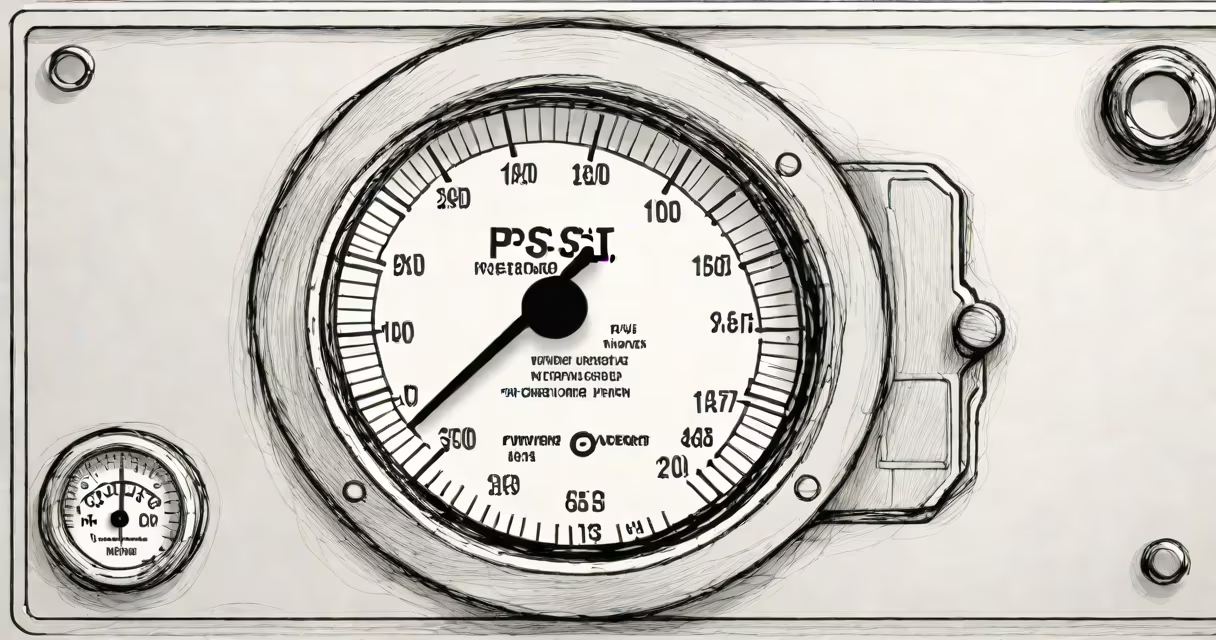
Psi measures pressure in pounds per square inch, a unit used to quantify force applied per unit area across a surface. It's standard in U.S. industrial, mechanical, and fluid systems.
Psi is derived from the imperial system and expresses how many pounds of force are exerted on each square inch of surface. For example, a tire inflated to 32 psi means 32 pounds of pressure push against every square inch of the inner tire wall.
It's widely used in automotive maintenance, HVAC systems, hydraulic machinery, and scuba gear. The unit appears on pressure gauges, air compressors, and plumbing fittings across North America.
Psi calculates pressure as force divided by area. A force of 1 pound acting uniformly over 1 square inch equals 1 psi. This makes it intuitive for engineers and technicians who work with physical components under stress.
For context, atmospheric pressure at sea level is about 14.7 psi. That means the air around us pushes on every surface with 14.7 pounds per square inch. When a system operates above that, such as a car engine's combustion chamber, pressures rise -often exceeding 1,000 psi during peak compression.
Pressure increases when volume decreases. In a sealed piston cylinder, compressing gas reduces space, forcing molecules closer together and raising psi. This principle applies in air compressors, where a motor drives a piston to squeeze air into a tank until it reaches 120 psi or higher.
Not all psi values represent the same kind of pressure. There are three primary categories:
| Type | Definition | Use Case | Example Value |
|---|---|---|---|
| PSIA (Absolute) | Pressure relative to a perfect vacuum | Aerospace, weather systems | 14.7 PSIA at sea level |
| PSIG (Gauge) | Pressure relative to ambient atmosphere | Tire pressure, HVAC refrigerant lines | 32 PSIG for a car tire |
| PSID (Differential) | Difference between two pressures | Filtration systems, flow meters | 5 PSID across a filter |
PSIG is most common in everyday tools. A pressure washer labeled "2,000 PSI" means 2,000 PSIG-2,000 pounds per square inch above ambient air pressure. The actual absolute pressure is 2,014.7 psi, but the system doesn't account for atmospheric baseline.
Confusion often arises when comparing PSIG to PSIA. A tire at 32 PSIG has a true pressure of 46.7 PSIA. Ignoring this difference can lead to errors in high-precision environments like aerospace or medical equipment calibration.
Many assume psi measures weight or force directly. It does not. Psi is not a measure of mass or energy-it's a measure of pressure, which is force per area. Confusing it with pounds (lb) or horsepower (hp) leads to design flaws.
Another error: thinking psi is interchangeable with bar or kPa. While they represent the same physical quantity, conversion matters. 1 psi ≈ 6.895 kPa. A 100 psi system is roughly 689.5 kPa. Using the wrong unit in calculations causes system failures-especially in international projects.
One non-obvious fact: psi is not part of the SI system. The International System of Units uses pascals (Pa), where 1 psi = 6,894.76 Pa. Engineers working globally must convert between psi and pascals when sharing data across regions.
Consider a sedan with recommended tire pressure of 35 PSIG. The driver inflates each tire using a compressor. The gauge reads 35 PSIG, meaning the internal pressure exceeds ambient air pressure by 35 pounds per square inch.
If the ambient pressure is 14.7 psi, the absolute pressure inside the tire is 49.7 PSIA. Over time, temperature changes affect this value. On a hot day, air expands-pressure rises. If unchecked, a tire can exceed safe limits, risking blowouts.
Using a calibrated digital gauge, the driver checks pressure at 90°F. The reading shows 38 PSIG. That's 52.7 PSIA. The increase aligns with the ideal gas law: PV = nRT. As temperature rises, pressure increases proportionally if volume remains constant.
This example shows why understanding psi isn't just academic-it affects safety, fuel efficiency, and tire lifespan.
Psi does not measure flow rate, temperature, or humidity. Flow rate is measured in gallons per minute (GPM), temperature in degrees Fahrenheit or Celsius, and humidity in relative humidity percentage. Mixing these units leads to incorrect diagnostics.
Similarly, psi isn't used in electrical systems. Voltage, current, and resistance are measured in volts, amps, and ohms. Applying psi to an electrical circuit would be meaningless.
I once replaced a leaking hydraulic line on a forklift. The system ran at 2,500 PSIG. During disassembly, I noticed a small oil drip at the fitting. The pressure gauge read 2,480 PSIG-within tolerance-but the leak persisted.
After replacing the O-ring and torqueing the fitting to 35 ft-lbs, the leak stopped. I verified with a pressure test. The system held 2,500 PSIG for 10 minutes with no drop. The issue wasn't pressure-it was sealing integrity.
This confirmed that psi indicates load, not reliability. A system can hold high psi but still fail due to poor assembly or material fatigue.
Psi measures pressure in pounds per square inch. It quantifies force distributed over a surface area. Common in U.S. industrial and mechanical systems, psi appears on gauges, valves, and specifications.
Understand the difference between PSIG (gauge), PSIA (absolute), and PSID (differential). Always confirm whether a reading includes atmospheric pressure. Convert between psi and SI units like kPa when needed.
Knowing what psi measures prevents errors in design, maintenance, and safety. Whether checking a tire or calibrating a machine, psi delivers precision where it matters.