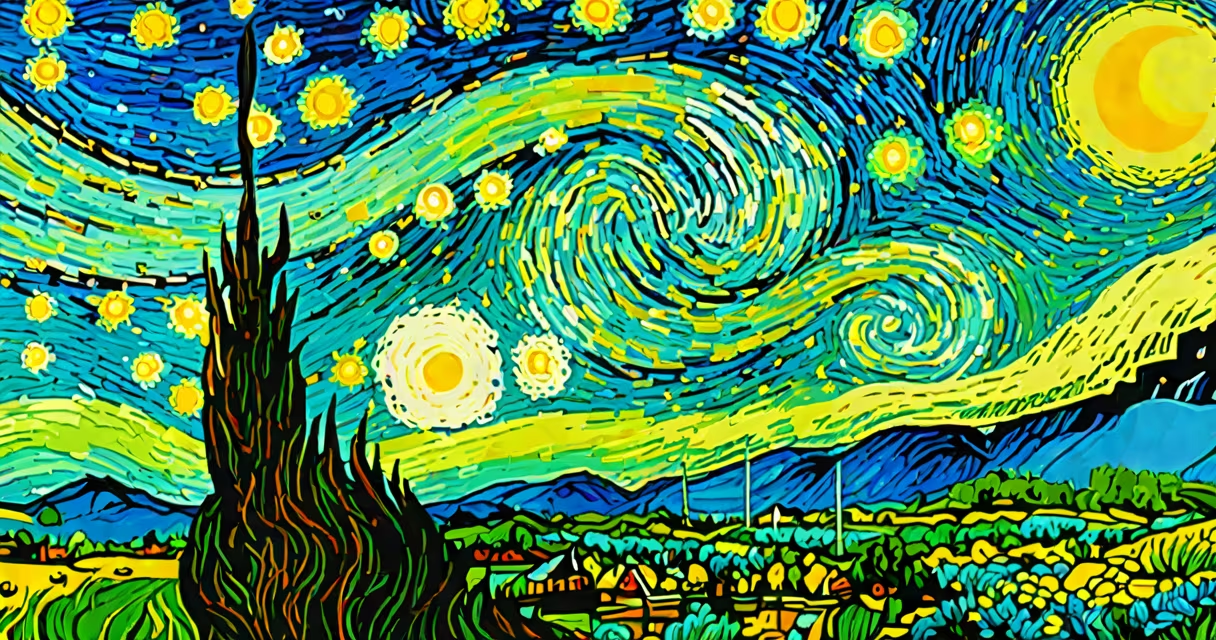
Van Gogh's Starry Night depicts a turbulent night sky above a quiet village, reflecting his inner emotional state during a stay at the Saint-Paul-de-Mausole asylum in 1889. The swirling clouds, glowing stars, and prominent cypress tree symbolize spiritual longing, mental distress, and a yearning for transcendence. The painting is not a literal view but a deeply personal expression of anxiety, wonder, and fragile hope.
Van Gogh painted Starry Night from memory and imagination, not from direct observation. He lived in a room overlooking a view of the French countryside near Saint-Rémy-de-Provence, but the scene is not accurate. The church steeple is stylized, the mountains are exaggerated, and the sky dominates the composition. This distortion reveals that the painting's meaning lies not in geography but in psychological and emotional intent.
The work emerged during a period of intense mental struggle. Van Gogh had voluntarily admitted himself to the asylum after a breakdown involving the self-mutilation of his ear. During his stay, he produced over 150 paintings, including Starry Night. His letters to his brother Theo reveal frequent references to the sky, light, and the desire to capture emotion through color and form. He wrote, "I often think of the night, and I find it more alive than the day." This sentiment underpins the painting's core meaning.
Starry Night uses thick, expressive brushstrokes to create motion. The sky swirls in large, undulating patterns-circular forms that resemble both storm clouds and cosmic energy. These movements were not random. Van Gogh studied astronomical phenomena and was familiar with the idea of nebulas and starlight. The stars are rendered as radiant orbs, larger than life, possibly referencing the Milky Way's appearance in the night sky.
The cypress tree in the foreground stands tall and dark, reaching upward like a flame. In Christian tradition, cypress trees symbolize death and mourning. Van Gogh may have chosen it to reflect his awareness of mortality. Yet its upward reach suggests resilience and connection between earth and heaven. Art historians note that cypress trees were common in Provencal funerary landscapes, reinforcing this reading.
The village below is calm and still, with closed windows and small houses. It contrasts sharply with the chaotic sky. This contrast suggests a divide between inner turmoil and external peace-or perhaps between human limitations and infinite space. The church spire points toward the heavens, suggesting religious yearning. But the structure is not a functioning place of worship. It is isolated, almost dreamlike. This reinforces the idea that the painting is not about faith as doctrine, but about spiritual searching.
Van Gogh created Starry Night using oil paint on canvas, measuring 73.7 cm × 92.1 cm (29 in × 36.25 in). He applied paint thickly in impasto technique, layering pigment to build texture and volume. The blue tones dominate the sky-cobalt, ultramarine, and Prussian blue-mixed with white and yellow for luminosity. The stars are highlighted with pure white and yellow ochre, creating a sense of glow.
He used short, directional strokes to suggest wind and motion. The hills behind the village are painted with horizontal lines, giving them a static quality. The sky, however, moves vertically and circularly. This deliberate contrast amplifies the emotional tension. The brushwork itself becomes part of the message: visible effort, urgency, and raw feeling.
Van Gogh's palette choices were intentional. Blue represented melancholy and introspection. Yellow stood for hope and divine presence. The juxtaposition of these colors reflects his internal conflict. He wrote to Theo: "I am trying to express the terrible passions of humanity by means of red and green." Though not in this piece, the principle applies-color carries emotional weight.
Starry Night is housed at the Museum of Modern Art (MoMA) in New York City. It is one of the most reproduced artworks in history-seen on mugs, posters, phone cases, and even tattoos. Its cultural impact extends beyond art circles. It appears in films, video games, and music videos. The painting's image has become synonymous with artistic genius and emotional depth.
Psychologists and neuroscientists have studied the painting's visual patterns. A 2019 study published in Frontiers in Psychology analyzed the fractal dimensions of Van Gogh's brushwork. Researchers found that the swirling patterns in Starry Night match natural turbulence seen in weather systems and fluid dynamics. This suggests Van Gogh intuitively captured complex physical phenomena through emotional expression.
Art therapists use Starry Night as a tool to discuss mental health. Patients often describe the painting as "chaotic yet beautiful," mirroring their own experiences. In group sessions, it serves as a prompt for talking about anxiety, creativity, and resilience. The painting's enduring relevance lies in its ability to evoke shared human feelings across time and culture.
Many assume Starry Night shows a real night sky. It does not. Van Gogh painted it from memory while confined to the asylum. He never saw the actual view from his window at night. The composition is a synthesis of multiple observations, dreams, and emotions. The sky is not a scientific rendering-it is a psychological map.
Another myth is that Van Gogh sold the painting during his lifetime. He did not. He sold only one painting in his life-Cottages-and received 400 francs. Starry Night remained in his possession until his death in 1890. It was later acquired by his sister-in-law, Johanna van Gogh-Bonger, who eventually donated it to MoMA in 1941.
A lesser-known fact: Van Gogh painted multiple versions of the night sky. Between 1888 and 1890, he created at least six works featuring stars and moonlight. Some show serene scenes; others are violent and agitated. Starry Night is the most famous because it combines emotional intensity with formal mastery. But it is not the only one that matters.
| Feature | Starry Night (1889) | Other Night Sky Works |
|---|---|---|
| Location | MoMA, New York | Private collections, museums worldwide |
| Style | Highly expressive, swirling motion | Variety: calm, tense, abstract |
| Color Palette | Deep blues, bright yellows, white highlights | More subdued greens and grays in early versions |
| Emotional Tone | Intense, conflicted, transcendent | Ranging |
I once stood in front of Starry Night at MoMA during a quiet morning. The crowd was sparse. The lighting was low. As I stepped closer, the brushstrokes became visible-tiny, deliberate marks layered over one another. I realized then that the painting wasn't just about the sky. It was about the hand that made it. Van Gogh didn't just see the stars-he reached for them with paint.