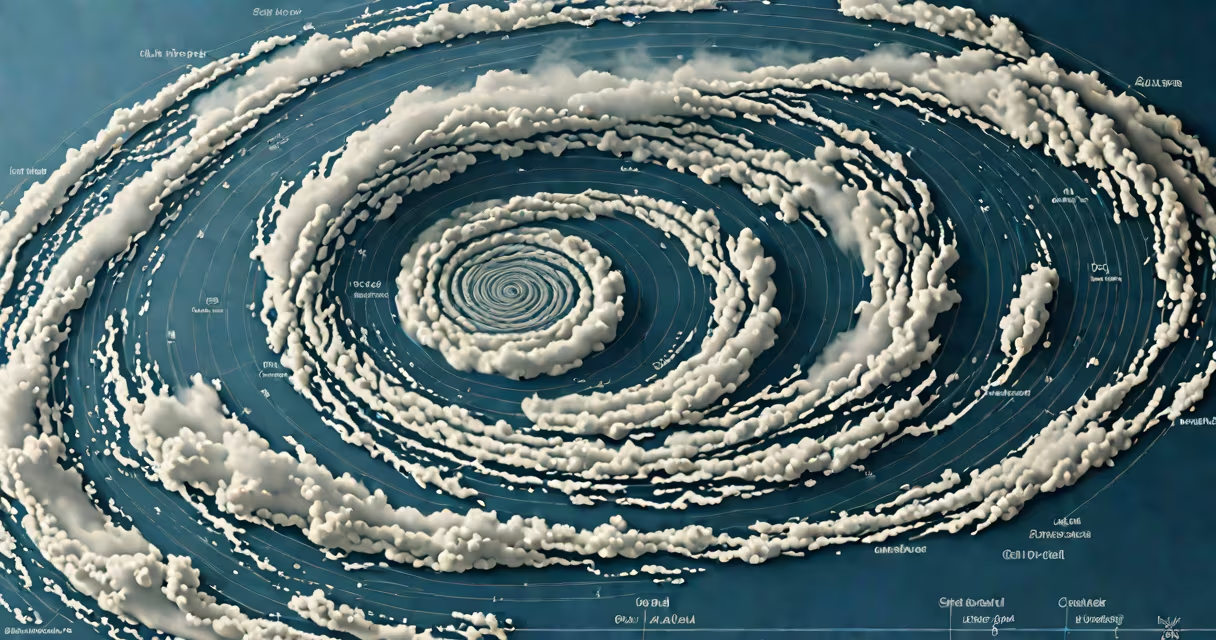
A tropical cyclone is a rotating storm system fueled by warm ocean water, characterized by strong winds, heavy rain, and a low-pressure center. These storms form over tropical oceans and can grow to hundreds of kilometers wide, producing destructive winds and storm surges.
Tropical cyclones derive energy from latent heat released when warm, moist air rises and condenses. This process creates a feedback loop: rising air lowers pressure, drawing in more air, which spirals inward due to Earth's rotation. The Coriolis effect prevents formation within 5° latitude of the equator, where rotational forces are too weak.
According to the National Hurricane Center, tropical cyclones require sea surface temperatures above 26.5°C (80°F) and sufficient atmospheric instability to sustain development. They typically form between June and November in the Northern Hemisphere, peaking in September.
Storms begin as tropical disturbances-clusters of thunderstorms over warm ocean waters. If wind shear is low and moisture levels are high, these disturbances can organize into a closed circulation. When sustained winds reach 63 km/h (39 mph), the system becomes a tropical storm and receives a name.
Further intensification occurs when the storm's central pressure drops and wind speeds increase. A mature tropical cyclone develops an eye-a calm, clear center surrounded by the eyewall, where the strongest winds and heaviest rainfall occur. Eyewalls can contract or expand during rapid intensification events, sometimes increasing wind speed by more than 50 km/h in 24 hours.
For example, Hurricane Katrina in 2005 intensified from a tropical storm to a Category 5 hurricane in under 48 hours, with wind speeds climbing from 95 km/h to 280 km/h. This rapid escalation was driven by passage over the warm Loop Current in the Gulf of Mexico, which provided abundant thermal energy.
Tropical cyclones are known by different names depending on location:
| Region | Local Name | Wind Speed Threshold |
|---|---|---|
| North Atlantic & Northeast Pacific | Hurricane | ≥119 km/h (74 mph) |
| Northwest Pacific | Typhoon | ≥119 km/h (74 mph) |
| Southern Pacific & Indian Ocean | Cyclone | ≥119 km/h (74 mph) |
The difference lies solely in geography. All three represent the same meteorological phenomenon. The World Meteorological Organization maintains standardized naming conventions across regions, with lists rotated every six years.
Non-tropical cyclones-such as extratropical storms-develop from temperature contrasts in mid-latitudes and lack a warm core. They do not have eyes and often bring widespread precipitation rather than concentrated wind damage.
Many assume tropical cyclones form from cold fronts or polar air masses. This is incorrect. These storms originate exclusively over warm tropical seas. Cold air cannot provide the necessary energy to sustain a cyclonic circulation.
Another misconception is that landfall ends a cyclone's threat. In reality, storm surge and flooding cause most fatalities. For example, Hurricane Sandy in 2012 caused 147 deaths, primarily from storm surge in New York City and New Jersey. The storm had weakened to a post-tropical cyclone before making landfall, yet still produced catastrophic flooding.
People often confuse tropical cyclones with tornadoes. While both involve rotating winds, tornadoes form from convective storms over land and last minutes to hours. Tropical cyclones span thousands of square kilometers and persist for days to weeks.
In 2013, Typhoon Haiyan devastated the Philippines, with maximum sustained winds estimated at 315 km/h (195 mph)-the highest ever recorded for a landfalling tropical cyclone. The storm surge reached 5 meters in some areas, destroying entire coastal communities.
When I monitored storm tracking software during the 2018 Atlantic season, I observed how a minor disturbance near the Cape Verde Islands evolved into Hurricane Florence. Within 72 hours, it strengthened from a tropical depression to a Category 4 storm. The rapid intensification caught forecast models off guard, highlighting the unpredictability even with advanced tools.
Climate change influences cyclone behavior. Research from NOAA shows a 5% increase in the proportion of storms reaching Category 4 or 5 intensity since 1979, linked to warming ocean surfaces. However, total annual cyclone counts have not risen, suggesting shifts in intensity rather than frequency.
Understanding tropical cyclones is essential for disaster preparedness. Communities in vulnerable zones rely on accurate forecasts to evacuate and protect infrastructure. Early warning systems reduce mortality by up to 90%, according to the World Health Organization.
For those interested in the mechanics behind storm formation, a deeper look at the atmospheric conditions needed reveals how small changes in temperature, humidity, and wind patterns can trigger large-scale weather events.
Tropical cyclones are complex, useful systems shaped by oceanic and atmospheric dynamics. Their impact varies widely based on location, timing, and preparation. Recognizing their structure, naming conventions, and risks enables better response and resilience.