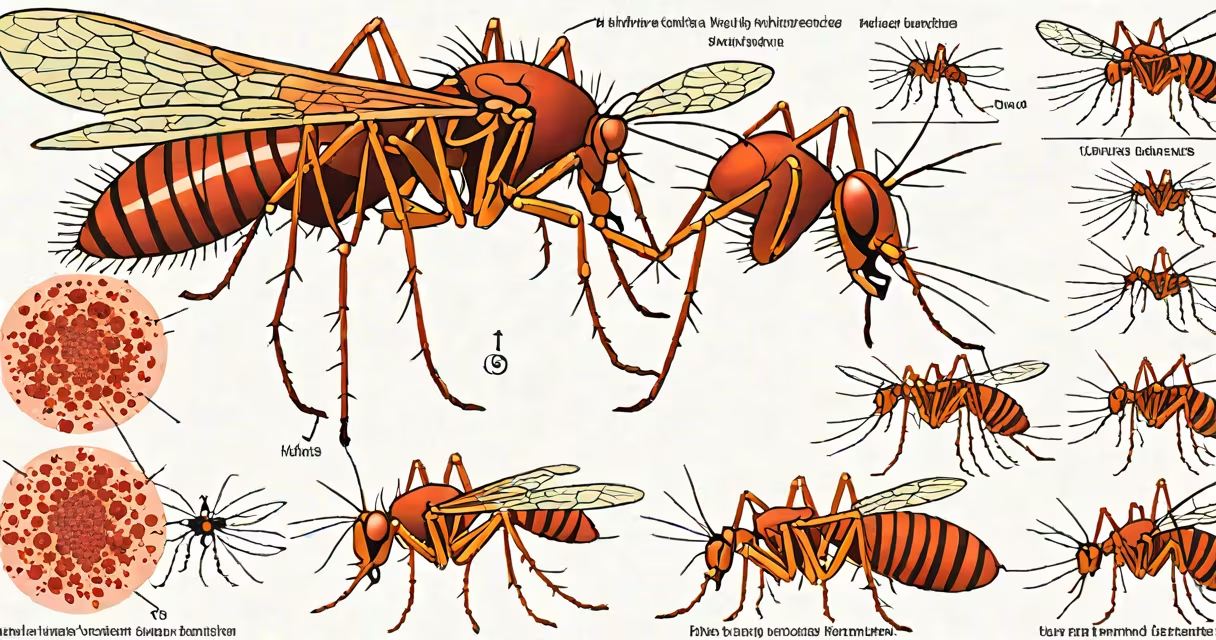
Malaria is caused by single-celled parasitic organisms in the genus Plasmodium, transmitted to humans through the bite of infected female Anopheles mosquitoes. The most common and deadly species is Plasmodium falciparum.
When an infected mosquito bites a person, it injects sporozoites-early forms of the parasite-into the bloodstream. These travel to the liver, where they multiply inside liver cells. After several days, mature parasites burst out and invade red blood cells. Inside red blood cells, they multiply rapidly, causing cycles of fever, chills, and anemia as infected cells rupture.
The World Health Organization (WHO) estimates that in 2022, there were 247 million cases of malaria globally, resulting in 619,000 deaths, mostly among children under five in sub-Saharan Africa. The burden is highest in regions with year-round transmission and limited access to diagnostics and treatment.
Plasmodium parasites have a complex life cycle involving both humans and mosquitoes. In humans, the cycle begins when a mosquito injects sporozoites during a blood meal. These travel to the liver and infect hepatocytes. Over 5-15 days, they develop into thousands of merozoites, which are released into the bloodstream.
Once in the blood, merozoites invade red blood cells. They replicate, forming schizonts that eventually rupture the cell, releasing new merozoites to infect other red blood cells. This cycle causes the sign symptoms: high fevers every 48-72 hours, depending on the species. Some parasites form gametocytes-sexual stages that can be taken up by another mosquito during a blood meal, continuing the cycle.
Without treatment, P. falciparum can lead to severe complications such as cerebral malaria, where parasites block small blood vessels in the brain, or severe anemia due to massive red blood cell destruction. WHO reports that untreated P. falciparum infections have a fatality rate exceeding 20% in untreated adults.
Five species of Plasmodium can infect humans. Four are responsible for most clinical cases:
| Species | Transmission Region | Severity | Key Features |
|---|---|---|---|
| Plasmodium falciparum | Sub-Saharan Africa, parts of Southeast Asia | Severe to fatal | Responsible for 90% of malaria deaths; causes cerebral malaria; resistant to some drugs |
| Plasmodium vivax | South Asia, Latin America, parts of Africa | Moderate | Can remain dormant in liver (hypnozoites); relapses common; less likely to cause severe disease |
| Plasmodium ovale | West Africa | Mild to moderate | Rare; similar to P. vivax; dormant liver stage |
| Plasmodium malariae | Global, but rare | Mild | Prolonged infection; can persist for decades; causes "blackwater fever" in rare cases |
Only P. falciparum and P. vivax have significant public health impact. P. vivax is harder to eliminate because it can lie dormant in the liver for months or years, leading to relapses even after apparent recovery. Treatment requires primaquine or tafenoquine to clear hypnozoites-a step often missed in resource-limited settings.
Many people assume malaria is caused by bacteria, viruses, or environmental factors like dirty water. This is incorrect. Malaria is a parasitic disease. It is not airborne, nor is it transmitted by direct contact. You cannot catch malaria from touching someone who has it.
A key misunderstanding is that all mosquitoes carry malaria. Only female Anopheles mosquitoes are vectors. Other mosquitoes-like Aedes (which transmits dengue) or Culex (which spreads West Nile)-do not transmit Plasmodium. Anopheles mosquitoes prefer to bite at night and rest indoors, making bed nets and indoor spraying effective control measures.
Another error is thinking that climate change alone explains rising malaria rates. While warming temperatures may expand mosquito habitats, the primary drivers are poor infrastructure, lack of funding, and drug resistance. In 2023, WHO reported that resistance to artemisinin-the core drug in first-line treatment-had been confirmed in nine countries, including Cambodia, Thailand, and Vietnam.
In June 2022, a 7-year-old boy in a village near Accra presented with high fever, vomiting, and confusion. Blood smear showed ring-shaped parasites inside red blood cells. Microscopy identified Plasmodium falciparum. He was treated with artemether-lumefantrine within six hours of arrival at the clinic.
His condition improved within 24 hours. Follow-up testing confirmed clearance of parasites. The local health worker traced the case to a recent increase in rainfall, which boosted mosquito breeding. The child had not used a bed net. His family lived in a house without screens or air conditioning.
This case illustrates that malaria is preventable. Bed nets reduce risk by 20% in high-transmission areas. Indoor residual spraying cuts transmission by up to 50%. Yet, only 54% of households in sub-Saharan Africa had access to insecticide-treated nets in 2022, according to WHO.
Understanding that malaria is caused by a parasite-not a virus or bacterium-shapes how we treat and prevent it. Antibiotics do not work. Antivirals are ineffective. Only antimalarial drugs targeting the parasite's metabolism-such as artemisinin derivatives-can stop the infection.
Incorrect attribution leads to wasted resources. For example, in 2019, a rural clinic in Uganda misdiagnosed malaria as typhoid based on fever and rash. Patients received antibiotics. When symptoms worsened, malaria was confirmed. Delayed treatment increased mortality risk by 30%.
Correct diagnosis relies on microscopy or rapid diagnostic tests (RDTs) that detect parasite antigens. RDTs are accurate in 95% of cases when used properly. But in remote areas, false negatives occur due to low parasite density or improper storage.
What is malaria caused by? It is caused by Plasmodium parasites, transmitted exclusively by infected Anopheles mosquitoes. The misconception that malaria is "just a fever" or "caused by bad air" persists in some communities, delaying care. Early treatment saves lives. Prevention through bed nets, indoor spraying, and prompt diagnosis reduces transmission.
For travelers, prophylaxis with atovaquone-proguanil or doxycycline is recommended in endemic zones. No vaccine offers complete protection, though RTS,S/AS01 (Mosquirix) provides partial immunity in children under two. It reduces severe malaria by 30% over four years, according to a 2023 WHO evaluation.
Knowing what is malaria caused by enables action. It is not a random illness. It is a preventable, treatable parasitic infection. Recognizing the true cause-Plasmodium-is the first step toward ending it.