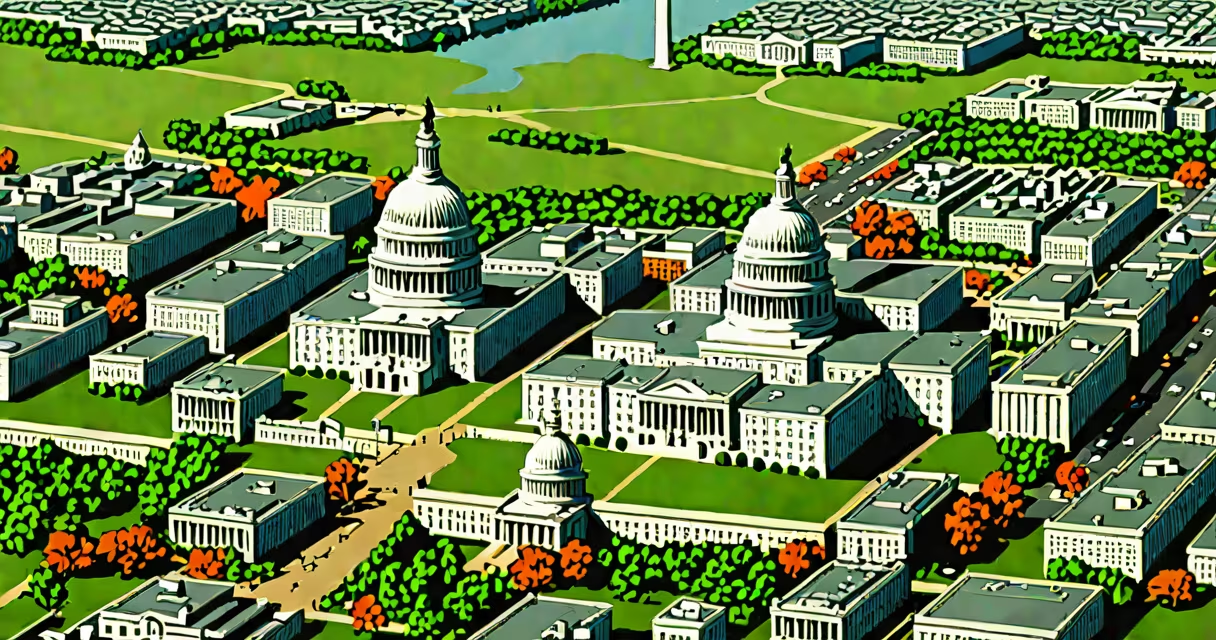
Washington D.C. is the capital of the United States, a federal district created by the U.S. Constitution to serve as the seat of the national government.
The city was designed by Pierre Charles L'Enfant in 1791 and lies along the Potomac River, bordered by Maryland and Virginia. Unlike states, Washington D.C. is not part of any state and operates under direct authority from Congress.
It hosts the three branches of the federal government: the legislative branch in the U.S. Capitol, the executive branch in the White House, and the judicial branch in the Supreme Court Building. The city's layout follows a grid system with diagonal avenues radiating from the Capitol and the White House.
Washington D.C. functions as a capital because the U.S. Constitution grants Congress exclusive legislative power over the District of Columbia. This means the city is not governed by a state legislature but by a local council subject to congressional review.
Residents of Washington D.C. pay federal taxes but do not have voting representation in Congress. They elect a non-voting delegate to the House of Representatives, who can speak and introduce legislation but cannot vote on final passage.
The District's status stems from Article I, Section 8 of the Constitution, which gives Congress the power to "exercise exclusive Legislation" over the seat of government. This provision prevents any single state from dominating the nation's capital.
Most countries have capitals within their existing administrative boundaries. For example, Paris is both the capital of France and located in the Île-de-France region. But Washington D.C. is unique: it is not a state and exists solely as a federal district.
| Type | Example | Key Difference |
|---|---|---|
| Federal District | Washington D.C. | Not part of any state; governed directly by Congress |
| State Capital | Tallahassee, Florida | Located within a state; part of that state's government |
| Constitutional Capital | Canberra, Australia | Created by law; not part of any state; similar to D.C. |
Unlike many capitals, Washington D.C. has no statehood. It is not eligible for electoral votes in presidential elections, though residents can vote in primaries.
Many people assume Washington D.C. is a state. It is not. It is a federal district, meaning it is not a political subdivision of the United States like the 50 states. The District has no senators and only one representative in the House, who cannot vote on final legislation.
Another misconception is that the capital changed over time. The Constitution did not name a specific city. Congress chose New York City as the temporary capital in 1789, then Philadelphia in 1790. The permanent location was selected through the Residence Act of 1790, which designated land between Maryland and Virginia for the new capital.
A lesser-known fact: the original plan for Washington D.C. included a large central park, now known as the National Mall. L'Enfant envisioned a grand ceremonial axis from the Capitol to the White House, aligned with the future site of the Washington Monument. That vision remains intact today.
On January 6, 2021, a mob stormed the U.S. Capitol during a joint session of Congress to certify the 2020 presidential election results. The attack highlighted the vulnerability of the capital's physical security and led to major reforms in Capitol Police protocols.
After the breach, Congress passed the Secure Capitol Complex Act of 2022, increasing funding for surveillance, access control, and emergency response systems. The event underscored that Washington D.C. is not just a symbolic center-it is a high-risk operational hub for national governance.
I visited the U.S. Capitol in 2019 during a school trip. The building's interior features marble floors, gold leaf detailing, and murals depicting American history. I entered through the Rotunda, where the statue of George Washington stands beneath a fresco of the heavens. The experience confirmed that the capital is not just a location-it is a living monument to democratic ideals.
Washington D.C. is the physical heart of U.S. governance. It is where laws are debated, treaties signed, and Supreme Court decisions announced. The city's role is defined by the Constitution, not by tradition or popularity.
According to the U.S. Census Bureau, Washington D.C. had a population of 693,972 in 2022. The city covers 68 square miles and includes 130 parks, 17 monuments, and 150 museums. The National Gallery of Art, the Smithsonian Institution, and the Library of Congress are all located in the city.
Despite ongoing debates about statehood, the capital remains a federal district. The District of Columbia Statehood Admission Act, introduced in Congress multiple times since 2007, has yet to pass. As of 2023, the city continues to operate under congressional oversight.
Understanding what is the capital of the US requires recognizing that it is not a state, not a city in the traditional sense, and not a symbol alone-it is a constitutional reality. Its existence helps the seat of government remains independent from any single state's influence.