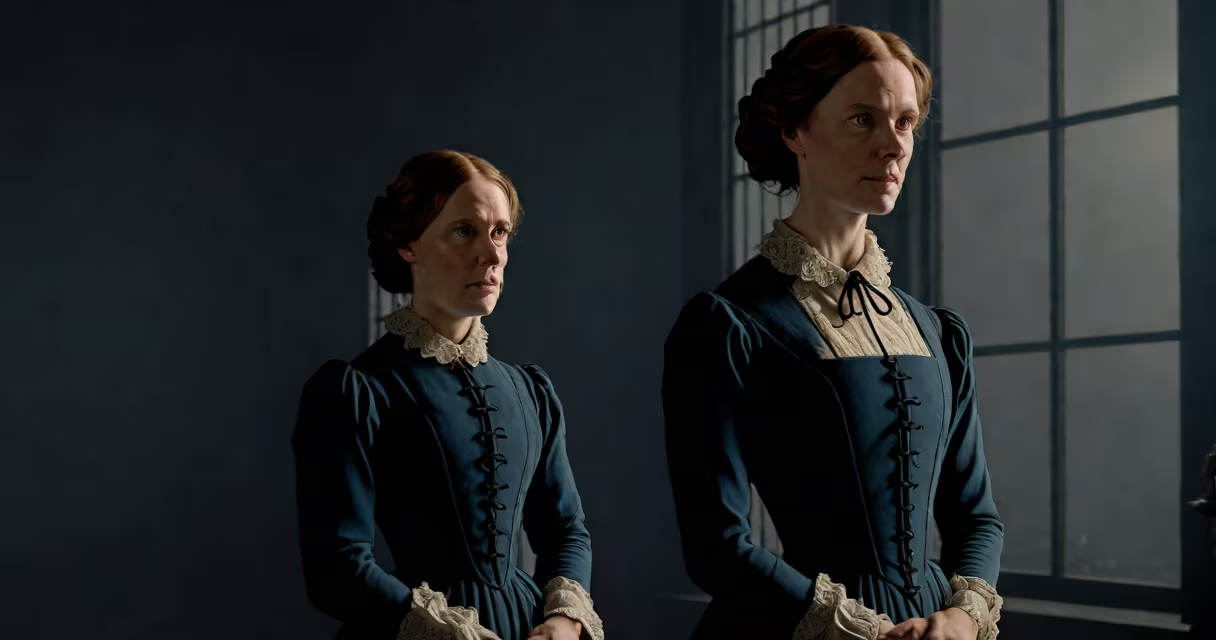
The plot of Jane Eyre follows the life of an orphaned girl who grows from a mistreated child into a self-reliant woman, going through hardship, moral conflict, and romantic entanglement in 19th-century England. Her process includes abusive family relationships, oppressive schooling, employment as a governess, and a passionate yet complicated romance with her employer, Mr. Edward Rochester.
Jane Eyre was published in 1847 under the pseudonym Currer Bell. The novel is structured as a first-person narrative, allowing readers direct access to Jane's inner thoughts, emotions, and evolving sense of justice. Its themes include social class, gender roles, religious hypocrisy, and personal autonomy-all grounded in the lived experience of a woman who refuses to accept unequal treatment.
Charlotte Brontë drew from her own upbringing in a strict religious household and her experiences as a teacher. The novel's setting-Lowood School, Thornfield Hall, Moor House, and Ferndean-mirrors stages of Jane's psychological and moral development. Each location reflects a phase in her identity formation, from institutionalized suffering to spiritual renewal.
Jane begins as a ten-year-old orphan living with her cruel aunt, Mrs. Reed, and her spoiled cousins at Gateshead Hall. She is physically and emotionally abused, labeled "ungrateful" despite her innocence. After being falsely accused of misconduct, she is locked in the red-room-a space symbolizing isolation and fear-and later sent away to Lowood Institution, a charity school for girls.
At Lowood, Jane endures harsh conditions, malnutrition, and the death of her friend Helen Burns from tuberculosis. The school's headmaster, Mr. Brocklehurst, enforces a rigid religious doctrine that equates suffering with virtue. Jane survives through resilience and intellectual curiosity. She becomes a teacher at Lowood and eventually accepts a position as governess at Thornfield Hall, a large country estate.
There, she meets Mr. Rochester, the brooding, secretive master of the house. He is distant but intellectually stimulating. Their relationship develops slowly-through conversations, shared reading, and mutual respect. Jane values his mind and honesty, even as she senses his emotional distance and hidden past.
During a stormy night, Jane hears strange laughter from the attic and discovers Bertha Mason, Rochester's first wife, locked behind a door. Bertha is described as mentally ill and violent-her existence is concealed from Jane and society. Rochester confesses he married Bertha for financial reasons, but she has since been confined for years due to her condition.
When Jane agrees to marry Rochester, she learns on their wedding day that Bertha is still legally married to him. The revelation shatters Jane's trust. She leaves Thornfield immediately, rejecting marriage to a man bound by another's legal claim. She walks into the moors with nothing but her clothes and a few coins.
She is rescued by St. John Rivers, a clergyman who offers her shelter and work as a teacher in a nearby village. He proposes marriage-not out of love, but because he believes she would make a suitable missionary wife. Jane refuses, not because she lacks affection, but because she cannot sacrifice her emotional integrity for duty.
Later, she inherits money from her unknown uncle, which gives her financial independence. She returns to Thornfield after learning it has burned down. Rochester, blinded in the fire, lives in solitude at Ferndean, a remote cottage. Jane finds him there, now humble and repentant. They marry in a quiet ceremony, and Jane becomes his caretaker and equal partner.
The novel presents multiple layers of conflict: internal (Jane's struggle between desire and principle), interpersonal (her relationships with authority figures), and societal (gender and class barriers). Jane's refusal to stay with Rochester until she can do so as an equal-rather than a dependent or mistress-defines her moral agency.
One common misunderstanding is that Jane and Rochester's union is a happy ending achieved through passive acceptance. In reality, Jane only returns after asserting her independence. She does not return to Thornfield as a servant or a second wife. She returns as a woman with resources, self-worth, and emotional clarity.
A lesser-known fact: the novel's original manuscript included a scene where Jane sees Rochester's face in a mirror during a dream. This moment was cut before publication. The surviving version emphasizes Jane's decision-making power-she chooses to return only after she is financially secure and emotionally prepared.
| Stage of Jane's Process | Location | Key Challenge | Outcome |
|---|---|---|---|
| Childhood | Gateshead Hall | Abuse by relatives, isolation | Exiled to Lowood |
| Adolescence | Lowood School | Starvation, disease, religious repression | Survives, becomes teacher |
| Young adulthood | Thornfield Hall | Love for Rochester, discovery of Bertha | Leaves without marrying |
| Independence | Moor House | Financial security, rejection of forced marriage | Reclaims autonomy |
| Resolution | Ferland | Return to Rochester, now disabled and humbled | Marriage as equals |
Many readers assume Jane Eyre is a romantic fairy tale. It is not. The novel rejects the idea that love conquers all-or that a woman can achieve happiness through submission. Jane's final union with Rochester is earned through endurance, self-knowledge, and economic independence. She does not return to him as a savior or a victim.
Another misconception is that Bertha Mason is a villain. She is not. She is a tragic figure-locked away, silenced, and denied personhood. Her presence exposes the limits of patriarchal control and the consequences of colonialism. As literary scholar Sandra M. Gilbert notes in The Madwoman in the Attic, Bertha represents the repressed female psyche-both a threat and a symptom of systemic violence.
I once read a passage aloud in a classroom where a student asked, "Why didn't Jane just stay?" The answer lies in the novel's central message: survival requires moral consistency. Jane chooses dignity over comfort. That choice defines her character.
Modern adaptations often simplify Jane's arc into a romance. But the original novel resists easy categorization. It blends gothic suspense, feminist critique, and psychological realism. According to the British Library, Jane Eyre remains one of the most frequently taught novels in UK secondary schools and is required reading in over 60% of American high school curricula.
Its enduring relevance stems from Jane's insistence on equality. She tells Rochester: "I am no bird; and no net ensnares me: I am a free human being with an independent will." This line encapsulates the novel's core demand: that women be seen as individuals capable of making their own decisions.
The plot of Jane Eyre is not a linear path to happiness. It is a process of becoming-of earning one's place through resistance, reflection, and courage. It remains a benchmark for stories about women who choose themselves.