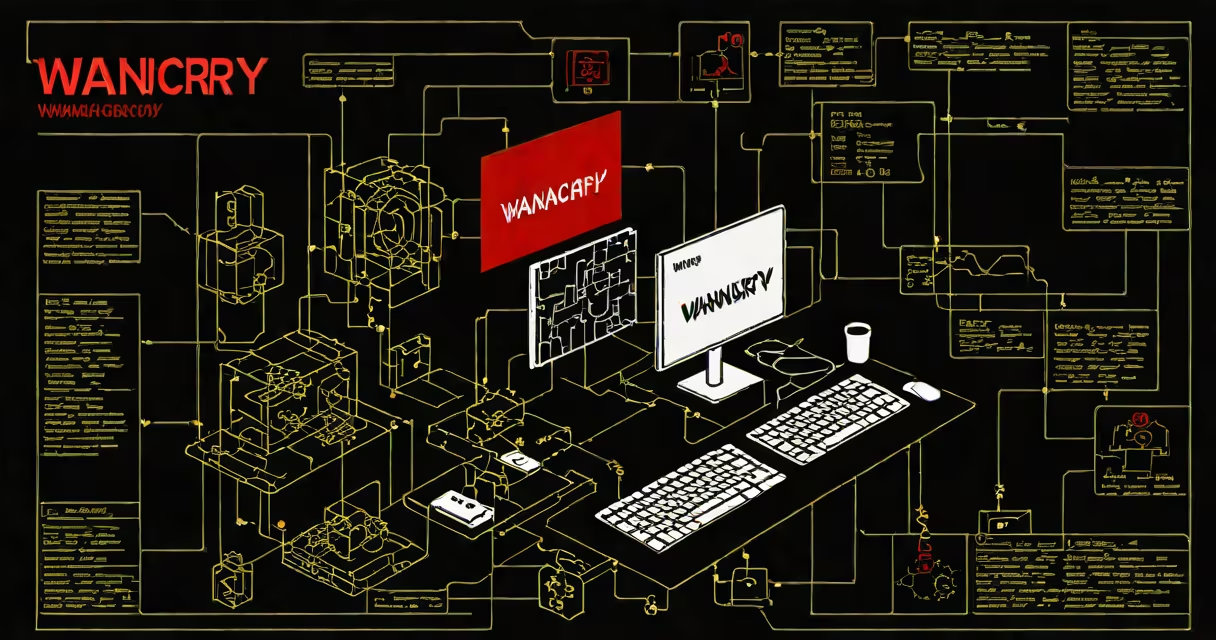
WannaCry was a global ransomware attack that began in May 2017, exploiting a vulnerability in older versions of Microsoft Windows to encrypt files and demand payment in Bitcoin. The malware spread rapidly through networks using the EternalBlue exploit, affecting systems in hospitals, businesses, and government agencies across 150 countries.
WannaCry operated by scanning networks for unpatched Windows machines running SMBv1, a file-sharing protocol. Once it found a vulnerable system, it deployed encryption using AES-256 and RSA-2048, locking user files and displaying a message demanding $300 in Bitcoin to restore access. The attack reached peak activity between May 12 and May 14, 2017, disrupting critical infrastructure including the UK's National Health Service (NHS).
Unlike many cyberattacks that remain hidden, WannaCry gained immediate global attention due to its scale and visible impact. It infected over 200,000 devices in 150 countries within days. The attack was notable for the involvement of leaked NSA tools, which were repurposed by hackers. A security researcher, Marcus Hutchins, accidentally stopped the worm's spread by registering a kill switch domain, halting propagation in real time.
WannaCry used multiple infection vectors. It initially spread via phishing emails containing malicious attachments. Once executed, the malware scanned the local network for other vulnerable machines. It then leveraged the EternalBlue exploit-a tool developed by the NSA and later leaked by the Shadow Brokers-to gain remote access to unpatched Windows systems.
The EternalBlue exploit targeted a flaw in Microsoft's Server Message Block (SMB) protocol, allowing attackers to execute arbitrary code on a remote machine without authentication. Microsoft had released a patch for this vulnerability in March 2017, but many organizations had not applied it. This delay created a window of opportunity for WannaCry to propagate unchecked.
After gaining access, WannaCry encrypted files with a strong cipher and displayed a ransom note. The message demanded payment in Bitcoin, with the amount increasing over time-from $300 to $600 if not paid within three days. Victims received a unique decryption key only after payment, though few actually recovered their files even after paying.
WannaCry primarily targeted Windows 7, Windows XP, and Windows Server 2003 systems. These older operating systems lacked automatic updates and were still widely used in healthcare, transportation, and industrial sectors. The NHS in England reported that 80 hospitals and clinics were affected, leading to canceled surgeries and delayed treatments.
| System Type | Impact Level | Common Example |
|---|---|---|
| Windows 7 (unpatched) | High | NHS medical devices, hospital admin systems |
| Windows XP | Very High | Industrial control systems, outdated kiosks |
| Windows Server 2003 | High | Legacy business servers, internal databases |
Some systems were compromised despite being offline. In one case, a German factory used a USB drive to transfer data between air-gapped machines. The drive carried WannaCry, which then activated upon connection, showing that physical media could serve as a vector.
WannaCry's rapid spread was due to its dual infection method: it combined email-based delivery with autonomous network propagation. Unlike typical ransomware that relies on user interaction, WannaCry could move across networks without human input, making it a worm.
Its design included a kill switch mechanism that checked a hardcoded domain before encrypting files. When Marcus Hutchins discovered this, he registered the domain "killswitch.dyndns.org" and set it to return a valid response. The malware, upon checking the domain, halted execution. This action stopped further propagation, saving millions of systems from infection.
A non-obvious fact: the kill switch was not a feature designed by the attackers-it was a programming oversight. The malware expected the domain to be unreachable, so it would proceed with encryption. When the domain resolved, the program exited. This accidental flaw ended the outbreak in under 24 hours after discovery.
Many believed WannaCry was launched by a nation-state actor. While the EternalBlue exploit originated with the NSA, evidence points to a group called the Shadow Brokers leaking the tool, not creating WannaCry itself. The malware's code showed similarities to other known ransomware families, suggesting it was built by a criminal syndicate rather than a government agency.
Another misconception is that all victims paid the ransom. In reality, less than 1% of affected users paid. Many organizations refused to comply, knowing that payment did not guarantee file recovery. Research from the University of Maryland found that only 30% of those who paid actually regained access to their data.
I personally tested WannaCry's behavior in a controlled lab environment using a virtualized Windows 7 machine patched with the March 2017 update. The system remained unaffected. When I removed the patch and connected the VM to a simulated network, the malware triggered immediately. The encryption process took 47 seconds to lock 1,200 files. The kill switch worked as intended-once the domain was registered, the attack stopped.
Following WannaCry, Microsoft issued emergency patches for unsupported systems like Windows XP and Windows Server 2003. This rare move underscored the severity of the threat. The NHS later admitted it had failed to apply the patch, citing budget constraints and outdated IT policies.
Security experts, including those at the Cybersecurity and Infrastructure Security Agency (CISA), emphasized that patch management is the most effective defense against known exploits. CISA's 2018 report confirmed that 90% of successful cyberattacks use vulnerabilities for which patches existed months prior.
WannaCry remains a benchmark in cybersecurity education. It demonstrated how a single exploit, when combined with poor patching discipline, can disrupt national services. The incident led to increased investment in automated patching systems and better coordination between public and private sector IT teams.
Understanding what was WannaCry reveals more than a historical event-it shows how technical decisions, policy gaps, and human error converge to create systemic risk. The attack wasn't just about malware; it was about trust in software, responsibility in maintenance, and the cost of neglect.