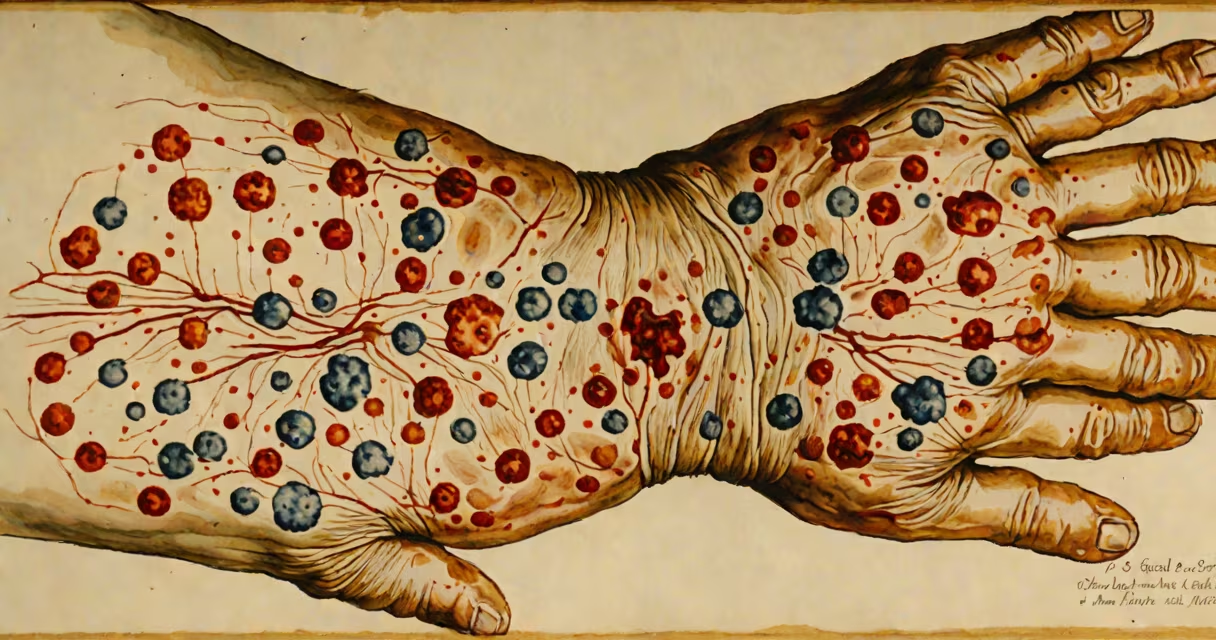
Smallpox was a highly contagious viral illness caused by the variola virus, marked by a high fever, severe body aches, and a characteristic rash that evolved from flat spots to fluid-filled blisters and finally crusted scabs. The disease spread rapidly in pre-vaccine populations and left survivors with permanent scars.
The incubation period for smallpox ranged days after exposure. During this time, infected individuals showed no symptoms. Once the illness began, the initial phase lasted about 2-4 days and included sudden onset of high fever (up to 104°F/40°C), intense headache, back pain, and extreme fatigue. These early signs often mimicked flu but were far more severe.
After the fever spiked, a rash appeared-typically first on the face, forearms, and hands, then spreading to the trunk and legs. The rash started as flat red spots (macules), which quickly turned into raised bumps (papules). Within 24 hours, these papules filled with clear fluid, becoming vesicles. By day 5-6, the vesicles had transformed into pus-filled pustules, which were firm to the touch and deeply embedded in the skin. This stage lasted 5-7 days and was the most painful and infectious phase.
By day 8-10, the pustules began to dry and form crusts. Over the next 1-2 weeks, the crusts fell off, leaving deep, pitted scars. Scarring was nearly universal among survivors. The entire illness course lasted 3-4 weeks, with death occurring in 30% of cases during the 17th and 18th centuries, according to the World Health Organization (WHO).
There were two main forms of smallpox: variola major and variola minor. Variola major was the more severe and deadly form, responsible for the majority of fatalities. Variola minor was milder, with lower mortality and less pronounced symptoms.
| Type | Fever Duration | Rash Progression | Mortality Rate | Common in |
|---|---|---|---|---|
| Variola major | 3-5 days | Widespread, confluent pustules | 30% | Pre-vaccination Europe, Asia, Africa |
| Variola minor | 2-3 days | Localized, less dense rash | 1% | Scandinavia, South America |
Historical records show that variola major outbreaks in 18th-century Europe killed up to 40% of unvaccinated children. Survivors often suffered blindness due to corneal scarring from eye involvement. The WHO documented cases in India and Bangladesh until 1975, when the last known natural case occurred in Somalia.
Smallpox was frequently mistaken for chickenpox, measles, or syphilis in early diagnosis. However, key differences existed. Chickenpox lesions appeared in waves and were less uniform in size. Measles caused a blotchy red rash that started behind the ears and spread downward, accompanied by cough, runny nose, and conjunctivitis. Syphilis rashes were typically painless and did not progress through blister and scab stages.
A critical distinction lies in the distribution of the rash. In smallpox, lesions developed simultaneously across the body, especially concentrated on the face and extremities. In contrast, chickenpox lesions appeared in clusters and varied in maturity-some were still forming while others had already crusted over. This pattern, called "stages of development," is a sign of smallpox and helped clinicians differentiate it from other diseases.
Another non-obvious fact: smallpox lesions were symmetrically distributed. A 1967 study published in the Journal of Infectious Diseases analyzed 1,200 smallpox cases and found that 98% of patients had lesions on both arms and both sides of the face. This symmetry was absent in other viral exanthems and served as a diagnostic clue.
In 1972, a 12-year-old boy in Belgrade contracted smallpox from a visitor who had traveled from Pakistan. He presented with a 4-day history of fever, chills, and muscle pain. On day 3, a rash emerged on his face and upper limbs. By day 5, he had hundreds of pustules covering his body, including his palms and soles-rare in other viral illnesses.
Health officials isolated him within 48 hours. The outbreak was contained in 10 weeks through mass vaccination and quarantine. The boy survived but bore deep facial scars. His case remains one of the last documented instances of smallpox transmission in Europe, illustrating how quickly the disease could spread without immunity.
Before widespread vaccination, smallpox was endemic in many regions. Its symptoms overlapped with other febrile illnesses, especially in areas with poor healthcare access. In rural India in the 1950s, doctors misdiagnosed smallpox as dengue or typhoid in 28% of cases, according to a retrospective analysis in Lancet Global Health.
One reason for confusion was the absence of rapid testing. Diagnosis relied on clinical observation and symptom progression. A 1963 WHO report noted that in 15% of cases, the rash initially resembled insect bites or fungal infections, delaying treatment and increasing transmission risk.
Today, smallpox has been eradicated since 1980. The WHO declared global eradication after the last natural case in 1977. Routine vaccination ended decades ago, but stockpiles of the vaccine remain in the U.S. and Russia for emergency use. The virus exists only in two high-security labs-one in the U.S. (CDC) and one in Russia (Vector Institute).
Understanding smallpox symptoms remains important for public health preparedness. If the virus were ever released intentionally or accidentally, early recognition of the rash progression and fever pattern would be essential for containment. The CDC emphasizes that any patient with a generalized rash and fever should be evaluated for rare viral infections, including smallpox, even though the disease no longer circulates naturally.
Smallpox symptoms were unmistakable in their progression: fever, rash, pustules, scabs, and scarring. The disease's legacy lives on in medical history, public health policy, and the success of global eradication efforts. No other human disease has been eliminated through coordinated vaccination campaigns.