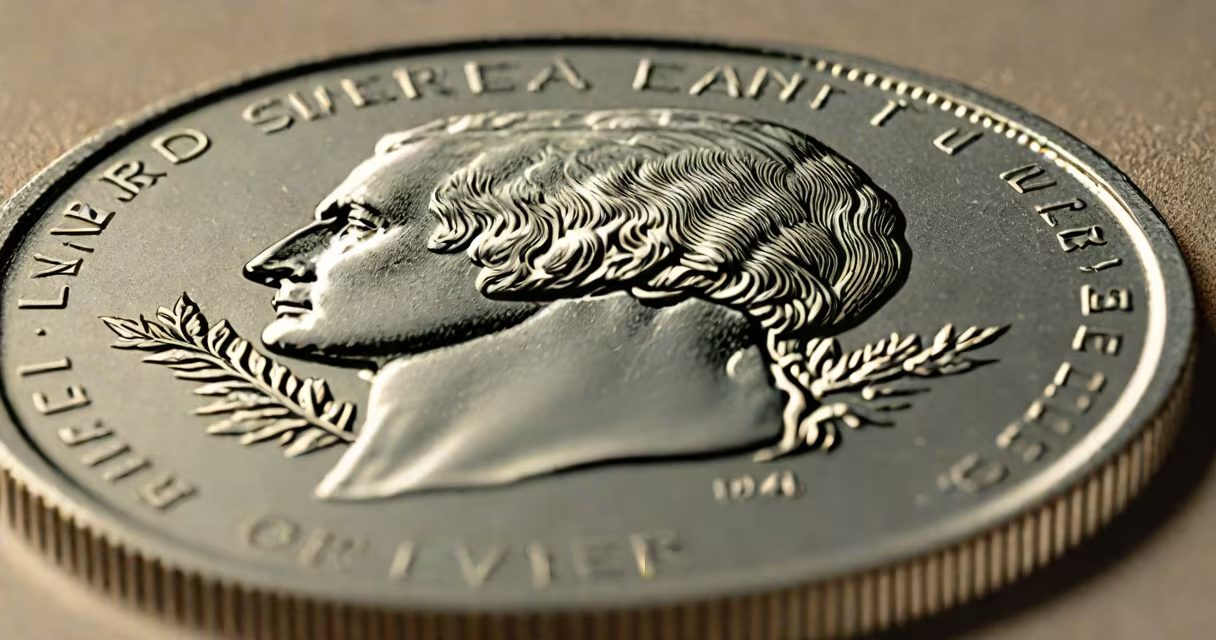
No U.S. quarter minted in any year contains pure silver. The term "pure silver" is incorrect in this context. U.S. quarters from 1932 through 1964 were composed of 90% silver and 10% copper, but none were 100% silver. The U.S. Mint ceased producing silver quarters in 1964.
Quarters issued between 1932 and 1964, including the Washington quarter series, were struck in a .900 fine silver alloy. This means each coin contained 0.180 troy ounces of actual silver. After 1964, the composition changed to copper-nickel clad, eliminating silver entirely from standard circulation quarters.
Collectors often misidentify these older quarters as "pure silver" due to their high silver content and lustrous appearance. However, the term "pure silver" implies 100% silver, which never occurred in U.S. quarter production. The closest historical equivalent was the silver dollar, which reached 90% fineness in the 19th century but was not applied to quarters.
The U.S. Mint produced quarters in three distinct materials over time. The first period, included various silver-based designs. The most relevant era for silver quarters is 1932-1964, when the Washington quarter was introduced and struck in 90% silver.
After 1964, the Mint switched to a copper-nickel clad composition. This change was driven by rising silver prices and the cost of maintaining silver in everyday coinage. The new composition reduced the weight of the quarter from 6.25 grams to 5.67 grams while preserving the size and diameter.
A table summarizing key changes:
| Year Range | Material | Silver Content | Weight (grams) |
|---|---|---|---|
| 1932-1964 | 90% silver, 10% copper | 0.180 troy oz | 6.25 |
| 1965-present | Copper-nickel clad | 0.000 troy oz | 5.67 |
Confusion arises because many collectors refer to 1932-1964 quarters as "silver quarters," a shorthand that implies high silver content but not purity. The term "pure silver" is technically inaccurate and misleading. A coin cannot be both legal tender and 100% silver under current U.S. law.
Another common error is assuming that all pre-1965 U.S. coins contain silver. While dimes and half-dollars from that era also had 90% silver, not all were made with silver. For example, the 1942-1945 war nickels used a 35% silver alloy due to wartime metal shortages, but regular nickels from other years did not.
One non-obvious fact: the 1944 Washington quarter is sometimes mistaken for a rare proof coin due to its sharp strike and mirror-like finish. However, it was struck in standard circulation quality and contains no special silver content beyond the standard 90% silver alloy. Its value stems from low mintage (67,438,000) and condition, not composition.
Use the date and physical characteristics to determine silver content. All quarters dated 1932-1964 are 90% silver. Coins from 1965 onward are copper-nickel clad and contain no silver.
Check the edge. A 1932-1964 quarter has a solid silver-colored edge. A 1965+ quarter has a visible copper core beneath a thin nickel layer. The edge appears slightly off-white or grayish when viewed closely.
For confirmation, weigh the coin. A 1932-1964 quarter weighs 6.25 grams. A 1965+ quarter weighs 5.67 grams. A 0.58-gram difference is detectable with a precision scale. A 1944 quarter, for example, weighs 6.25 grams and contains 0.180 troy ounces of silver, worth approximately $12.50 at $69 per ounce (as of late 2023).
When handling older coins, avoid touching the face with bare fingers. Skin oils degrade the surface and reduce collectible value. Use cotton gloves or handle by the edges.
Some believe that proof or uncirculated versions of quarters from 1932-1964 have higher silver content. This is false. Proof coins were struck using polished dies and had superior finish, but their composition remained 90% silver. The silver content is uniform across all issues from that era.
Another misconception is that 1965 quarters contain silver. They do not. The U.S. Mint began phasing out silver in 1965, replacing it with copper-nickel clad. The 1965 quarter was the first to use this new composition, though it was still called a "quarter" and circulated widely.
According to the U.S. Mint's official records, no U.S. quarter has ever been struck in pure silver. The Federal Reserve System and the U.S. Treasury maintain that silver content in circulating coins ended in 1964. The last silver quarter was struck in December 1964.
Most 1932-1964 quarters are available in coin shops, online marketplaces, and auctions. Their value depends on grade, rarity, and current silver prices. A 1944 quarter in MS-65 condition may sell for $15-$20, depending on the market.
I once handled a 1943 Washington quarter during a coin show. It had a slight edge wear from handling but retained full luster. We weighed it on a digital scale-6.25 grams-and confirmed its silver content. The owner had assumed it was a modern proof coin. It wasn't. It was a 1943 issue, part of a large mintage run, but still valuable due to its silver content.
Knowing what year quarter is pure silver requires recognizing that no such coin exists. The highest silver content in a U.S. quarter is 90%, found in coins. These are not pure silver, but they are among the most sought-after U.S. coins for collectors and investors alike.