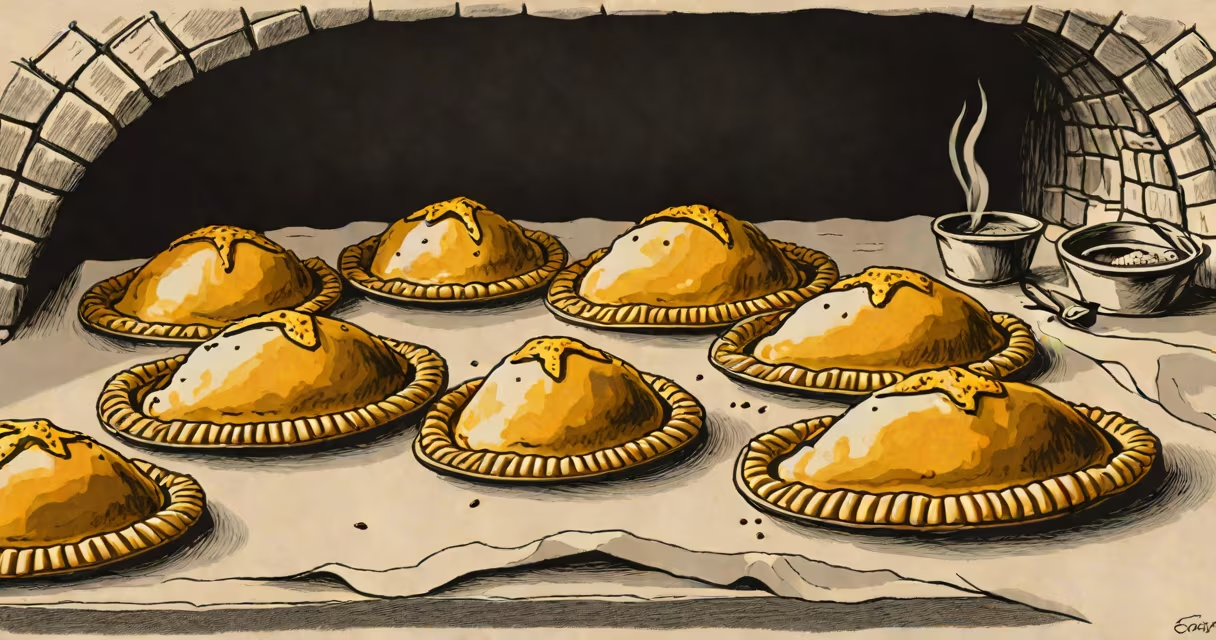
Empanadas originated in Galicia, a region in northwestern Spain, during the Middle Ages, but they became widespread across Latin America through Spanish colonization and local adaptation.
The earliest known form of empanada was a meat-filled pastry baked in a clay oven, with the name derived from the Spanish verb "empanar," meaning "to wrap in bread." These early versions were made with salted pork, onions, and spices, often served during religious festivals.
Spanish colonists brought the concept to the Americas in the 16th century. Over time, indigenous ingredients and cooking methods transformed the dish across regions. Today, empanadas are found in dozens of forms across 15+ countries, each reflecting local tastes and resources.
Empanadas consist of a dough wrapper enclosing a filling, then baked or fried. The dough is typically made from flour, water, fat (like lard or butter), and salt. Fillings vary widely but usually include meat, cheese, vegetables, or seafood.
The preparation method determines texture and flavor. Baked empanadas have a crisp, golden crust. Fried ones are richer and more tender. Some regional styles use a double-layered crust, while others fold the dough into a half-moon shape with crimped edges.
A key factor in authenticity is the sealing technique. In Chile, empanadas are pinched tightly at the edges to prevent leakage. In Argentina, the edges are folded into a distinctive "crimped" pattern resembling a flower. This detail affects both appearance and structural integrity during cooking.
Empanadas differ by country. The most common types include:
| Region | Common Filling | Dough Type | Preparation Method |
|---|---|---|---|
| Spain (Galicia) | Salt cod, potatoes, onions | Wheat flour, lard | Baked |
| Argentina | Beef, onion, hard-boiled egg | Flour, butter, water | Baked |
| Chile | Beef, raisins, olives, hard-boiled egg | Flour, lard, baking powder | Baked |
| Colombia | Chicken, peas, corn, olives | Flour, oil, salt | Fried |
| Mexico (Northern states) | Shredded beef, guajillo chili, cumin | Flour, shortening | Fried |
Despite shared origins, the dish evolved independently in each region. In Peru, empanadas de viento contain a sweet potato and cheese filling, while in Uruguay, they're often filled with spicy beef and olives.
One lesser-known fact: in parts of southern Brazil, empanadas are made with cassava flour and filled with shredded beef and banana. This reflects African and Indigenous influences absent in Spanish versions.
Many assume empanadas are exclusively Mexican or Argentine. This is incorrect. While both nations have iconic versions, empanadas predate national borders and exist in over 20 countries across Latin America and Spain.
Another misconception is that empanadas are always savory. In some regions, such as northern Colombia and parts of Venezuela, sweet empanadas filled with dulce de leche or fruit are common. These are distinct from the savory versions and should not be grouped under the same category.
Empanadas are not the same as empanaditas-smaller, bite-sized versions popular in Puerto Rico and Cuba. Empanaditas are often served as appetizers, while full-size empanadas are meals.
In Santiago, empanadas are sold by street vendors and bakeries alike. On a typical weekday morning, a vendor named Rosa sells 120 empanadas from her cart near the Parque Forestal. Her signature empanada includes ground beef, onions, raisins, olives, and a pinch of cumin, baked at 375°F for 35 minutes.
Rosa uses a traditional recipe passed down from her grandmother, who learned it from a Spanish immigrant in the 1940s. The dough is hand-kneaded with lard and water, rolled thin, and sealed using a unique crimping tool. She charges $1.25 per empanada, selling out by noon.
This example shows how empanadas maintain cultural continuity despite geographic distance. The dish remains a staple of daily life, not just a tourist curiosity.
I once visited a small bakery in Córdoba, Argentina, where the owner made 200 empanadas daily. He used a wooden rolling pin and hand-crimped each one. The smell of beef and cumin filled the air. I tried one fresh from the oven-crisp on the outside, juicy inside. That experience confirmed what historical records show: empanadas are more than food-they're identity.
Empanadas represent centuries of migration, trade, and cultural fusion. They reflect how food travels and transforms. According to the Food & Wine magazine, empanadas are among the most enduring symbols of Latin American culinary heritage.
Historians at the University of Salamanca note that empanadas were part of the diet of Spanish explorers during their voyages to the New World. Their portability and long shelf life made them ideal for travel.
Today, empanadas are not just a meal-they're a living archive of history. The filling choices, dough thickness, and sealing techniques reveal decades of adaptation. Understanding where empanadas come from requires looking beyond a single country.