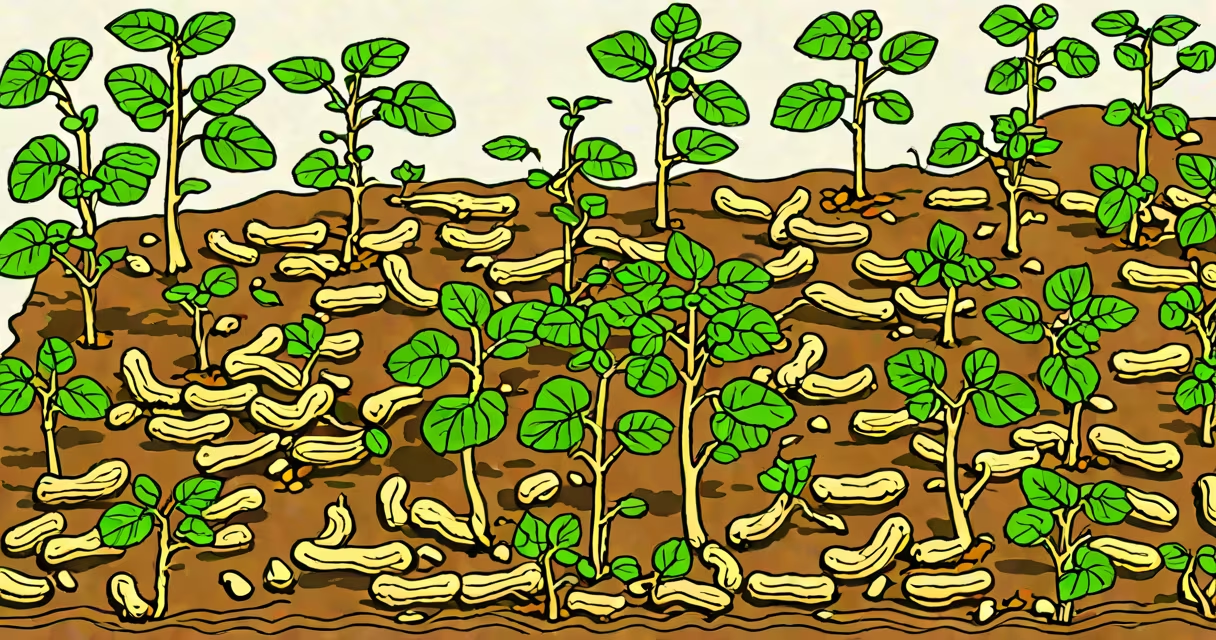
Peanuts grow underground as legumes that develop from flowers that penetrate the soil after pollination. The plant, scientifically known as Arachis hypogaea, produces pegs-elongated ovules-that push into the soil and form the edible pods. This unique growth pattern distinguishes peanuts from other nuts.
Most commercial peanut production occurs in warm, temperate climates with well-drained sandy loam soils. The United States, China, India, Brazil, and Nigeria lead global output. In the U.S., Georgia, Alabama, Florida, and Texas account for over 90% of domestic harvests. These regions offer ideal growing seasons between 120 and 150 days with average temperatures between 20°C and 30°C (68°F-86°F).
After flowering, the plant's stalks bend downward due to gravity and mechanical pressure, a process called geotropism. The flower's fertilized ovary forms a peg that penetrates the soil. Once buried, the peg elongates and develops into a pod containing one to four seeds. The entire process--takes about 110 to 140 days depending on variety and weather.
Three major peanut types exist: runner, Virginia, and Spanish. Each thrives in specific climates and serves different markets.
| Type | Common Use | Growing Region | Pod Size |
|---|---|---|---|
| Runner | Commercial peanut butter, snacks | U.S. Southeast, India | Small to medium |
| Virginia | Roasted salted peanuts, whole-shell sales | U.S. Southeast, South Africa | Larger |
| Spanish | Peanut butter, candy, flour | India, West Africa, U.S. Southwest | Smallest |
Runner varieties dominate U.S. production, making up over 80% of planted acreage. They mature early and have high oil content. Virginia peanuts require longer growing seasons and are prized for their size and flavor. Spanish peanuts thrive in drier soils and are often grown in rotation with cotton or corn.
Peanuts require loose, well-aerated soil with pH between 5.8 and 6.5. Compacted or clay-heavy soils reduce peg penetration and lower yields. Soil moisture must remain consistent during peg development-too much water causes rot; too little stunts growth.
Optimal rainfall ranges,000 mm annually. In dry areas, irrigation is essential. Drought stress during peg formation reduces pod numbers by up to 40%, according to USDA data. Conversely, excessive rain after pegging increases aflatoxin risk-a fungal toxin that can contaminate crops.
Harvest timing is critical. Pods mature between 120 and 150 days after planting. Delaying harvest leads to overripening and increased spoilage. Farmers use mechanical diggers that lift the entire plant, then invert it to dry in the sun for several days. After drying, the crop is threshed to separate pods from vines.
Many assume peanuts grow on trees or vines. They do not. Peanuts are subterranean legumes. The plant grows upright, but the fruit forms below ground. This makes them unique among common "nuts" such as almonds, walnuts, and cashews, which grow on trees.
Another misconception is that peanuts are high in fat because they're "nutty." While they contain 49% fat by weight, most of it is monounsaturated and polyunsaturated-heart-healthy fats. A 1-ounce serving contains 16 grams of fat, but only 2.5 grams are saturated. The American Heart Association notes that replacing saturated fats with unsaturated ones lowers LDL cholesterol levels.
A lesser-known fact: peanut plants are self-pollinating. Flowers open and close within 15 minutes. Pollen transfer happens internally, eliminating reliance on bees or wind. However, honeybees are still used in large fields to increase yield by up to 15% through cross-pollination stimulation, according to the University of Georgia Extension Service.
In 2023, Georgia produced 1.3 billion pounds of peanuts-the highest in the U.S. Farmers plant around 500,000 acres annually. They typically begin sowing in late April to early May, depending on soil temperature reaching 15°C (59°F).
One farm in Sumter County uses precision planting equipment that places seeds 1.5 inches deep at 3-inch intervals. After emergence, farmers apply nitrogen fertilizer at 20 lb/acre to support early growth. During pegging stage, they monitor soil moisture via sensors. When soil moisture drops below 60%, irrigation activates automatically.
At harvest, a combine equipped with a peanut digger lifts the plants and deposits them onto a conveyor belt. The belt runs through a dryer set to 110°C (230°F) for 12 hours to reduce moisture from 40% to 10%. This prevents mold and ensures safe storage. The dried pods are then sorted by size and color before shipment.
During my visit to a Georgia farm in 2022, I watched a harvester pull up a single row of plants. The pegs were visible-thin, brown stems pushing into the soil. After digging, we pulled out a sample: 80% of the pods had formed successfully. That year's yield averaged 3,500 lbs per acre-above the national average of 2,900 lbs.
The term "ground nut" implies the fruit grows in the ground. But this confuses cause and effect. The plant grows above ground. The fruit forms below ground due to a biological mechanism. Calling them "ground nuts" suggests they grow like tubers (potatoes) or roots (carrots), which is incorrect.
Botanically, peanuts are legumes. They fix nitrogen in the soil, improving fertility for subsequent crops. This makes them valuable in crop rotation systems. In India, farmers rotate peanuts with rice and wheat to maintain soil health and reduce pesticide use.
Understanding where peanuts grow clarifies their agricultural role. They are not tree nuts. They are not root vegetables. They are unique in their reproductive strategy-flowers above, pods below. This adaptation evolved in the tropical savannas of South America, where wild Arachis hypogaea originated.