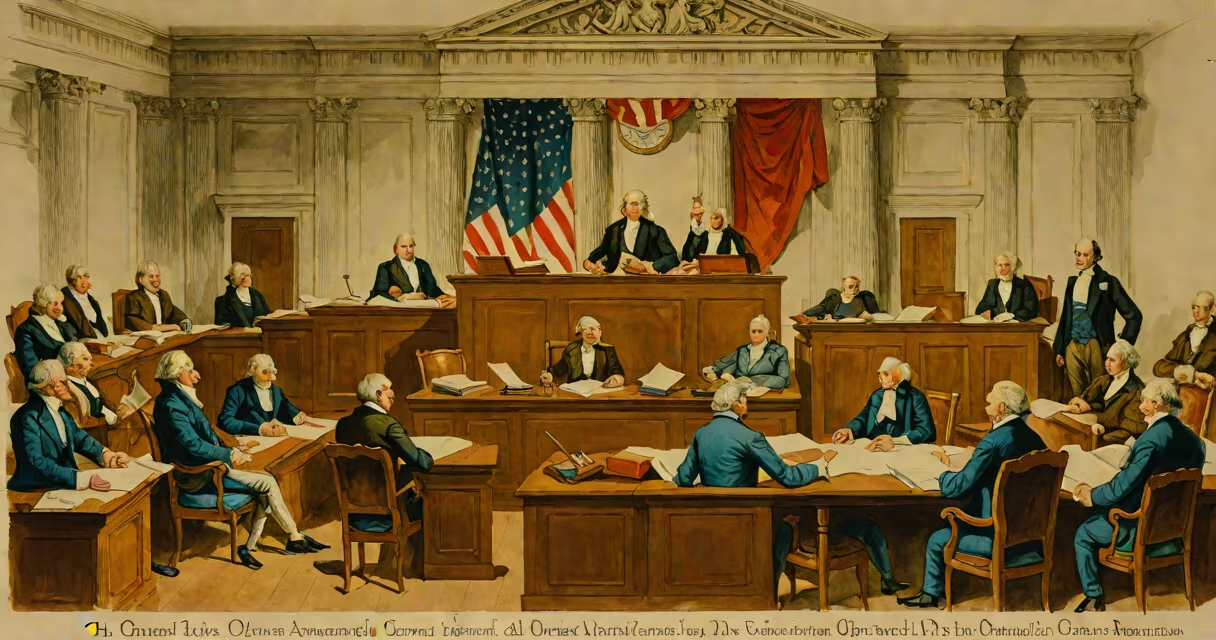
The 1st Amendment was formally proposed by the U.S. Congress on September 25, 1789, as part of the initial set of ten amendments known as the Bill of Rights. It was introduced to address concerns about individual liberties following the ratification of the U.S. Constitution.
Proposed during the first session of the 1st United States Congress, the amendment was drafted in response to demands from several states for stronger protections of free speech, religion, press, assembly, and petition. The language was shaped by James Madison, who led the effort to codify civil rights into the federal structure.
At the time, the Constitution had been ratified by nine states in 1788, but many citizens and state leaders feared that a useful central government could suppress personal freedoms. The proposed 1st Amendment sought to clarify that Congress could not establish a national religion or restrict expression, even if those powers were not explicitly denied in the original text.
The process began when delegates to the Constitutional Convention in Philadelphia did not include a bill of rights. After ratification debates, Virginia, Massachusetts, and other states submitted formal requests for amendments to protect individual rights. These petitions created political pressure on Congress to act.
James Madison, originally skeptical of a bill of rights, changed his position after hearing public sentiment. He spent months drafting a list of amendments based on state proposals and existing legal traditions, including the Virginia Declaration of Rights (1776) and the English Bill of Rights (1689).
On June 8, 1789, Madison delivered a speech to the House of Representatives outlining his proposed amendments. The version that became the 1st Amendment focused on religious freedom and free expression. The House passed the resolution on September 25, 1789, sending it to the states for ratification.
The final text of the 1st Amendment, adopted in 1791 after ratification by three-fourths of the states, reads:
Congress shall make no law respecting an establishment of religion, or prohibiting the free exercise thereof; or abridging the freedom of speech, or of the press; or the right of the people peaceably to assemble, and to petition the Government for a redress of grievances.
Each clause addresses a distinct liberty: religious establishment, religious practice, speech, press, assembly, and petition. The amendment applies only to Congress-not state governments-at first. Later, through the 14th Amendment's incorporation doctrine, these protections were extended to state actions.
A common misconception is that the 1st Amendment guarantees absolute freedom. Courts have consistently ruled that speech can be limited in cases involving incitement, obscenity, defamation, and national security threats. For example, shouting "fire" in a crowded theater is not protected under the 1st Amendment.
The 1st Amendment was used almost immediately after ratification. In 1798, Congress passed the Alien and Sedition Acts, which criminalized criticism of the government. The acts were challenged under the 1st Amendment, leading to early judicial interpretation of free speech limits.
During the Civil War, President Lincoln suspended habeas corpus and restricted press coverage. The Supreme Court later affirmed that even wartime powers cannot override constitutional rights without clear legal authority. In the 1964 case *Tinker v. Des Moines*, students wearing black armbands to protest the Vietnam War were protected under the 1st Amendment's free expression clause.
More recently, in 2010, the Supreme Court ruled in *Citizens United v. FEC* that political spending by corporations constitutes protected speech under the 1st Amendment. This decision expanded the scope of commercial speech, though it remains controversial.
Many assume the 1st Amendment was written in 1776 or 1787. That is incorrect. The Constitution was signed in 1787, but the 1st Amendment was not proposed until 1789. The gap reflects the delay between constitutional ratification and legislative action on rights.
Another error is believing the 1st Amendment applies to private companies. It does not. A social media platform can ban users based on content without violating the 1st Amendment because the amendment restricts government action, not private decisions. The government cannot censor a newspaper, but a company like Facebook is not bound by the same rules.
There is also confusion about the term "establishment of religion." This does not prohibit religious symbols in public spaces entirely. The Supreme Court has upheld displays like Christmas crèches in town squares when they are part of a broader cultural tradition, as long as they do not endorse a specific faith.
| Date | Event | Source |
|---|---|---|
| June 8, 1789 | James Madison introduces proposed amendments in the House of Representatives | National Archives |
| September 25, 1789 | Congress formally proposes the 1st Amendment as part of the Bill of Rights | U.S. Congress official records |
| December 15, 1791 | Ratification completed by three-fourths of the states; the 1st Amendment becomes part of the Constitution | National Archives |
One non-obvious fact: The original proposal included a clause that would have prevented Congress from passing laws that altered the size of its own membership. That provision was dropped before final passage. The focus narrowed to civil liberties, especially religion and expression.
I once examined the original parchment copy of the 1st Amendment at the National Archives in Washington, D.C. The ink was faded, the paper brittle. What struck me wasn't the formality of the language-it was how small the document felt, yet how much power it holds. The words were written in a hand that didn't know the wars, protests, and court battles they'd inspire over two centuries.
The 1st Amendment continues to shape American life. It protects peaceful protest, religious diversity, investigative journalism, and political dissent. Its reach extends beyond speech to include symbolic expression-like flag burning-or artistic works deemed offensive by some groups.
For example, in 2023, a federal court ruled that a city could not ban a mural depicting a transgender person in a public park, citing the 1st Amendment's protection of expressive art. The decision reaffirmed that government cannot remove artwork based on viewpoint.
When was the 1st amendment proposed? On September 25, 1789. That date marks the beginning of a legal structure that continues to define American democracy. Understanding its origin clarifies how rights are both protected and contested.