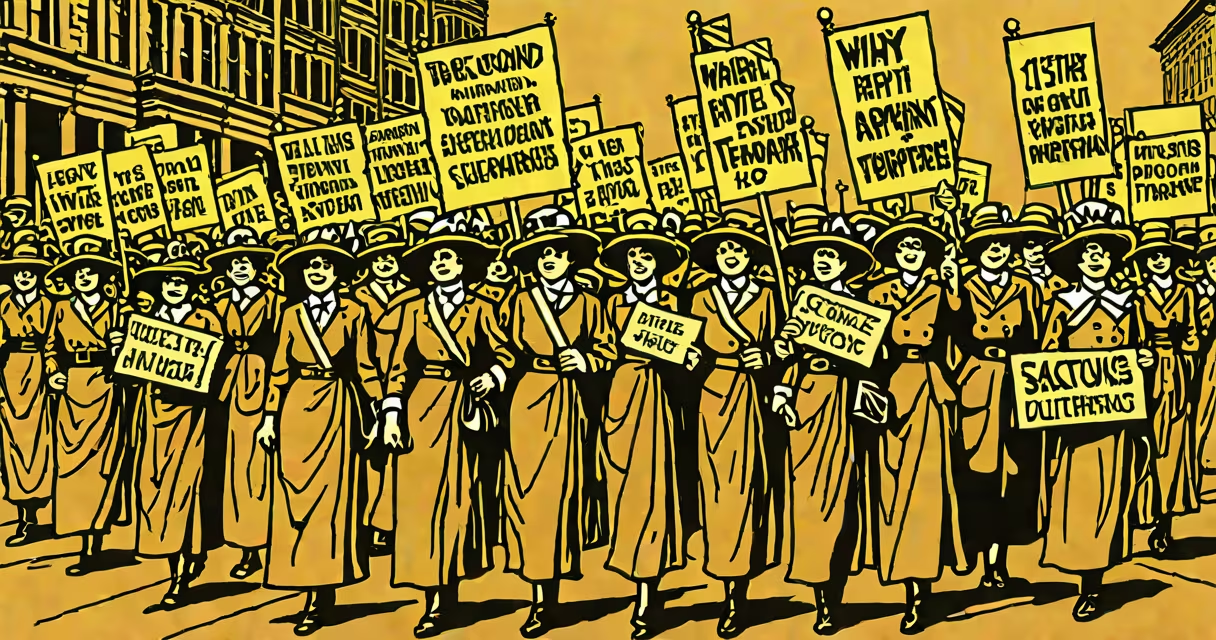
The 19th Amendment to the U.S. Constitution was passed to prohibit any U.S. state or federal authority from denying the right to vote based on sex. It was ratified in 1920 after a 70-year campaign by women's suffrage advocates who challenged legal and cultural barriers to political participation.
The amendment emerged from sustained pressure by organized movements, particularly the National American Woman Suffrage Association (NAWSA) and the more militant National Woman's Party (NWP). These groups used public demonstrations, lobbying, civil disobedience, and strategic state-by-state campaigns to build momentum. The push gained urgency during World War I, when women's contributions to war efforts highlighted their civic responsibility and undermined arguments that they were unfit for the ballot.
By 1918, President Woodrow Wilson endorsed the amendment, calling it essential to democratic ideals. Congress passed it in June 1919, and the states began ratification. Tennessee became the 36th state to ratify it on August 18, 1920, providing the final vote needed. The certification came on August 26, 1920, making the 19th Amendment part of the Constitution.
The amendment's language is concise: "The right of citizens of the United States to vote shall not be denied or abridged by the United States or by any State on account of sex." This clause applies to all levels of government-federal, state, and local-and prohibits gender-based voter suppression.
It does not require states to register women to vote or provide them with polling access. Instead, it invalidates laws that explicitly bar women from voting due to gender. Any law that denies voting rights based on sex is unconstitutional under this amendment.
For example, if a state passed a law saying only men could vote in primary elections, that law would violate the 19th Amendment. Courts have consistently upheld this interpretation. In 1971, the Supreme Court ruled in *Reed v. Reed* that sex-based discrimination in voting and other areas violates the Equal Protection Clause of the 14th Amendment, reinforcing the 19th Amendment's impact.
Two major organizations led the fight. NAWSA, led by Carrie Chapman Catt, focused on state-by-state ratification and coordinated lobbying. Their strategy emphasized respectability, public education, and collaboration with political parties. They won key victories in states like Kansas, Oregon, and New York before national passage.
The NWP, founded by Alice Paul and Lucy Burns, used radical tactics such as hunger strikes, picketing the White House, and organizing the 1913 Women's March in Washington, D.C. Members were arrested and imprisoned, often subjected to force-feeding during protests. Their visibility pressured Wilson and Congress to act.
One key moment occurred in 1917 when 16 suffragists were jailed and endured harsh treatment. Public outrage grew after news spread about their conditions. The media coverage helped shift public opinion and increased support for the amendment.
Many assume the 19th Amendment gave all women the right to vote immediately. That is incorrect. While the amendment outlawed sex-based denial of voting rights, enforcement varied widely. Many Black women in the South faced voter suppression through literacy tests, poll taxes, and intimidation-barriers that persisted well into the 1960s.
For example, in Mississippi, despite the 19th Amendment, fewer than 1% of eligible Black women voted in 1920. The Voting Rights Act of 1965 eventually dismantled these barriers. The 19th Amendment did not eliminate racial discrimination in voting-it only removed gender-based exclusion.
A second misconception is that the amendment passed because of wartime service. While women's roles in factories, hospitals, and clerical work during WWI were significant, they were not the sole reason. The movement had roots in the Seneca Falls Convention of 1848 and decades of grassroots organizing. The war accelerated attention but did not create the demand.
Opposition came from multiple sectors. Business leaders feared women's votes would disrupt traditional economic structures. Religious groups argued that politics was outside women's proper role. Some states actively blocked ratification.
Strategies to overcome resistance included:
By 1919, 30 states had already granted women the vote. This precedent made national ratification more palatable to skeptics. The final ratification in Tennessee was decisive-the state legislature narrowly approved the amendment after a dramatic floor debate and a young man, Harry Burn, switched his vote from "no" to "yes" based on a letter from his mother urging him to support women's rights.
On August 18, 1920, the Tennessee state legislature held a final vote on ratifying the 19th Amendment. The vote was tied at 48-48. Representative Harry Burn, a 28-year-old Republican, cast the deciding vote. He later said he changed his mind after receiving a letter from his mother, who wrote: "Please vote for woman suffrage."
His vote passed the amendment. The next day, the U.S. Secretary of State certified the amendment. Within weeks, women in all 48 states could legally vote in federal elections.
This moment illustrates how personal decisions, public pressure, and institutional processes combined to achieve constitutional change. It also shows that ratification wasn't automatic-it required political courage and public mobilization.
The first version of the amendment was introduced in Congress in 1869. It failed then and again in 1878. It took 41 years of persistent effort, including multiple congressional votes, state referendums, and national conventions, before it finally passed.
Between 1869 and 1919, the proposal was reintroduced 16 times in the Senate and 15 times in the House. Each time, it died in committee or failed to secure the two-thirds majority needed for passage. The eventual success in 1919 was due to shifting political alignments, war-time labor needs, and growing public awareness.
The 19th Amendment differs from earlier amendments in both timing and intent. Unlike the 13th (abolishing slavery), 14th (granting citizenship and equal protection), and 15th (prohibiting race-based voting denial), the 19th Amendment addressed gender-not race or status.
However, it shares structural similarities. All four are constitutional amendments that override state laws. The 19th Amendment, like the 15th, was designed to prevent state-level disenfranchisement. But while the 15th applied to race, the 19th applied to sex.
| Amendment | Protected Group | Year Passed | Key Provision |
|---|---|---|---|
| 13th | Slaves | 1865 | Abolishes slavery |
| 14th | All persons born in U.S. | 1868 | Citizenship and equal protection |
| 15th | Black men | 1870 | Prohibits race-based voting denial |
| 19th | Women | 1920 | Prohibits sex-based voting denial |
Each amendment expanded the electorate, but none eliminated systemic barriers entirely. The 19th Amendment was a milestone-but not the end of the struggle for voting equality.
In 2018, I attended a centennial celebration of the 19th Amendment in Nashville, Tennessee. One attendee, a 92-year-old woman, shared that her grandmother had marched in the 1913 parade. She recalled her grandmother saying, "We didn't win it in a day. We fought for it in silence, in protest, in letters."
That moment reminded me that the amendment's passage wasn't just a legal event-it was a lived reality for generations. The right to vote was earned through persistence, sacrifice, and collective action.
The 19th Amendment was passed because decades of advocacy, strategic organizing, and public pressure created a political environment where constitutional change became inevitable. It ended legal sex-based denial of voting rights in the United States. The amendment's passage marked a turning point in American democracy, though full electoral inclusion remained incomplete for many.