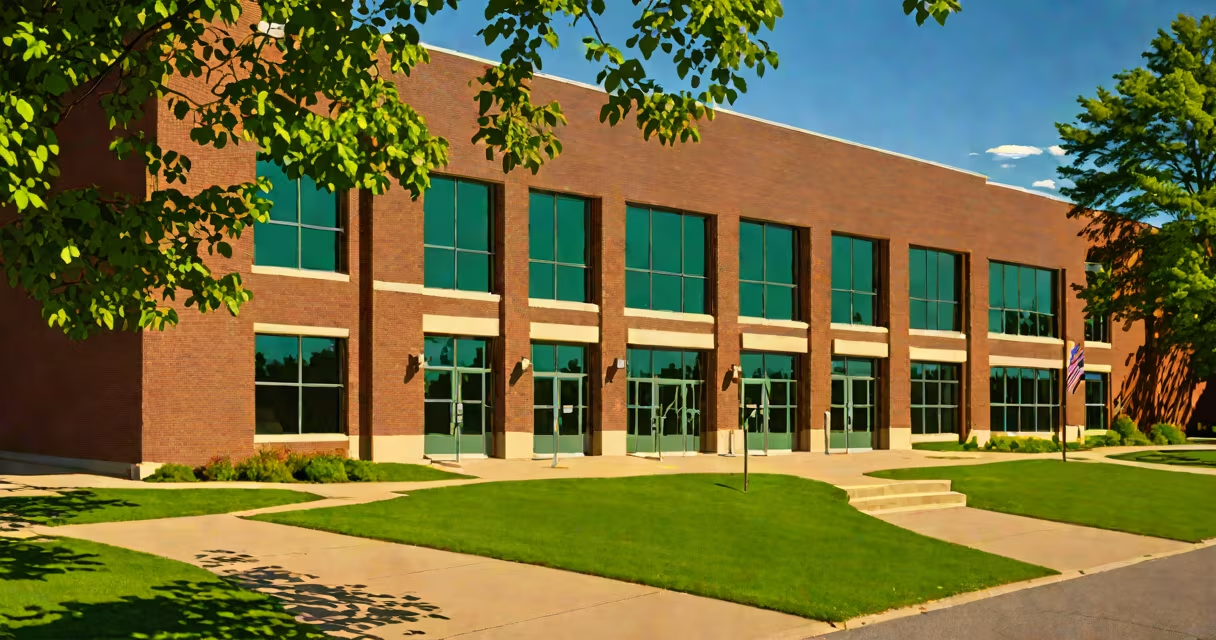
The Chippewa Falls School District is a public school district headquartered in Chippewa Falls, Wisconsin, serving approximately 2,647 students across six schools in grades K-12. It operates under the authority of the Wisconsin Department of Public Instruction and reports annual performance data through the state's accountability system.
Founded in 1856, the district includes four elementary schools (K-5), one middle school (grades 6-8), and one complete high school (grades 9-12). The district's central office is located at 1100 N. 4th Street, and it administers facilities across a 25-square-mile area in Chippewa County. Its mission emphasizes college and career readiness, equity in access, and continuous improvement in student achievement.
Student enrollment in the 2023-2024 academic year was 2,647, with 52% identifying as White, 22% as Hispanic, 13% as American Indian, 8% as Black, and 5% as multiracial. The district's graduation rate for the 2022-2023 cohort was 92%, slightly above the statewide average of 89%. These figures are reported annually by the Wisconsin Department of Public Instruction.
Chippewa Falls School District functions under a locally elected school board consisting of five members. The board sets policy, approves budgets, hires the superintendent, and oversees curriculum and fiscal management. The current superintendent, Dr. Jennifer L. Schmitt, assumed leadership in July 2021 after serving as assistant superintendent since 2017.
Each school within the district follows the Wisconsin Model Academic Standards, which define learning expectations in math, science, language arts, social studies, and physical education. The district uses a standards-based grading system and provides special education services under the Individuals with Disabilities Education Act (IDEA).
Instructional delivery includes hybrid models during emergencies. During the 2020-2021 pandemic, the district offered remote learning options for families who opted out of in-person instruction. A 2022 internal review found that 87% of surveyed parents reported satisfaction with communication from teachers and administrators.
The district operates six schools across three campuses:
| School Name | Grades | Location | Enrollment (2023-2024) |
|---|---|---|---|
| Chippewa Falls High School | 9-12 | 1100 N. 4th St. | 982 |
| Chippewa Falls Middle School | 6-8 | 1100 N. 4th St. | 567 |
| Lincoln Elementary | K-5 | 1200 S. 1st St. | 314 |
| Washington Elementary | K-5 | 1400 W. 5th St. | 305 |
| Jefferson Elementary | K-5 | 1600 N. 6th St. | 289 |
| Madison Elementary | K-5 | 1800 E. 3rd St. | 189 |
High school students may enroll in dual credit courses through UW-Stout and local community colleges. In 2023, 14% of seniors completed at least one college course while still in high school. The district also offers career and technical education programs in health sciences, automotive technology, and information technology.
A non-obvious distinction: Chippewa Falls School District does not operate a charter school. All institutions are traditional public schools funded through state and local property taxes. This differs from neighboring districts such as Binghamton School District, which includes a charter option under its governance structure.
State assessment results from 2022-2023 show that 63% of 3rd-8th graders met or exceeded proficiency in math, and 68% did so in reading. These percentages lag behind the state averages of 67% in math and 71% in reading. The district's composite index score, calculated by the Wisconsin DPI, was 72.4 out of 100, placing it in the 54th percentile among Wisconsin districts.
Funding comes from three primary sources: 65% from local property taxes, 25% from state aid, and 10% from federal grants. The 2023-2024 operating budget totaled $48.7 million, with per-pupil spending of $18,400. This exceeds the state average of $16,800 per pupil.
During a 2021 audit conducted by the Wisconsin Department of Administration, no material deficiencies were found in financial reporting. However, the audit noted a 3% increase in administrative costs over three years, attributed to expanded mental health staffing and technology upgrades.
Some assume Chippewa Falls School District is part of a larger regional consortium. It is not. The district maintains independent governance, budgeting, and hiring practices. It does not share staff or facilities with nearby districts such as Exeter School District, despite proximity.
Another misconception is that the district lacks diversity. While the student population is predominantly White, the district has implemented culturally responsive teaching initiatives since 2019. These include professional development for educators on implicit bias and curriculum integration of Native American history, particularly related to the Ojibwe people, whose ancestral lands include the region.
I visited Chippewa Falls High School in October 2022 during a career fair. Over 20 local employers participated, including manufacturers, healthcare providers, and tech firms. Students engaged in mock interviews and skills demonstrations. The event highlighted the district's focus on workforce pathways beyond four-year college attendance.
For comparison, the Binghamton School District, located in New York, operates under a different state structure and includes a charter school. The Exeter School District, in New Hampshire, has a higher median household income and lower poverty rate. Chippewa Falls School District reflects a rural Midwest profile with higher reliance on agricultural and manufacturing sectors in its student demographics.
Chippewa Falls School District remains focused on improving long-term outcomes. Recent initiatives include expanding early literacy screening in kindergarten and increasing access to free breakfast and lunch for all students. The district plans to launch a new STEM lab at the high school in fall 2024, funded through a $1.2 million grant from the U.S. Department of Education.
Understanding the Chippewa Falls School District requires attention to its local context, funding model, and demographic reality. It is not a national model, nor is it representative of urban districts. Its strengths lie in consistent service delivery, community engagement, and measurable progress in student achievement over time.