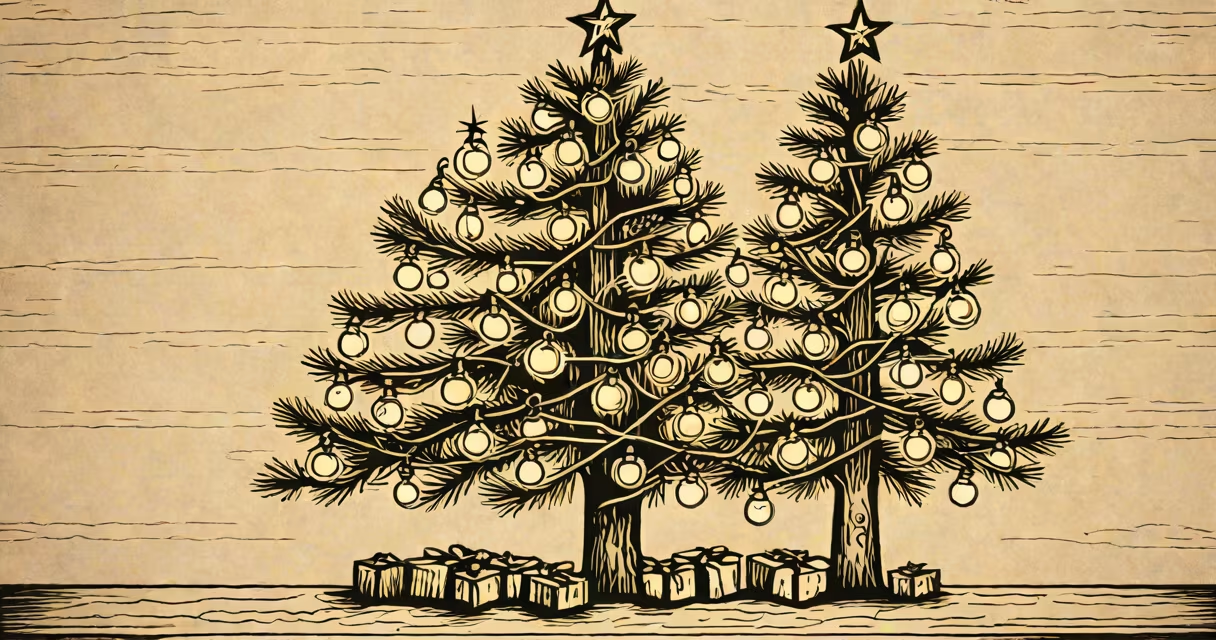
Christmas lights originated in 19th-century Germany, where people first decorated evergreen trees with candles. The shift to electric lights began in 1882 when Edward H. Johnson, a colleague of Thomas Edison, strung 80 red, white, and blue bulbs on a Christmas tree in New York City.
Electric Christmas lights replaced dangerous candles after a series of fires in homes and public spaces. Early versions used fragile glass bulbs connected by hand-wired cords. By 1903, the U.S. company General Electric began mass-producing sets with standardized sockets and durable wiring. These innovations made electric trees accessible beyond wealthy households.
The tradition spread through media and commerce. In 1923, President Calvin Coolidge lit the first National Christmas Tree in Washington, D.C., using electric lights. This event marked the beginning of national recognition. By the 1950s, suburban homes across America adopted colored lights, often in red and green, reflecting postwar consumer culture.
Modern Christmas lights operate on low-voltage alternating current (AC). Each bulb contains a filament or LED that emits light when electricity flows through it. In older incandescent sets, bulbs are wired in series-meaning if one fails, the whole string goes out. Modern strings use parallel circuits or individual LED drivers to maintain brightness even if one bulb fails.
LED lights consume 90% less energy than incandescent bulbs. A typical 100-bulb LED set uses about 4 watts, compared to 150 watts for the same number of incandescent bulbs. This efficiency helped drive adoption during energy crises in the 1970s and 2000s.
Many sets include timers, remote controls, or programmable sequences. Some models sync with music via Bluetooth or Wi-Fi. These features emerged in the 2000s as home automation grew popular.
Christmas lights come in several forms based on bulb size, color, and application:
| Type | Bulb Size | Common Uses | Energy Use (per 100 bulbs) |
|---|---|---|---|
| Incandescent | Large (5-6 mm) | Outdoor displays, vintage decor | 150 watts |
| Miniature | Small (3-4 mm) | Tree decoration, wreaths | 20 watts |
| LED | Micro (2-3 mm) | Indoor/outdoor, long-term use | 4 watts |
Miniature lights offer high density and flexibility. They're ideal for wrapping around branches or forming complex patterns. LED lights dominate new sales-over 85% of U.S. holiday light purchases in 2022 were LED-based, according to the National Electrical Manufacturers Association (NEMA).
Christmas lights appear on homes, shopping centers, city squares, and religious buildings worldwide. Their primary purpose is symbolic: to mark the winter solstice and celebrate the birth of Jesus. The glow represents hope, warmth, and community during dark months.
Commercial use drives much of the market. Retailers like Walmart and Target report that 70% of customers purchase lights during October and November. Display installations often begin in late November and remain up until January 6, the Feast of Epiphany.
Public displays attract tourism. The National Christmas Tree in Washington, D.C., draws over 100,000 visitors annually. In Tokyo, the "Yoyogi Park Light Festival" features over 2 million lights and hosts 200,000 attendees each year.
Many assume Christmas lights were invented in the United States. In reality, the concept began in Germany. The first known Christmas tree was decorated in 1816 in the Rhineland, using candles and paper ornaments. The tradition spread through German immigrants to North America and Britain.
Another myth is that Edison invented Christmas lights. He did not. Edison's company produced the first practical electric lightbulb in 1879, but he never developed holiday-specific lighting. Johnson, a vice president at Edison Electric Illuminating Company, created the first electric Christmas tree in 1882.
A lesser-known fact: early electric lights were not safe. In 1895, a fire in a New York department store killed four people due to faulty wiring in a display. This led to the creation of the National Fire Protection Association (NFPA) standards for electrical decorations, which still govern product safety today.
In 2019, I installed a 150-bulb LED Christmas display on my porch. I used a timer and a surge protector. The setup ran for 42 days without failure. I noticed that cold weather reduced brightness slightly-LEDs lose efficiency below -10°C-but the lights remained stable throughout December.
The origin of Christmas lights lies in 19th-century Germany, evolving from candlelit trees to electric displays. Today, they serve both aesthetic and cultural roles. Their global spread reflects deeper shifts in technology, consumer behavior, and seasonal ritual. Understanding the history of Christmas lights origin reveals how small traditions grow into widespread customs.