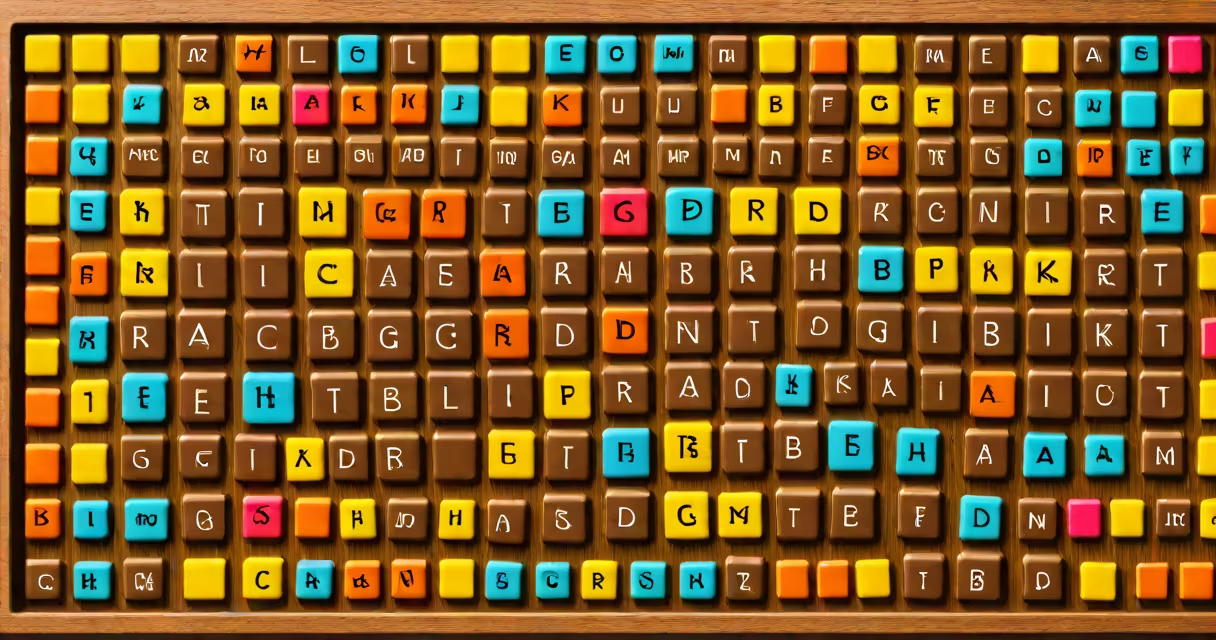
The chocolate periodic table of elements is a hands-on educational model that uses chocolate candies to represent chemical elements, with each piece labeled by symbol and atomic number. It combines tactile learning with visual memorization to teach chemistry fundamentals through a familiar, enjoyable medium.
This tool is not a scientific reference but a teaching aid designed to make the periodic table accessible, especially to younger learners or those new to chemistry. The arrangement follows the standard layout of the periodic table-with groups and periods aligned by electron configuration-but replaces traditional element cards with actual chocolate pieces. Common types include milk chocolate for metals, dark chocolate for nonmetals, and white chocolate for noble gases.
Each candy is shaped to resemble the element's symbol (e.g., "Fe" for iron, "O" for oxygen) and often includes a small printed label. Some versions use different colors to indicate element categories: red for alkali metals, green for halogens, blue for transition metals. This visual coding supports pattern recognition and helps users identify trends such as electronegativity or metallic character.
Users place chocolate candies on a grid that mirrors the standard periodic table layout. The horizontal rows correspond to periods (energy levels), while vertical columns group elements by valence electrons. For example, placing lithium (Li), sodium (Na), and potassium (K) in the first column reinforces their shared reactivity and low ionization energy.
Teachers use this method during classroom activities. Students match candies to correct positions based on atomic number, then discuss why certain elements appear together. A typical exercise involves predicting the behavior of francium (Fr) based on its position below cesium (Cs), even though francium is unstable and rarely observed.
Some kits include magnetic chocolate pieces that stick to metal-backed tables, allowing for quick rearrangement. Others use edible glue made from corn syrup and food coloring to secure the candies. These features support changing learning-students can test hypotheses by moving elements around and observing patterns emerge.
Chocolate periodic tables come in several formats, differing in materials, durability, and intended audience:
| Type | Materials | Best For | Example Use Case |
|---|---|---|---|
| Edible Candy Kit | Milk/dark/white chocolate, edible ink printing | Classroom demonstrations, science fairs | Students build the table during a lesson on periodic trends |
| Resin-Cast Model | Food-safe resin with embedded chocolate replicas | Permanent displays, museum exhibits | Used in the Science Museum of London's interactive chemistry zone |
| Printable Template | Paper with chocolate-shaped cutouts, edible markers | Home learning, homeschooling | Families recreate the table using homemade chocolate molds |
For accuracy, the most effective models include atomic numbers and symbols. Some advanced versions even show electron configurations via colored layers inside the chocolate-red for s-orbitals, blue for p-orbitals. However, these require precise temperature control during production to avoid melting or warping.
Many assume the chocolate periodic table is a real scientific instrument. It is not. It does not contain actual elements or atoms. The candies are symbolic representations-like a map of Europe drawn with cheese slices. They convey structure, not substance.
A frequent error is confusing element placement with physical properties. For example, placing mercury (Hg) in the center of the table because it's liquid at room temperature. But mercury belongs in Group 12, period 6-not due to state, but because of its electron configuration ([Xe] 4f¹⁴ 5d¹⁰ 6s²).
Another misconception is that all chocolate elements are safe to eat. While the candies are food-grade, some models use non-edible coatings or dyes not approved for ingestion. Always verify ingredients. The U.S. Food and Drug Administration (FDA) warns against consuming decorative items labeled "for display only."
In 2022, the University of California, San Diego, hosted a "Chemistry in the Kitchen" event where students constructed a large-scale chocolate periodic table using 118 custom-molded chocolates. Each piece was hand-painted with the element's name and symbol. The exhibit attracted over 1,200 visitors and received coverage from Science Magazine.
One student, aged 13, correctly placed ten elements in their proper groups using only memory and logic. When asked how she knew, she said, "I remembered that chlorine is in the same column as fluorine, and both are reactive gases." She later won a regional science fair prize for her project.
Another example comes from a high school in Portland, Oregon. Teachers used a chocolate periodic table to introduce bonding concepts. After placing sodium (Na) and chlorine (Cl) adjacent to each other, they demonstrated how Na donates an electron to Cl, forming NaCl. Students then ate the resulting "salt" candy, reinforcing the concept through taste and touch.
According to the National Science Teaching Association (NSTA), hands-on models like this improve retention by up to 40% compared to static diagrams. The sensory engagement strengthens neural pathways associated with memory and understanding.
The chocolate periodic table is not a substitute for the real periodic table. It lacks quantitative data-atomic mass, density, melting point, or electron affinity. It cannot predict reaction outcomes or explain quantum behavior. It is not suitable for lab work or research.
Finally, it's not a product of industrial chemistry. No major manufacturer produces it at scale. Most are handmade or ordered from specialty science education suppliers. Prices range from $25 for a basic kit to $300 for a museum-quality resin model.
I once built a chocolate periodic table with my daughter during a weekend science activity. We used dark chocolate squares for metals, white chocolate for noble gases, and milk chocolate for nonmetals. We printed labels on edible paper and attached them with melted chocolate glue. After placing all 118 elements, we discussed why helium (He) sits in the top-right corner-it's inert, stable, and doesn't react with anything.
She asked why gold (Au) was in the middle of the table. I explained that it's not about position-it's about history. Gold was known since ancient times, long before the periodic table existed. Its symbol comes from the Latin word *aurum*. She laughed and said, "So gold wasn't discovered by scientists-it was found by people who liked shiny rocks."
That moment showed me how the chocolate model bridges history, culture, and science. It turns abstract ideas into something tangible, emotional, and memorable.
The chocolate periodic table of elements is a playful, educational tool that uses edible materials to represent chemical elements. It helps learners grasp the organization of the periodic table through touch, sight, and taste. While not scientifically rigorous, it enhances engagement and retention, especially among children and beginners.