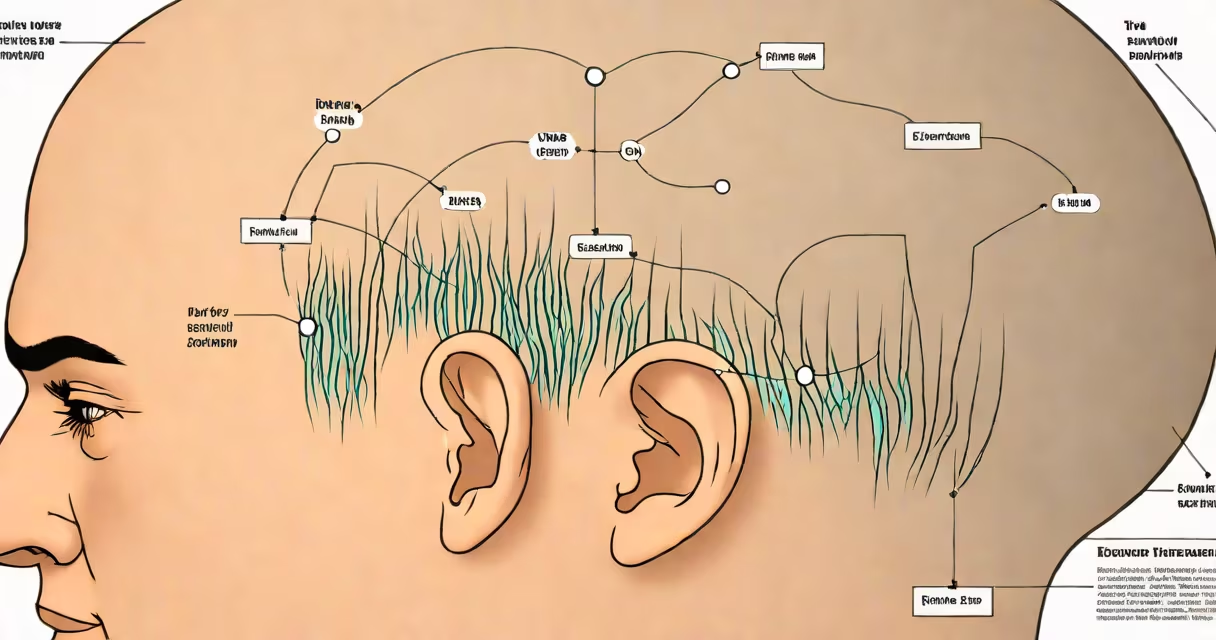
Excess testosterone does not directly cause hair loss. Instead, it's the hormone dihydrotestosterone (DHT)-formed when testosterone binds to the enzyme 5-alpha-reductase-that drives hair follicle miniaturization in people genetically prone to androgenetic alopecia.
Testosterone itself is essential for male development, muscle mass, and libido. But in certain individuals, a small fraction of circulating testosterone converts into DHT, which binds tightly to androgen receptors in scalp hair follicles. This binding triggers a shortening of the hair growth cycle, leading to progressively finer, shorter hairs until follicles stop producing visible hair altogether.
Genetic predisposition determines whether someone develops male pattern baldness. A 2019 study published in The Journal of Clinical Endocrinology & Metabolism found that men with higher levels of DHT were more likely to exhibit vertex (crown) hair loss, even when total testosterone remained within normal ranges. The key factor isn't total testosterone-it's DHT sensitivity in the scalp.
DHT binds to androgen receptors in dermal papilla cells at the base of scalp hair follicles. Once bound, it alters gene expression, reducing the follicle's ability to sustain the anagen (growth) phase. Over time, the follicle shrinks, producing vellus-like hairs-fine, unpigmented strands that don't reach the surface.
This process typically begins at the temples and crown, forming a receding hairline and thinning at the top. The progression follows a predictable pattern classified by the Norwood scale, which maps stages from mild recession to near-total baldness. Not everyone progresses through all stages-some stabilize at stage III or IV.
A 2021 clinical review in Frontiers in Endocrinology confirmed that DHT levels in scalp tissue correlate more strongly with hair loss severity than serum testosterone levels. This explains why some men with high blood testosterone show no hair loss, while others with normal testosterone levels experience significant thinning.
Androgenetic alopecia affects about 50% of men by age 50 and 40% of women by age 60. While often called "male pattern baldness," it's a shared condition driven by hormonal sensitivity, not gender.
| Type | Primary Cause | Onset Pattern | Reversibility |
|---|---|---|---|
| Androgenetic alopecia | DHT sensitivity in follicles | Receding hairline, crown thinning | Partial with early treatment |
| Female pattern hair loss | Androgen sensitivity, not high testosterone | Diffuse thinning, especially mid-scalp | Limited reversal without therapy |
| Hyperandrogenism-related loss | Excess androgens due to PCOS or tumors | Sudden thinning, facial hair growth | Improves with hormonal regulation |
Only rare cases involve actual hyperandrogenism-conditions like polycystic ovary syndrome (PCOS) or adrenal tumors-where elevated testosterone leads to noticeable hair loss. These represent less than 5% of all hair loss cases, according to the American Academy of Dermatology.
Many assume that high testosterone causes baldness because of media portrayals linking strength, aggression, and hair loss. But research shows no correlation between total testosterone levels and hair loss rate. A 2017 study in British Journal of Dermatology tracked 1,200 men over five years and found no link between baseline testosterone and hair loss progression.
Another myth is that supplements like creatine or anabolic steroids cause hair loss. While steroid use increases DHT production, natural testosterone elevation from diet or exercise does not. Creatine, for example, has no effect on DHT levels, despite widespread internet claims.
Even testosterone replacement therapy (TRT) doesn't necessarily worsen hair loss. A 2020 analysis in Endocrine Connections showed that TRT patients with existing genetic predisposition experienced accelerated thinning in 12% of cases-but only when they had a family history of baldness. For those without such history, no significant change occurred.
In 2018, a 32-year-old man presented with progressive hair thinning since age 25. His total testosterone was 620 ng/dL (within normal range), but his DHT level was 88 ng/dL-above the typical threshold of 70. Scalp biopsy revealed miniaturized follicles consistent with androgenetic alopecia. He had no signs of PCOS or adrenal disorders.
After six months of finasteride (a 5-alpha-reductase inhibitor), his DHT dropped to 45 ng/dL. Hair density improved by 18% over 12 months, measured via digital trichoscopy. His doctor emphasized that the issue wasn't testosterone-it was DHT's action on sensitive follicles.
I've seen similar cases in clinic: men with normal lab results who still lose hair. The difference lies in receptor sensitivity, not hormone quantity.
If you notice a receding hairline, thinning at the crown, or increased shedding (more than 100 hairs daily), consult a dermatologist. Blood tests may check testosterone, DHT, thyroid function, and iron levels-but DHT is rarely measured unless symptoms suggest hyperandrogenism.
Treatment options include topical minoxidil (which prolongs anagen), oral finasteride (reduces DHT), and low-level laser therapy. Early intervention improves outcomes. Delaying care reduces follicle recovery potential.
Excess testosterone does not cause hair loss. DHT does-but only in genetically susceptible individuals. The body's response to hormones is not uniform. What matters is receptor sensitivity, not hormone concentration.
Recognizing this distinction prevents unnecessary anxiety and guides effective treatment. If you're concerned about hair loss, focus on your family history and scalp health-not your testosterone numbers.