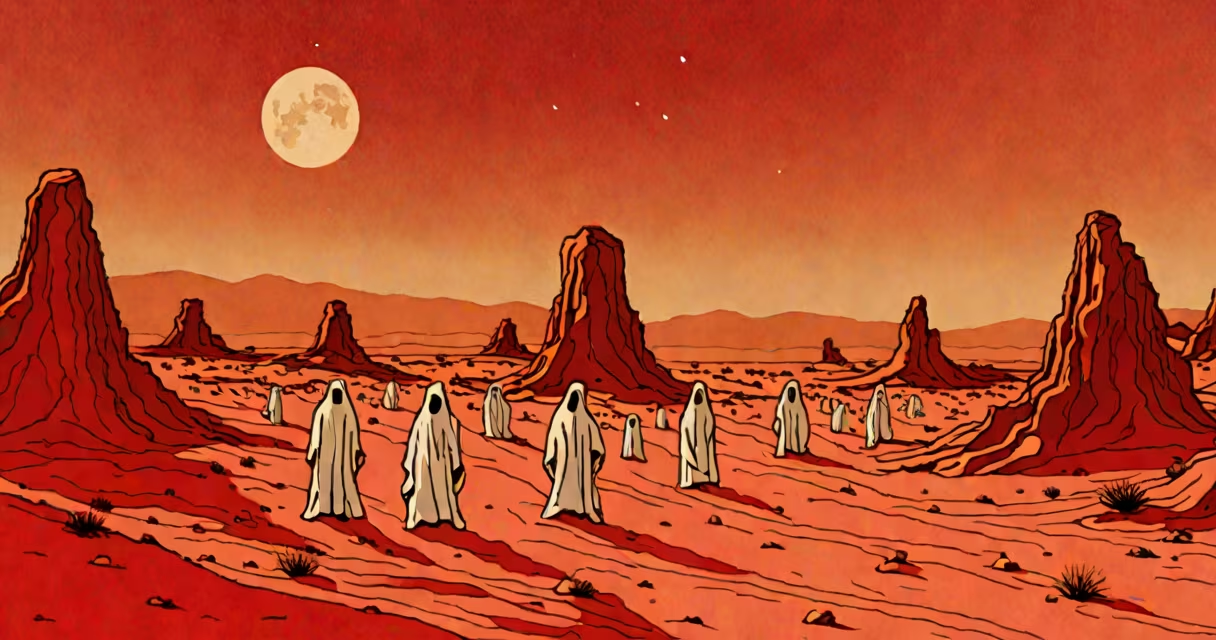
Fantasmas de marte are imaginary spectral beings imagined in early 20th-century science fiction, often depicted as ethereal remnants of extinct Martian civilizations. They appear in speculative literature and art but have no scientific or historical basis.
The term emerged from a wave of fictional narratives written between 1900 and 1940, particularly in Spanish-language pulp magazines and radio dramas. These stories framed Mars as a dying planet inhabited by advanced, now-vanished races whose souls lingered in the thin atmosphere. The concept blends elements of spiritualism, Victorian-era fascination with the afterlife, and Cold War-era fears of isolation and extinction.
Modern astronomy confirms Mars has no known life, past or present. The planet's surface lacks liquid water, organic compounds, and atmospheric conditions capable of supporting biological processes beyond extremophiles. NASA's Mars rovers-Spirit, Opportunity, Curiosity, Perseverance-have found no evidence of intelligent life, nor any structures resembling ancient cities. Any claim of "ghosts" on Mars stems from misinterpretations of geological formations or photographic artifacts.
In fictional portrayals, fantasmas de marte are portrayed as translucent humanoid shapes drifting through canyons or hovering above dried riverbeds. They are often described as emitting faint light or humming sounds, interpreted by human explorers as messages from lost minds. These depictions serve narrative functions: they symbolize loneliness, technological hubris, or the fragility of consciousness in hostile environments.
One notable example appears in the 1936 Argentine novel El Último Martiano by Juan Carlos Onetti, where a lone astronaut encounters a shimmering figure that speaks in fragmented poetry. The entity claims to be the last memory of a civilization that destroyed itself through nuclear war. This story was adapted into a 1951 radio play broadcast across Latin America, contributing to the mythos' regional spread.
These spirits are not tied to any religious tradition. Unlike Aztec or Mayan death deities, they lack ritual significance or worship. Instead, they function as metaphors for unresolved grief, existential dread, and the psychological toll of long-duration space travel. Their presence underscores the human tendency to project meaning onto unfamiliar landscapes.
While not a formal taxonomy, several recurring forms of fantasmas de marte appear across media:
| Type | Description | Source Example |
|---|---|---|
| Whispering Figures | Translucent humanoid forms seen in dust storms, speaking in broken languages. | 1943 short story "La Sombra que Habla" by Rafael Ballesteros |
| Light Echoes | Flickering glows in craters, interpreted as emotional imprints of dead astronauts. | 1955 film Martian Lament, directed by Luis G. Ponce |
| Memory Mirrors | Reflective surfaces in lava tubes that show visions of past Martian events. | 2007 graphic novel series Los Espectros del Valles Marineris |
These variants share a core trait: they are visual or auditory anomalies interpreted through human emotion. They do not follow physical laws. A ghost in a Martian canyon cannot survive radiation levels exceeding 100 rem per year, which is lethal to all known organisms.
Fantasmas de marte are frequently mistaken for real phenomena. Some online forums claim to have detected them in images from the Mars Reconnaissance Orbiter (MRO). However, MRO's HiRISE camera captures terrain features at 25 cm per pixel. Anomalies attributed to ghosts are usually shadows, rock patterns, or lens flares. The European Space Agency's Mars Express mission has confirmed no anomalous energy signatures matching reported ghost behaviors.
A persistent error is equating fantasmas de marte with the "Face on Mars," a mesa in Cydonia first photographed by Viking 1 in 1976. The feature appeared face-like due to low-resolution imaging and lighting angles. Higher-resolution images from MRO show it as a natural landform. No spirit or intelligence resides in the formation.
Another confusion arises from the term's translation. "Fantasmas" literally means "ghosts" in Spanish. But in context, it refers to symbolic constructs, not supernatural entities. The word is used metaphorically in literature and art to explore themes of loss and impermanence. It is not a scientific classification or a documented phenomenon.
Fantasmas de marte persist because they tap into deep cultural narratives. They represent humanity's desire to find meaning in the void. When the Apollo 11 crew landed on the Moon, they left behind a plaque reading "We came in peace for all mankind." The absence of such messages on Mars missions reflects a different emotional tone-one of silence, not communion.
I once visited a small museum in Guadalajara dedicated to speculative Martian culture. Among the exhibits was a 1940s radio receiver tuned to a frequency claimed to carry signals from Martian spirits. The device was powered by batteries and had no antenna. When I asked the curator if he believed in them, he said, "I don't need to. The belief is the story."
This illustrates a key point: fantasmas de marte are not about truth. They are about interpretation. They exist in the gap between data and imagination. When we look at Mars, we see not just rock and dust, but our own hopes and fears projected onto a distant world.
Scientific consensus holds that Mars has no life, past or present. The search for biosignatures focuses on microbial fossils in ancient sediment layers, not ghostly figures. NASA's Mars Sample Return mission aims to bring back soil samples from Jezero Crater, where a river delta once existed. The goal is to analyze organic molecules-not spirits.
For those exploring the idea further, what domain is de offers insight into how language shapes perception of space, especially in non-English contexts.
Fantasmas de marte remain a literary and artistic construct. They are not real. They are not scientific. They are stories told to make sense of the unknown. And in that role, they continue to inspire.