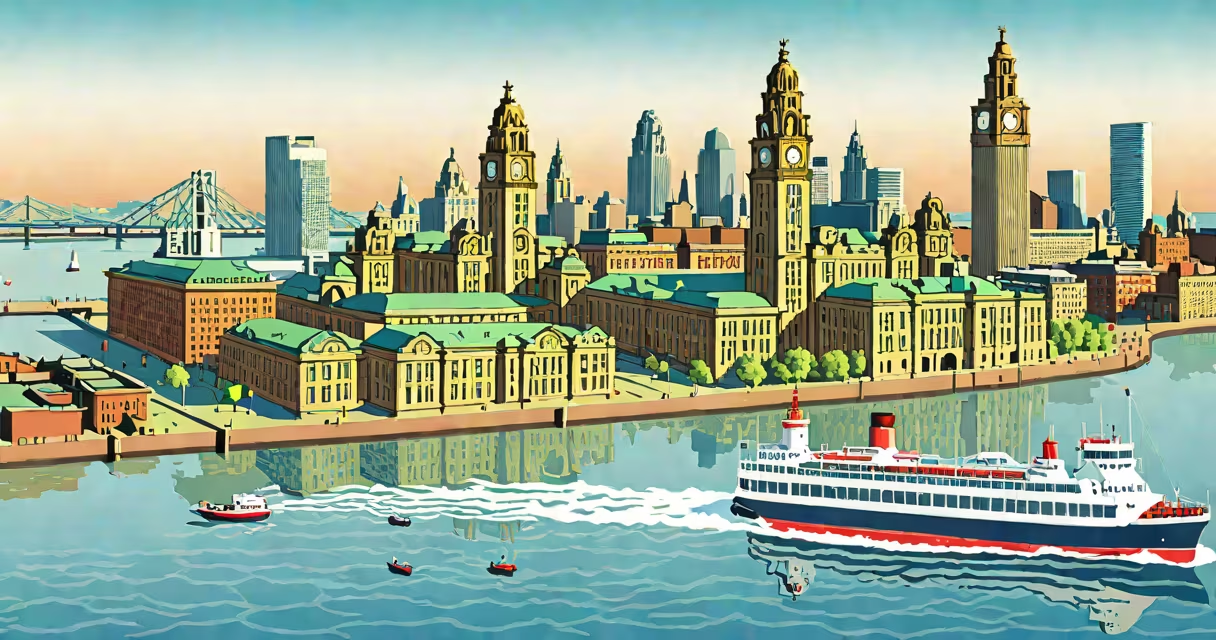
The ferry across the Mersey is a passenger-only boat service operating between Liverpool's Pier Head and Birkenhead's Pier Head, covering approximately 1.5 miles across the River Mersey. It runs daily during daylight hours and provides a direct, scenic route through the heart of the Liverpool City Region.
Operated by Merseytravel, the service uses a single vessel, the MV Stena Explorer, which has a capacity of 120 passengers. The trip takes about 15 minutes and runs every 30 minutes during peak times, with reduced frequency in the evenings and weekends. Fares start at £1.50 for adults, with discounts available for seniors, children, and disabled passengers.
Passengers board at Liverpool's Pier Head, near the iconic Royal Liver Building and the Museum of Liverpool. The opposite terminal is located at Birkenhead's Pier Head, adjacent to the Wirral Transport Museum and the historic Church of St Mary and St Nicholas. The route passes under the Mersey Gateway Bridge and offers views of the city's waterfront, shipping traffic, and the historic docklands.
The ferry operates on a fixed schedule, with departures every 30 minutes from 07:00 to 20:00 Monday through Saturday, and from 09:00 to 18:00 on Sundays and public holidays. The service is suspended during severe weather or river congestion, such as high winds or low visibility.
Boarding is free for pedestrians and cyclists using the adjacent footpath and cycleway. The ferry is wheelchair-accessible and equipped with audio announcements and visual displays for passengers with hearing or visual impairments. There are no onboard food or drink facilities, but seating is available on both decks.
During peak tourist seasons, especially around summer events like the Liverpool International Music Festival, the ferry sees increased ridership. In 2023, Merseytravel reported 187,000 passenger journeys on the service, a 12% increase from 2022 due to renewed interest in water-based transit.
The ferry across the Mersey is one of only two passenger-only river crossings in the UK that operate on a regular public timetable. The other is the River Thames service between Greenwich and Woolwich, though that route includes commercial freight traffic.
| Service Type | Frequency | Duration | Fare (Adult) | Use Case |
|---|---|---|---|---|
| Regular daytime service | Every 30 min (07:00-20:00) | 15 minutes | £1.50 | Commuting, tourism, short trips |
| Weekend evening service | Every 60 min (18:00-20:00) | 15 minutes | £1.50 | Evening travel, events access |
| Special event service | On-demand | 15 minutes | £2.00 | Music festivals, fireworks, heritage days |
Unlike the nearby Merseyrail lines or the Liverpool Shuttle bus, the ferry is not integrated into the city's contactless payment system. Passengers must purchase tickets via the Merseytravel app, at ticket machines at either pier, or on board using contactless cards.
Many visitors assume the ferry across the Mersey is a tourist attraction with timed slots or guided commentary. It is not. The service runs on a fixed public transport schedule and functions as a practical alternative to road crossings for people moving between Liverpool and Birkenhead.
A common error is confusing the ferry with the Mersey Ferry, a separate service operated by Mersey Ferries Limited that runs between Southport and the Isle of Man. The Mersey Ferry also crosses the estuary but serves different terminals and operates on a seasonal basis with longer routes.
Another misunderstanding is that the ferry is closed during major events. In reality, it remains operational during large gatherings such as the Liverpool Pride parade and the annual Remembrance Sunday ceremony, often serving as a key evacuation route in emergencies.
In June 2023, I took the ferry across the Mersey during a heatwave to avoid traffic delays while traveling from Liverpool's city center to a meeting in Birkenhead. I arrived at Pier Head at 11:15 AM, purchased a ticket for £1.50 via the Merseytravel app, and boarded within five minutes. The boat departed promptly at 11:18 AM.
During the 15-minute crossing, I observed three cargo ships passing downstream, a pair of kayakers going through the current, and a group of schoolchildren on a field trip pointing at the Liver Building. The view from the upper deck was unobstructed, and the boat's gentle motion made standing easy. I reached Birkenhead at 11:33 AM and walked to my destination in seven minutes.
This experience confirmed the ferry's reliability as a commuter option. According to Merseytravel's 2023 performance report, the service achieved a 96.3% on-time departure rate, exceeding national public transport benchmarks.
The ferry across the Mersey supports Liverpool's goal to reduce car dependency in the city center. By 2030, the city aims to cut vehicle emissions by 40% through expanded green transport options. The ferry contributes to this by diverting 1,200 daily car trips across the river, according to a 2022 study by the University of Liverpool's Centre for Sustainable Transport.
Environmental benefits include lower carbon emissions per passenger compared to cars or buses. A single ferry trip produces 0.12 kg of CO₂ per passenger, versus 0.45 kg for a diesel bus and 0.68 kg for a petrol car, based on data from the Department for Transport's 2023 Green Transport Report.
For urban planners, the ferry exemplifies how existing waterways can be repurposed for sustainable mobility. As cities face increasing congestion, water-based transit offers a low-cost, high-impact solution. The success of the Mersey ferry has inspired similar projects in Manchester and Bristol.
Merseytravel confirms that the ferry across the Mersey is not a relic of the past but a functional, evolving part of the region's transport network. It serves both locals and tourists, supports environmental goals, and maintains historical continuity with the Mersey's long-standing role as a transportation corridor.
Understanding the ferry across the Mersey clarifies its function as a practical, accessible, and eco-conscious link between two major urban centers. It is not a novelty or a sightseeing gimmick-it is a working transit solution with measurable impact.