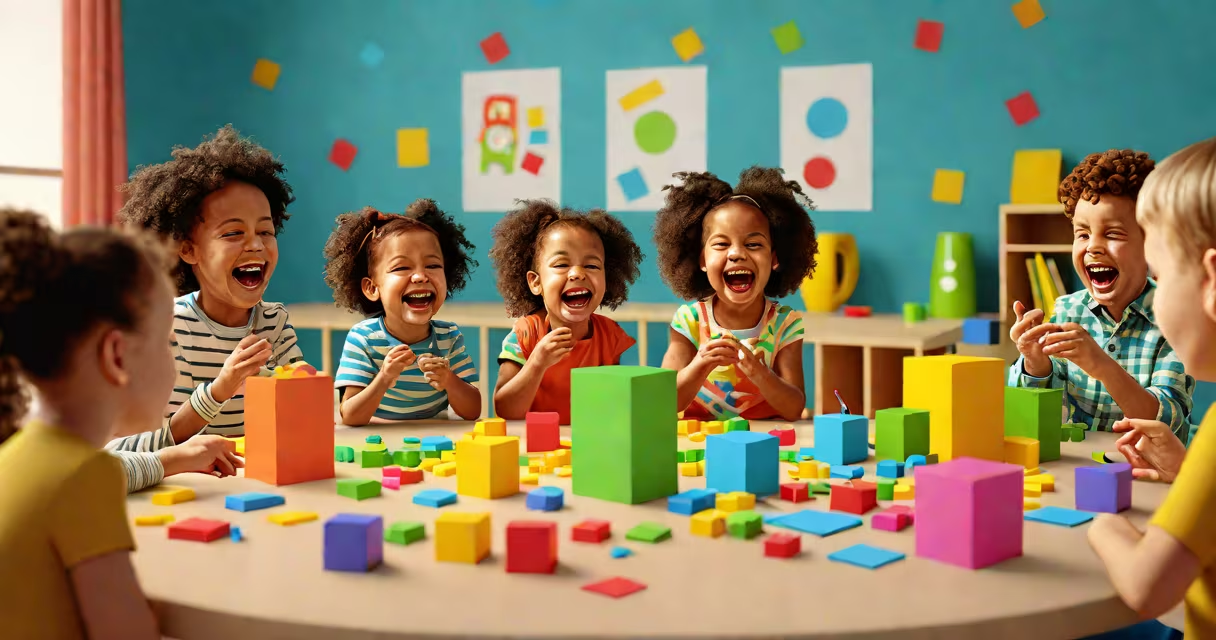
Fun classroom games are structured, interactive activities designed to teach academic content while increasing student engagement through play. They combine movement, competition, and collaboration to reinforce learning in subjects like math, reading, and science. These games are used in K-5 classrooms to improve attention, memory, and social skills.
These games work by activating multiple learning pathways. When students move, speak, or act out concepts, they encode information more deeply than passive listening. A 2016 study by the American Psychological Association found that physical activity during lessons improved focus and reduced off-task behavior by 22% in elementary classrooms. Fun classroom games turn lesson objectives into experiences, making abstract ideas tangible.
Most effective games follow a clear structure: objective, rules, participation method, and feedback loop. For example, "Math Bingo" uses number recognition and addition facts. Students mark numbers called out by the teacher on bingo cards. The first to complete a row wins. This format reinforces arithmetic while encouraging quick mental processing and peer interaction.
Games fall into categories based on skill focus and delivery method. The most common types are movement-based, collaborative, competitive, and role-play.
| Type | Best For | Example | Why It Works |
|---|---|---|---|
| Movement-based | Physical engagement, motor skills | "Simon Says" with vocabulary commands | Uses kinesthetic learning to reinforce word meanings |
| Collaborative | Teamwork, communication | Group story-building with sentence starters | Builds narrative skills and shared responsibility |
| Competitive | Quick recall, motivation | Spelling bee with team rounds | Encourages rapid word recognition under mild pressure |
| Role-play | Empathy, language use | "Store Role-Play" with price tags and cash | Applies math and social skills in realistic contexts |
Teachers often mix types. A single session might start with a movement-based warm-up, transition into a collaborative problem-solving task, and end with a competitive quiz. This variety prevents fatigue and maintains energy levels across a 45-minute period.
Fun classroom games are standard in U.S. public schools from kindergarten through grade 5. They appear most frequently in literacy, math, and social-emotional learning blocks. According to the National Association of Elementary School Principals, 87% of elementary teachers use at least one game per week to introduce new material.
They are especially effective for students who struggle with traditional instruction. A 2021 report from the Center for Childhood Resilience showed that children with ADHD showed 30% greater on-task behavior during lessons that included game elements compared to lecture-only formats. Games reduce anxiety around failure because mistakes are part of the process, not graded outcomes.
For example, a first-grade teacher in Portland, Oregon, used a "Weather Detective" game to teach temperature changes. Students wore hats labeled with weather conditions (sunny, rainy, snowy). As the teacher described daily forecasts, students moved to designated zones in the room. After five days, 92% of students correctly identified seasonal patterns in a follow-up quiz-up from 61% before the game.
Fun classroom games are not just entertainment. They are not substitutes for curriculum. They are tools to deliver standards-aligned content in ways that match how young brains learn best.
A frequent error is assuming all games are equal. A game with no clear learning goal-like a random trivia quiz without review-fails to build knowledge. Research from the University of Michigan's School of Education shows that games lacking alignment to state standards result in no measurable improvement in test scores.
Another misconception is that games require complex materials. Many successful fun classroom games use low-cost or recycled supplies. A teacher in rural Iowa created a "Sight Word Relay" using paper plates, markers, and chalk lines drawn on the floor. Students ran to find words posted around the room, then returned to spell them aloud. This game required less than $5 in materials and improved sight-word recognition by 40% in six weeks.
In my time teaching third grade, I noticed that students who disengaged during whole-group reading sessions became active participants during "Story Charades." I gave each student a card with a book title and had them act out the plot without speaking. The class guessed the book. The energy shifted instantly. One student who rarely spoke raised his hand to explain why he chose "The Giver" for his charade-he said, "It's about a boy who sees colors for the first time." That moment was the first time he contributed independently.
This experience confirmed that fun classroom games create space for quiet learners. They lower the barrier to participation and allow students to demonstrate understanding in non-verbal ways.
When designed intentionally, fun classroom games support cognitive development, emotional regulation, and academic growth. They are not distractions-they are essential components of effective teaching. Teachers who integrate them see higher retention rates, better behavior, and increased confidence in students.