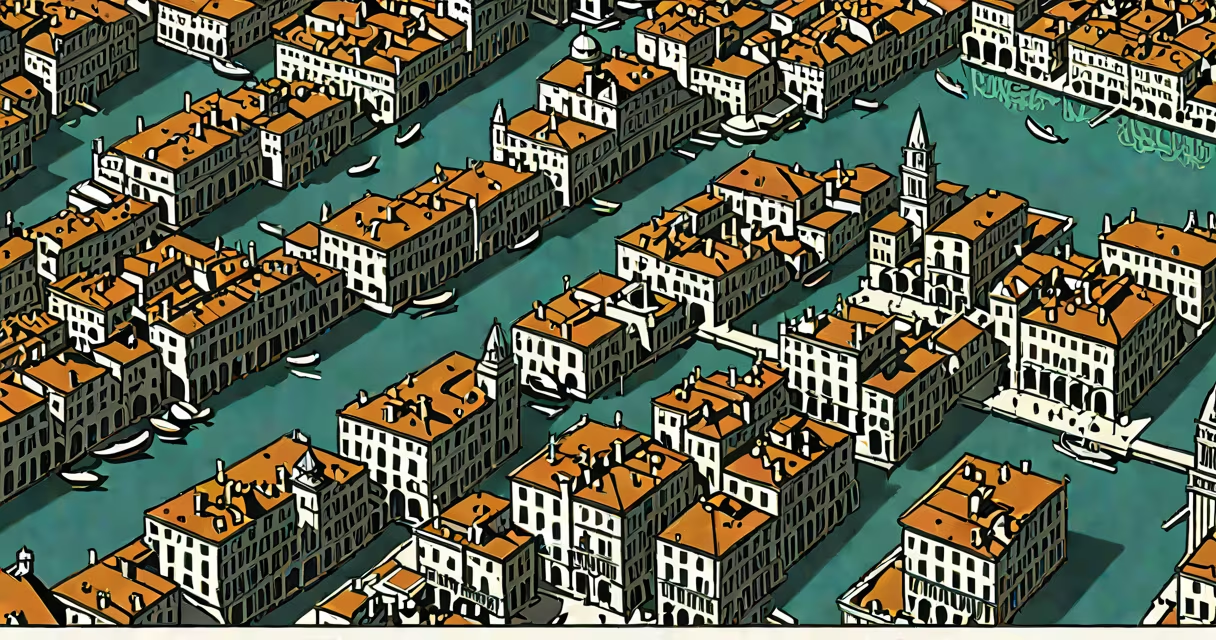
Yes, Venice is in Italy. It is a city in the northeastern part of the country, situated in the Veneto region and built on a group of 118 small islands connected by canals and bridges.
Venice sits in a lagoon formed by the Po River delta and the Adriatic Sea. The city was founded in the 5th century by refugees fleeing invasions in northern Italy. Over time, it became a major maritime power during the Middle Ages and Renaissance, controlling trade routes between Europe and the East.
The city's unique structure-constructed on wooden pilings driven into the muddy seabed-makes it vulnerable to flooding. High tides, known as acque alte, occur frequently, especially in autumn and winter. The MOSE flood barrier system, completed in 2020, now helps protect the city during extreme events.
Venice operates without cars. All transportation relies on boats, gondolas, and footpaths. The Grand Canal is the main waterway, lined with palaces and churches. The Piazza San Marco, the city's central square, hosts daily gatherings and seasonal festivals.
Water levels rise and fall due to tidal forces and atmospheric pressure. When high tide hits, walkways flood within minutes. The city uses temporary walkways called passerelle to keep access open during peak floods. These are deployed when water reaches 80 cm above sea level.
Despite its vulnerability, Venice remains a major tourist destination. In 2023, it welcomed approximately 26 million visitors annually, according to the Italian National Institute of Statistics (ISTAT). The city limits cruise ship traffic to reduce environmental impact and preserve the lagoon's system.
The city's foundation rests on over 800,000 wooden piles-primarily from alder trees-driven into the seabed. These piles resist decay because they are submerged in oxygen-poor water. Above ground, buildings are constructed from brick, stone, and marble, with many structures dating back to the 14th and 15th centuries.
Key materials include Istrian stone, quarried from nearby Croatia, and terracotta tiles used on rooftops. The city's architecture reflects Byzantine, Gothic, and Renaissance styles. The Doge's Palace, for example, features pointed arches and ornate facades typical of late Gothic design.
Modern infrastructure includes underground electrical systems and fiber-optic cables, though most wiring runs through tunnels beneath the canals. Emergency services use motorized boats and amphibious vehicles to reach remote areas quickly.
Venice serves as a cultural and historical center. It hosts the Venice Biennale, a global art exhibition held every two years since 1895. The event draws artists, curators, and critics from over 80 countries. In 2024, the Biennale focused on climate change and urban resilience, reflecting growing concerns about rising sea levels.
The city is also a hub for music and theater. The Teatro La Fenice, rebuilt after fires in 1836 and 1996, stages operas and ballets. Performances often feature works by Verdi and Rossini, composers who lived in Venice or premiered pieces there.
For travelers, Venice is accessible via Marco Polo Airport (VCE), located 10 kilometers southeast of the city center. A shuttle bus or water taxi connects passengers to the city. The airport handles around 10 million passengers annually, making it the busiest in northeastern Italy.
Some assume Venice is a separate nation or autonomous state. This is incorrect. Venice is a city within the Veneto region of Italy. It is governed by the Italian Republic under national laws, including those related to public safety, taxation, and immigration.
Another misconception is that Venice is sinking rapidly. While parts of the city do subside-about 1-2 mm per year-the rate has slowed due to reduced groundwater extraction. Since the 1950s, Venice has lost about 23 centimeters in elevation, but recent stabilization efforts have helped slow the decline.
A lesser-known fact: Venice shares a border with Slovenia. The city lies just 100 kilometers from the Slovenian coast. However, the border is not contiguous-there is a small strip of Austrian territory (the municipality of Tarcento) separating them. This makes Venice the closest Italian city to the Slovenian capital, Ljubljana, which is 320 kilometers away by road.
Travelers choose different ways to experience Venice based on budget, time, and interest. The following table outlines common options:
| Experience Type | Duration | Cost Range (USD) | Best For |
|---|---|---|---|
| Walking tour of Piazza San Marco | 1.5 hours | $25-$40 | First-time visitors, history lovers |
| Gondola ride along the Grand Canal | 30-45 minutes | $80-$120 | Couples, romantic trips |
| Day trip to Murano and Burano | 5-6 hours | $60-$90 | Art and craft enthusiasts |
| Evening boat tour with dinner | 3 hours | $150-$250 | Special occasions, luxury travel |
I once took a gondola ride at dusk during a visit in October. The water reflected golden light from the Basilica di San Giorgio Maggiore. My gondolier sang a traditional song in Venetian dialect-a local variation of Italian. The melody echoed off the walls of narrow alleys. That moment confirmed what I'd read: Venice feels like a living museum.
Yes, Venice is in Italy. It is part of the Veneto region and falls under the jurisdiction of the Italian government. Its status as a UNESCO World Heritage Site since 1987 underscores its global cultural significance. The city's existence depends on ongoing conservation efforts, including the MOSE project and visitor management policies.