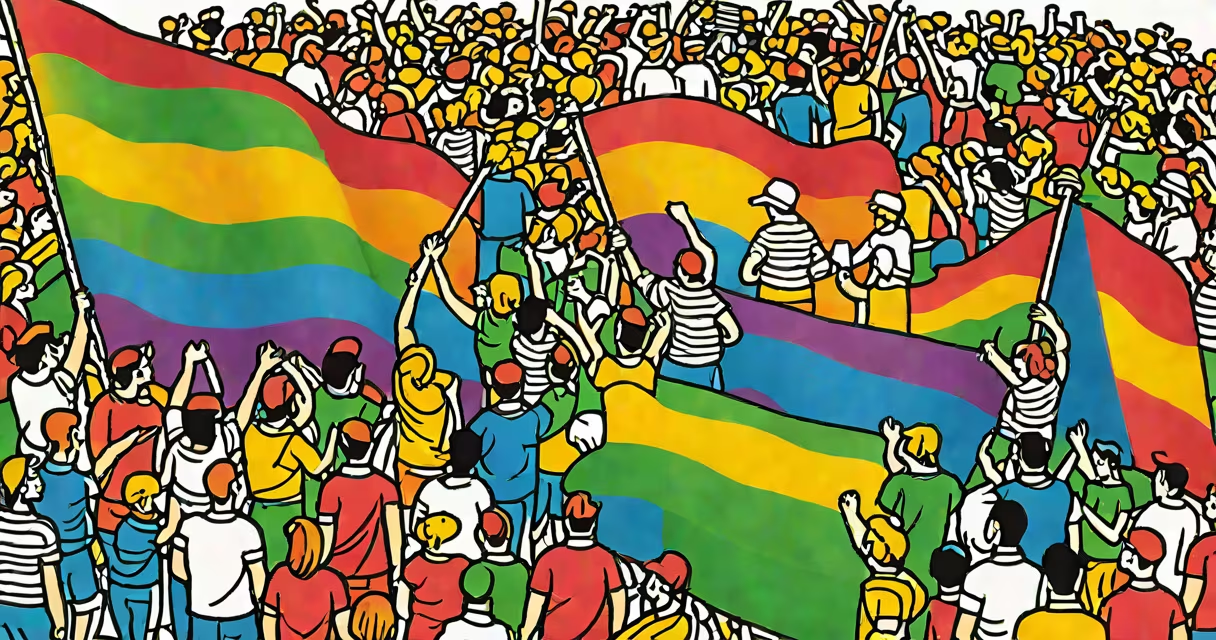
The term "lgbt community meaning" refers to the collective identity, shared experiences, and social networks formed by people who identify as lesbian, gay, bisexual, transgender, or part of related sexual and gender minority groups. This community centers around mutual support, visibility, and advocacy for equal rights and representation.
People within the lgbt community often share common challenges related to discrimination, social stigma, and mental health disparities. They also engage in cultural practices such as Pride events, activism, and storytelling that affirm their identities. The community is not monolithic-it includes diverse voices based on race, class, age, disability status, and geographic location.
According to the Williams Institute at UCLA, approximately 1.6 million adults in the United States identify as transgender, and about 5.6% of U.S. adults identify as LGBTQ. These figures reflect the size and diversity of the population that forms the foundation of the lgbt community meaning.
At its core, the lgbt community operates through informal and formal networks. Informal connections form through friendships, online forums, and local gatherings. Formal structures include nonprofit organizations, advocacy groups, and healthcare providers specializing in LGBTQ care.
These networks provide emotional support, resources, and safe spaces. For example, the Trevor Project reports that LGBTQ youth who have access to supportive communities are 40% less likely to report suicidal ideation compared to those without such support. This demonstrates how community ties directly impact well-being.
Community involvement also drives policy change. The 2015 U.S. Supreme Court decision in Obergefell v. Hodges, which legalized same-sex marriage nationwide, was influenced by decades of grassroots organizing and public education efforts led by LGBTQ activists and allies.
The acronym LGBTQ stands for lesbian, gay, bisexual, transgender, and queer. Each letter represents distinct identities, though they often intersect. Some people use expanded versions like LGBTQIA+ to include intersex, asexual, and other identities.
Transgender individuals may identify as male, female, both, neither, or beyond binary categories. Non-binary and genderqueer identities challenge the traditional gender binary. Bisexual people are attracted to more than one gender, while pansexual individuals are attracted regardless of gender.
| Identity | Definition | Example |
|---|---|---|
| Lesbian | Woman who is primarily attracted to women | A woman in a relationship with another woman |
| Gay | Man who is primarily attracted to men | A man in a romantic partnership with another man |
| Bisexual | Person attracted to more than one gender | An individual in relationships with both men and women |
| Transgender | Person whose gender identity differs from assigned sex at birth | A person who was assigned male at birth but identifies as female |
| Queer | Term used broadly to describe non-heteronormative identities | A person who rejects rigid labels and embraces fluidity |
That identity is personal and self-defined. No single structure governs how someone must express their identity. The term "queer" was historically used as a slur but has been reclaimed by many in the community as a positive, inclusive label.
One widespread misunderstanding is equating the lgbt community with sexuality alone. While sexual orientation is central, gender identity, expression, and culture are equally important parts of the community's makeup. A transgender person may be heterosexual, and a gay man may be cisgender.
Another misconception is assuming all LGBTQ people share the same political views or life experiences. Research from the Pew Research Center shows that LGBTQ Americans hold varied opinions on issues like religion, politics, and family structure. There is no single "LGBTQ perspective."
The lgbt community is not synonymous with Western culture. In countries like Uganda and Russia, LGBTQ people face criminalization and violence. Despite this, global LGBTQ movements exist-from the 2018 protests in Turkey to the 2022 Pride march in São Paulo, Brazil-showing that the community spans continents and cultures.
I once attended a small-town Pride event in rural Oregon. The turnout was modest-about 75 people-but the atmosphere was deeply affirming. I spoke with a 72-year-old lesbian woman who had never come out until her late 60s. She said, "I didn't think anyone like me existed here." That moment underscored how important the lgbt community meaning is-not just as a label, but as a lifeline.
Studies confirm this. A 2021 study published in the journal *Pediatrics* found that LGBTQ youth who lived in communities with visible Pride events reported higher levels of self-worth and lower rates of depression. Visibility matters. So does belonging.
Some people confuse the lgbt community with religious or spiritual groups. But while some faith-based organizations support LGBTQ people, the lgbt community itself is secular and rooted in human rights principles. The distinction lies in purpose: the lgbt community seeks equality and dignity under law and society, not conversion or assimilation.
Several symbols represent aspects of the lgbt community. The rainbow flag, designed by Gilbert Baker in 1978, remains the most recognized symbol of LGBTQ pride. Each color represents a different value: red for life, orange for healing, yellow for sunlight, green for nature, blue for harmony, and violet for spirit.
Other symbols include the pink triangle, originally used by Nazis to mark gay men in concentration camps, later reclaimed as a protest symbol during the AIDS crisis. Today, it appears in memorials and activist art.
Similarly, the lgbt unicorn symbolizes hope, magic, and inclusivity. It's often used in digital spaces and art to represent the idea of being uniquely seen and valued. Explore the lgbt unicorn meaning.
The lgbt community meaning is not a static concept. It evolves through lived experience, historical struggle, and ongoing cultural expression. It includes people of all ages, races, religions, and abilities who share a commitment to authenticity and equity. Understanding this meaning requires recognizing both the diversity within the group and the shared values of acceptance, resilience, and visibility.