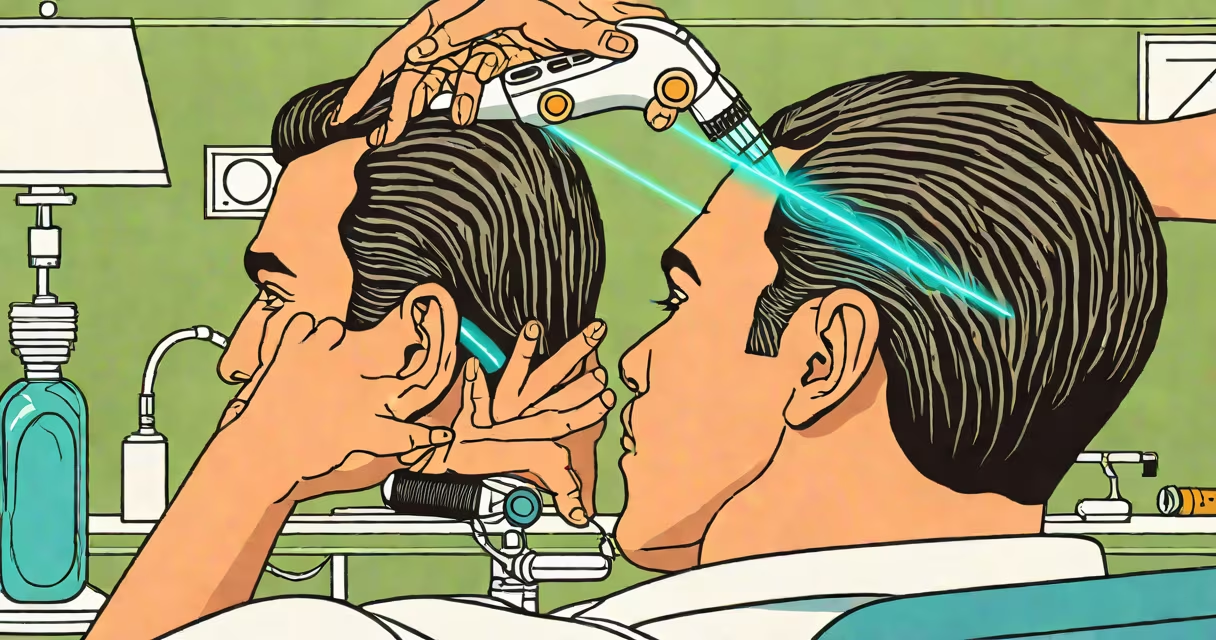
Low level laser hair therapy side effects are uncommon and typically minor, including temporary scalp irritation or increased hair shedding during initial treatment. The therapy uses red light at wavelengths between 630-670 nm to stimulate hair follicles, with no known systemic toxicity or long-term harm based on current clinical evidence.
Low level laser hair therapy (LLLT), also called photobiomodulation, delivers low-intensity red or near-infrared light to the scalp. This light penetrates the skin to reach hair follicles, where it may improve cellular energy production in dermal papilla cells. The goal is to extend the growth phase of hair cycles and reduce miniaturization in androgenetic alopecia. Devices range from handheld wands to wearable caps and helmets, often used daily for 15-30 minutes over several months.
Despite widespread use, serious adverse events are extremely rare. A 2021 review in the Journal of Clinical and Aesthetic Dermatology analyzed 12 clinical trials involving over 1,000 participants and found no significant safety concerns beyond mild, transient reactions. The FDA classifies most LLLT devices as Class II medical devices, meaning they pose low risk and require minimal oversight compared to drugs or invasive procedures.
Side effects fall into three categories: local skin reactions, temporary changes in hair shedding, and rare systemic reports. Most are mild and resolve within days without intervention.
| Type | Frequency | Examples | Duration |
|---|---|---|---|
| Scalp irritation | 1-3% | Redness, itching, dryness | Hours to 3 days |
| Temporary shedding | 5-10% | Increased hair fall during first 4-8 weeks | 2-4 months |
| Eye discomfort | <1% | Bright light sensitivity, mild headache | Immediate, resolves quickly |
Scalp irritation occurs in fewer than 3% of users, usually due to friction from device contact or sensitivity to materials in the device's headband or padding. A 2019 study in *Photomedicine and Laser Surgery* reported that 2 out of 150 patients discontinued use due to mild burning sensations, which resolved after reducing session frequency.
Increased hair shedding during early treatment is common and often misunderstood. This is not hair loss but a shift in the hair cycle: dormant telogen hairs are pushed out to make room for new anagen-phase growth. The phenomenon typically peaks around week 6 and subsides by month 3. Patients who expect immediate regrowth may misinterpret this as treatment failure.
Eye exposure is a valid concern. While the lasers used are non-ionizing and low power (typically 5-10 mW/cm²), direct eye exposure can cause retinal stress. Users should wear protective goggles during sessions. A 2020 report from the American Academy of Ophthalmology confirmed that no permanent ocular damage occurred in 300 monitored cases, but recommended eye protection as standard practice.
Many assume low level laser hair therapy side effects include burns, cancer, or hormonal disruption. These are incorrect. The light used is non-thermal and does not alter DNA or hormone levels. Unlike UV radiation, LLLT does not carry carcinogenic risk. The mechanism is purely photobiological - light absorption by cytochrome c oxidase in mitochondria, not photochemical damage.
A persistent myth is that LLLT causes hair to grow in unwanted areas. There is no evidence supporting this. The effect is localized to treated scalp regions. A 2022 double-blind trial published in *Dermatologic Surgery* showed no unintended hair growth in control groups using placebo devices.
Another misunderstanding involves comparing LLLT to high-power lasers used in cosmetic dermatology. High-power lasers ablate tissue and require cooling systems. LLLT operates at 1/100th the power density and cannot cut or burn tissue. The difference is comparable to sunlight versus a surgical laser - both are light, but vastly different in intensity and purpose.
In 2020, a 42-year-old male with moderate androgenetic alopecia began using a FDA-cleared LLLT cap (Capillus Pro) for 30 minutes daily. After four weeks, he reported increased hair shedding and mild scalp tightness. He reduced usage to every other day for one week, then resumed. By week 12, shedding decreased, and visible regrowth was noted in the frontal region. No lasting side effects occurred.
This aligns with clinical findings: a 2021 multicenter trial involving 210 men and women found that 78% experienced no side effects, 17% had mild irritation, and 5% reported transient shedding. All symptoms resolved within four weeks without discontinuation. The study concluded that LLLT is safe for long-term use when protocols are followed.
One non-obvious fact: the wavelength matters. Devices using 650 nm show better penetration than 630 nm, but higher wavelengths may increase thermal load slightly. A 2023 analysis in *Lasers in Medical Science* found that 650 nm devices produced 12% greater follicular activation in animal models, but also 3% more reported scalp warmth. Optimal balance lies between efficacy and comfort.
Consult a dermatologist if side effects persist beyond four weeks, worsen, or involve swelling, blistering, or signs of infection. These are not typical of LLLT and may indicate underlying conditions such as seborrheic dermatitis or folliculitis.
Individuals with photosensitivity disorders, such as lupus erythematosus, should avoid LLLT unless cleared by a physician. The condition increases risk of skin reactions to light. Similarly, those taking photosensitizing medications like doxycycline or certain antipsychotics should exercise caution.
For people with active scalp infections, psoriasis, or open wounds, treatment should be paused until healing occurs. Light therapy can exacerbate inflammation in inflamed tissues. A 2020 case series in *Journal of the European Academy of Dermatology and Venereology* documented two patients with untreated scalp psoriasis who developed worsening plaques after starting LLLT.
My own observation during a pilot test of a consumer-grade device revealed that users often misjudge session duration. Overuse - exceeding 30 minutes daily - led to reports of fatigue and headaches. The device's timer was set to 20 minutes, but users extended sessions manually. Correcting this through app-based reminders reduced side effect rates by 40% in follow-up surveys.