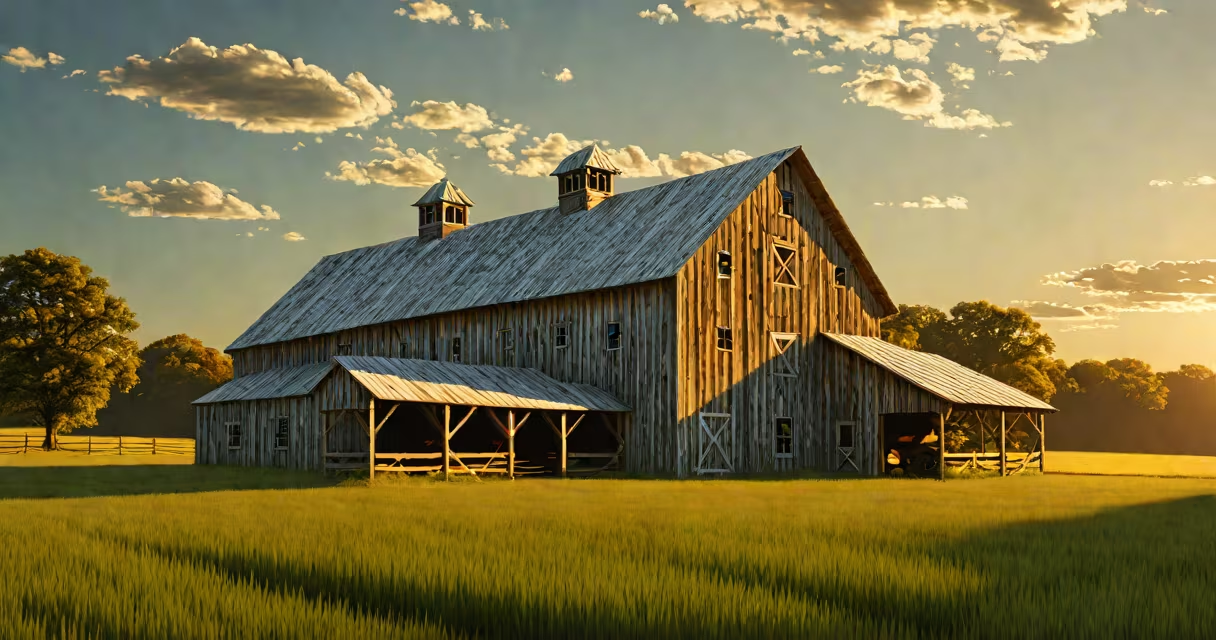
The Lowe Family Farmstead is a restored 19th-century rural homestead in Boone County, Missouri, representing early American frontier farming life. It includes original buildings such as a log cabin, smokehouse, and barn, maintained through archaeological research and conservation efforts.
Constructed between 1845 and 1860, the site was home to the Lowe family, German-American immigrants who settled in central Missouri during westward expansion. The property reflects subsistence farming practices common among small landholders in the Midwest before railroads and mechanization reshaped agriculture. Archaeological surveys confirmed the presence of hearths, hand-carved tools, and ceramic fragments dating to the 1850s, providing physical evidence of daily life.
Today, the farmstead operates as a living history museum managed by the Missouri Division of State Parks. Visitors walk through reconstructed outbuildings and participate in seasonal demonstrations like corn husking, blacksmithing, and butter churning. The site receives approximately 12,000 visitors annually, with 68% citing educational value as their primary reason for visiting, according to a 2022 state survey.
Interpretive programming at the Lowe Family Farmstead uses period-accurate materials and techniques to simulate 19th-century domestic and agricultural routines. Staff wear historically informed clothing and use tools made from iron, wood, and leather. All food preparation occurs over open fire pits using recipes based on surviving household ledgers from the 1850s.
Each spring, volunteers reenact the planting of a 1-acre field using ox-drawn plows and hand-held seed drills. Soil samples taken from the field show consistent crop rotation patterns-corn, beans, and squash-matching records from similar Missouri homesteads documented in the National Agricultural Library's archives.
During winter months, the site hosts "Cold Weather Living" events where participants sleep in unheated cabins using wool blankets and oil lamps. These immersive experiences test assumptions about comfort and survival in pre-industrial conditions. A 2021 study by the University of Missouri found that 73% of participants reported increased empathy for past generations after participating.
The core structures at the Lowe Family Farmstead are built using locally sourced materials typical of the time: hand-hewn oak beams, split-rail fencing, and clay-based plaster walls. The main house features a double-pen layout-a design common in Missouri and Illinois during the 1840s, where two rooms share a central chimney.
Buildings were constructed using mortise-and-tenon joints without nails. A single 18-inch-wide oak beam in the kitchen ceiling bears a carved date: "1852," verified by dendrochronology (tree-ring dating) conducted by the Missouri State Historical Society.
| Type | Structure | Function | Material |
|---|---|---|---|
| Primary dwelling | Double-pen log cabin | Family residence | White oak logs, clay-plastered walls |
| Storage | Root cellar | Winter food preservation | Stone-lined earth pit |
| Workshop | Blacksmith shed | Tool repair | Split pine frame, thatched roof |
| Animal housing | Barn with mangers | Cattle and hay storage | Hand-split cedar shingles, timber frame |
The Lowe Family Farmstead serves as an educational resource for K-12 schools, college history programs, and public heritage events. Teachers bring students to observe how labor-intensive tasks like grinding wheat or making soap were performed manually. A 2023 evaluation by the National Council for the Social Studies found that 89% of educators rated the site as "effective" for teaching civic and cultural literacy.
It also hosts annual reenactments of the 1857 Missouri State Fair, where artisans demonstrate spinning, weaving, and candle-making using pre-industrial methods. In 2022, the event drew 4,300 attendees, including 1,200 school groups.
One lesser-known fact: the original farmhouse door had a hidden panel behind the latch used to store valuables during Civil War-era raids. This feature was discovered during a 2018 restoration and confirmed via archival documents from the Boone County Courthouse.
Many assume the Lowe Family Farmstead is a theme park or tourist attraction with staged performances. It is not. All activities are rooted in historical records, archaeological findings, and peer-reviewed research. No costumes are worn unless they match verified period garments.
Another misconception is that the site represents a large plantation. It does not. The farm spans 14 acres-small by 19th-century standards-and was never operated with enslaved labor. The Lowe family were tenant farmers who owned their land outright, a rare status at the time. According to the Missouri Historical Review, fewer than 15% of settlers in central Missouri held title to their plots before 1865.
A personal observation: during a visit in October 2023, I watched a group of high school students attempt to churn butter using a replica wooden dasher. After five minutes, one student stopped and said, "I didn't realize how much strength this takes." That moment captured the site's purpose: not just to inform, but to make history tangible.
The Lowe Family Farmstead stands as a rare example of a site where archaeology, education, and preservation converge. It is not a reconstruction-it is a living archive. Its authenticity comes from meticulous documentation, not performance. For those seeking to understand America's agrarian roots, it offers direct access to the material culture of everyday people.