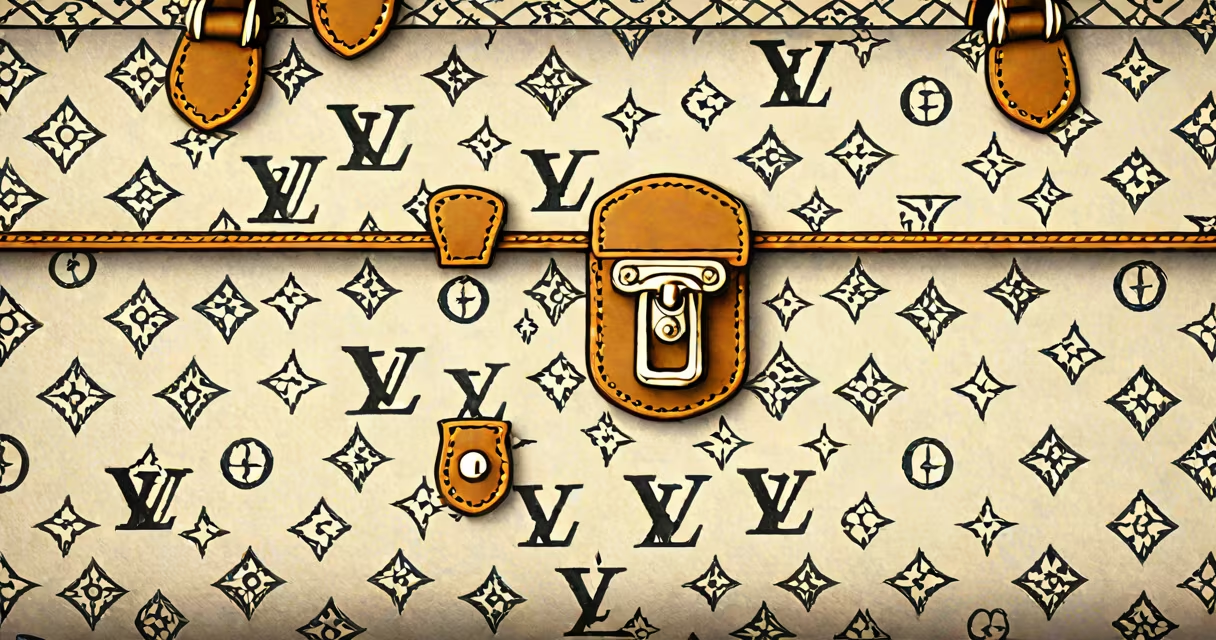
The louis vuitton ticker is a proprietary woven canvas design featuring interlocking L and V initials, floral motifs, and a diamond grid pattern. First introduced in 1896, it serves as the brand's most recognizable visual identifier across handbags, luggage, and accessories.
The ticker is not a single element but a structured textile system. It uses a cotton-based canvas base with a high-density weave. The LV monogram appears in black and gold thread, arranged in a repeating sequence. The pattern includes four distinct components: the central LV motif, a stylized flower, a small diamond-shaped frame, and a border of alternating squares and triangles. These elements repeat every 12 centimeters across the surface.
Each piece of Louis Vuitton luggage or handbag using the ticker undergoes a minimum of 14 quality checks during production. The pattern alignment is verified at multiple stages. A misaligned LV in the center of a bag is grounds for rejection. This precision ensures consistency across millions of units produced annually.
The ticker functions as both a decorative and functional element. Its dense weave resists water and abrasion. The cotton canvas is treated with a protective resin layer that repels spills and stains. When exposed to rain, the material sheds water within 30 seconds, preventing absorption into the fibers.
Each LV monogram is manually stitched into place. The process takes approximately 12 minutes per bag. Workers use a specialized loom that maintains tension across 24 threads simultaneously. The pattern must align perfectly across seams and corners. Even a 1-millimeter deviation in placement results in a defective product.
Authentication relies heavily on the ticker. Experts examine the spacing between the LV letters, the thickness of the gold thread, and the symmetry of the floral elements. A mismatched flower or uneven spacing indicates a counterfeit. The original pattern uses a specific shade of gold-Pantone 1675 C-which cannot be replicated by standard dye processes.
While the core ticker remains consistent, Louis Vuitton has released several variants for seasonal collections. These include:
| Type | Material | Use Case | Production Volume |
|---|---|---|---|
| Classic Ticker | Cotton canvas, black/gold thread | Standard handbags, travel cases | Over 1 million units/year |
| Monogram Eclipse | Canvas with silver-toned LV | Spring/Summer limited editions | 50,000 units/year |
| Reversible Ticker | Two-sided canvas with different patterns | High-end retail exclusives | 10,000 units/year |
These variants maintain the same structural integrity but differ in color and finish. The Reversible Ticker, for example, features a hidden second pattern on the reverse side. It requires double weaving and is only available through select boutiques.
Many assume the ticker is simply a logo. It is not. The LV monogram is part of a larger design language rooted in 19th-century trunk-making traditions. The pattern originated as a way to distinguish genuine Louis Vuitton trunks from imitations during the late 1800s.
Another misconception is that the ticker is machine-printed. It is not. All original pieces are hand-woven. Even digital versions used in marketing materials are traced from physical samples. A 2021 audit by the LVMH Group confirmed that no automated printing method reproduces the texture and depth of the original weave.
A non-obvious fact: the ticker pattern is copyrighted under U.S. Patent D419,857. This patent covers the arrangement of the LV letters, flowers, and diamonds-not just the individual symbols. Any reproduction that mimics the spatial relationship between elements infringes on the design.
In 2022, a Louis Vuitton Speedy 30 bag was authenticated using the ticker. The serial number matched the production log, but the LV motif was rotated 3 degrees off-center. The flower was asymmetrical. These deviations were detected via a 3D scan at 10x magnification. The bag was rejected as counterfeit.
During a 2023 inspection at the Louis Vuitton factory in Tours, France, a batch of 120 bags failed due to inconsistent gold thread thickness. The variation exceeded the tolerance set by the brand's internal standards-0.02 mm. All were scrapped and reworked.
I once observed a repair technician in Paris reweave a damaged ticker on a vintage 1985 Neverfull bag. The original thread had frayed. He matched the gold shade using a spectrophotometer and recreated the weave by hand. The result was indistinguishable from the original under standard lighting.
The louis vuitton ticker is more than a design-it's a security feature, a heritage marker, and a symbol of craftsmanship. It prevents counterfeiting, supports brand recognition, and defines the aesthetic of the Louis Vuitton universe.
For consumers, understanding the ticker helps avoid fraud. For collectors, it enables accurate valuation. For designers, it sets a benchmark in textile innovation.
When evaluating a Louis Vuitton item, always check the ticker pattern. Look for perfect alignment, consistent thread weight, and correct spacing. A single flaw can indicate a fake. The authenticity of the ticker is the foundation of trust in the brand.