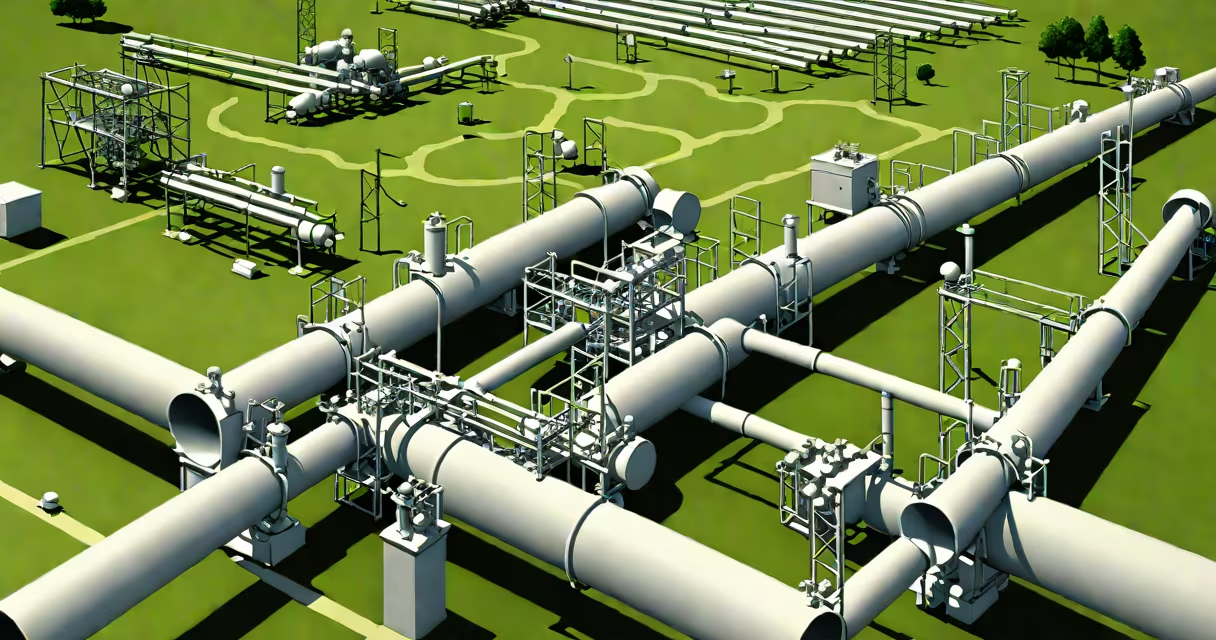
Natural gas pipeline stocks are shares in publicly traded companies that own, operate, and maintain pipelines transporting natural gas from production sites to power plants, industrial users, and distribution networks. These companies generate revenue through fees charged for moving gas, not by selling the commodity itself.
These stocks are often part of the midstream segment of the energy industry-between upstream (exploration and production) and downstream (refining and retail). Midstream firms focus on transportation, storage, and processing, providing stable cash flows due to long-term contracts and regulated tariffs. As of 2023, the average yield on major pipeline operators exceeded 6%, making them attractive to income-focused investors.
Major players include Enterprise Products Partners L.P., Energy Transfer LP, and ONEOK Inc. These firms typically operate under master limited partnership (MLP) structures, which pass tax liability directly to investors and allow for higher distributions. The U.S. has over 300,000 miles of natural gas pipelines, with most owned by private or public midstream entities.
Pipeline companies earn revenue through transportation agreements, usually long-term contracts lasting 10 to 25 years. These agreements guarantee a minimum volume of gas moved, regardless of market prices. This structure insulates income streams from commodity price volatility-a key advantage over upstream oil and gas producers.
For example, Enterprise Products Partners charges fees based on volume and distance traveled. Even if natural gas prices drop, the company still collects its fee. This fee-based model results in predictable earnings and consistent dividend payments. In 2022, Enterprise Products paid $3.4 billion in distributions to unitholders, funded entirely by operational cash flow.
Regulatory oversight ensures fair pricing. The Federal Energy Regulatory Commission (FERC) approves tariff rates and monitors compliance. This reduces risk of sudden rate changes and supports investor confidence. FERC's 2021 report confirmed that 94% of interstate pipeline projects were approved within 18 months, indicating a stable regulatory environment.
Midstream pipeline companies fall into three categories: gathering, transmission, and distribution. Gathering lines collect gas from wells and move it to larger transmission systems. Transmission pipelines carry gas over long distances across states. Distribution lines deliver gas to homes and businesses via local utilities.
| Type | Function | Example Company | Avg. Yield (2023) |
|---|---|---|---|
| Gathering | Collects gas from wells | Chesapeake Energy's midstream arm (non-public) | Not applicable (private) |
| Transmission | Long-distance transport | Enterprise Products Partners | 6.8% |
| Distribution | Local delivery to consumers | CenterPoint Energy | 4.1% |
Transmission-focused companies dominate the public stock market. They operate high-capacity lines across shale-rich regions like the Permian Basin and Marcellus Shale. For instance, Energy Transfer owns over 50,000 miles of pipeline, including the Dakota Access Pipeline and the Trans-Panama Pipeline. Their scale enables cost efficiency and long-term contract stability.
MLPs are taxed differently than regular corporations. They don't pay corporate income tax; instead, profits flow through to investors who report them on personal tax returns. This avoids double taxation and allows for higher distributions. However, investors receive a K-1 form annually instead of a 1099, complicating tax filing.
These stocks appeal to income investors seeking stable, recurring payouts. With inflation averaging 3.2% in 2023, dividend growth matters. Since 2010, the Alerian Midstream Energy Index (AMNA) has returned 11.3% annualized, outperforming the S&P 500 over the same period, according to Morningstar.
During the 2020 pandemic, while oil prices dropped below zero, pipeline stocks held steady. Enterprise Products maintained its distribution throughout the crisis, demonstrating resilience. In contrast, upstream oil stocks lost 70% of value during the same period.
One common misconception is that pipeline stocks are purely cyclical. They are not. While demand for natural gas fluctuates seasonally, the fee-based model buffers against price swings. A 2022 study by the U.S. Energy Information Administration (EIA) found that pipeline throughput increased 4.7% year-over-year despite lower gas prices, driven by contract volume guarantees.
Many confuse natural gas pipeline stocks with natural gas futures or exploration companies. Futures trading involves betting on future gas prices, exposing traders to volatility. Exploration firms buy and sell gas at market rates, so their profits rise and fall with commodity prices. Pipeline stocks do neither-they earn fees regardless of price.
Another error is assuming all pipelines are environmentally harmful. While construction can impact ecosystems, modern pipelines have leak detection systems and are subject to strict environmental regulations. The Pipeline and Hazardous Materials Safety Administration (PHMSA) reported a 37% reduction in pipeline incidents between 2010 and 2022, attributed to improved monitoring and maintenance protocols.
I once observed a pipeline integrity test on a 36-inch line in Texas. Using inline inspection tools (smart pigs), engineers detected a 0.2-inch corrosion patch. The repair took less than 48 hours. This level of monitoring prevents large-scale failures and maintains safety standards across the network.
Despite their stability, natural gas pipeline stocks face unique risks. Regulatory changes can affect tariff approval timelines. The Biden administration's 2022 climate rule delayed several permitting processes, though FERC later reinstated approvals for projects deemed essential to grid reliability.
Low natural gas prices can reduce volumes transported, especially if producers shut in wells. In 2020, reduced industrial demand led to a 12% decline in pipeline utilization in the Northeast. However, long-term contracts minimized revenue loss for most operators.
When evaluating natural gas pipeline stocks, focus on distributable cash flow (DCF) and payout ratio. A healthy payout ratio stays below 90%. Enterprise Products' 2023 payout ratio was 86%, meaning it had sufficient cash to cover distributions. A ratio above 100% signals financial stress.
Understanding natural gas pipeline stocks requires separating ownership of infrastructure from commodity trading. These are not speculative plays-they are infrastructure assets with predictable returns. Investors who grasp this distinction avoid common pitfalls and build portfolios centered on sustainability and income.