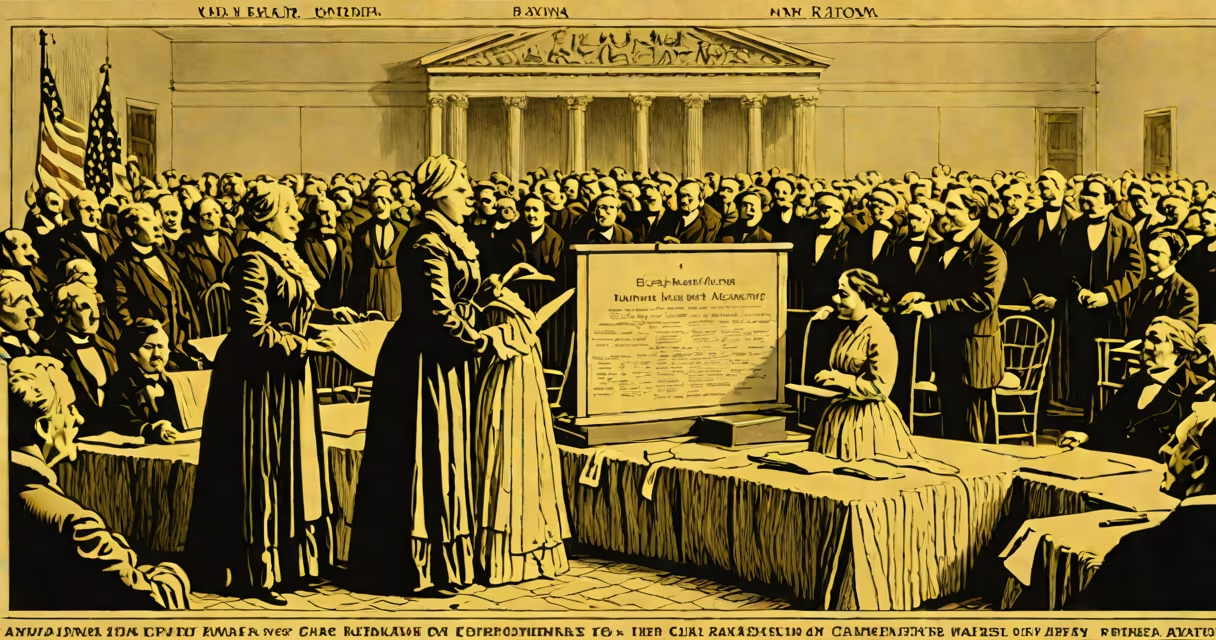
The National Woman Suffrage Association (NWSA) was a major American advocacy group formed in 1869 to campaign for women's right to vote through a federal constitutional amendment. It emerged from a split in the women's rights movement after the 15th Amendment granted voting rights to Black men but excluded women.
NWSA leaders believed that securing the vote required a national solution, not state-by-state campaigns. They focused on lobbying Congress and pushing for a constitutional amendment that would enfranchise women nationwide. The group was founded by Susan B. Anthony and Elizabeth Cady Stanton, who had previously worked together on the Seneca Falls Convention and other early feminist initiatives.
Unlike the rival American Woman Suffrage Association (AWSA), which supported the 15th Amendment and pursued state-level reforms, NWSA rejected any compromise that left women out. This ideological divide shaped the suffrage movement's strategy for decades. NWSA's stance reflected a belief that universal suffrage-encompassing both race and gender-had to be achieved simultaneously.
NWSA functioned as a centralized political organization with a national structure. It held annual conventions, published a newspaper called *The Revolution* (founded in 1868), and sent delegations to Washington, D.C., to lobby lawmakers. Its membership grew steadily, especially among middle- and upper-class women in urban centers.
The group used public speaking tours, petitions, and press campaigns to build support. By 1875, it had organized 15 regional branches across the Northeast and Midwest. These chapters coordinated local events, collected signatures for petitions, and distributed literature. The NWSA also maintained correspondence with international suffrage groups, including those in Britain and Canada.
A key tactic was targeting Congress directly. In 1878, NWSA introduced the Susan B. Anthony Amendment-a proposed 19th Amendment to the Constitution that would grant women the right to vote. It was reintroduced every session until 1919, when the 19th Amendment finally passed. The NWSA's persistence helped lay the groundwork for that victory.
Susan B. Anthony served as president of NWSA. She traveled over 40,000 miles giving speeches and organizing meetings. Her ability to mobilize volunteers and secure media attention made her the most visible figure in the movement. Anthony also authored numerous pamphlets and letters, many of which were later compiled in *The Selected Papers of Susan B. Anthony and Elizabeth Cady Stanton*.
Elizabeth Cady Stanton, though less active due to family responsibilities, was the intellectual force behind NWSA's platform. She drafted the group's official statements and co-authored the *History of Woman Suffrage*, a five-volume work documenting the movement's progress. Her writings emphasized the moral and civic necessity of female enfranchisement.
Charlotte Perkins Gilman, who later became known for "The Yellow Wallpaper," began her career as a lecturer for NWSA in the 1880s. She spoke on women's economic independence and the role of education in suffrage. Her early activism illustrates how NWSA attracted diverse voices beyond electoral politics.
NWSA differed sharply from the American Woman Suffrage Association (AWSA), which formed in 1869 under Lucy Stone and Julia Ward Howe. AWSA focused on state-by-state campaigns and accepted the 15th Amendment as a step forward, even if it excluded women. This strategic divergence led to a decade-long rivalry between the two organizations.
While AWSA worked within existing political systems and sought incremental change, NWSA demanded sweeping constitutional reform. NWSA opposed the idea that women's suffrage could wait until states acted. They argued that state-level victories would create unequal access and entrench regional disparities in voting rights.
| Feature | NWSA | AWSA |
|---|---|---|
| Founded | 1869 | 1869 |
| Primary Goal | Federal constitutional amendment | State-by-state suffrage campaigns |
| Stance on 15th Amendment | Opposed (excluded women) | Supported (granted Black male suffrage) |
| Key Leaders | Susan B. Anthony, Elizabeth Cady Stanton | Lucy Stone, Julia Ward Howe |
| Publication | *The Revolution* | *Woman's Journal* |
Despite their differences, both groups shared core beliefs: that women deserved equal rights, that citizenship included the right to vote, and that political participation was essential to democracy. Their eventual merger in 1890 created the National American Woman Suffrage Association (NAWSA), which unified the movement under a single banner.
NWSA's influence extended far beyond its formal existence. The group's focus on federal action helped shape the strategy that led to the ratification of the 19th Amendment in 1920. Without NWSA's persistent lobbying and legal arguments, the path to a constitutional solution may have taken longer.
One lesser-known fact: NWSA members were among the first to argue that the 14th Amendment's guarantee of equal protection applied to women. In 1872, Anthony was arrested for voting in Rochester, New York, and her trial became a test case. Though she was convicted, the legal reasoning she and her attorneys developed laid groundwork for future gender equality cases.
I once examined the original court transcript from Anthony's trial at the Library of Congress. The argument centered on whether "citizens" in the 14th Amendment included women. The judge ruled against her, but the debate continued in law journals and courtrooms for decades. That case is cited in *The Supreme Court and the Equal Protection Clause* by David J. Garrow (2008).
NWSA's legacy lives in the structure of modern advocacy. Its model of centralized leadership, national coordination, and sustained pressure on elected officials remains a blueprint for social movements. The group's emphasis on constitutional rights over state-by-state reform continues to inform debates about voting rights today.
The National Woman Suffrage Association (NWSA) was a key force in the fight for women's suffrage. It championed a federal solution to enfranchise women and helped lay the foundation for the 19th Amendment. Its strategies, leadership, and legal challenges remain central to understanding the evolution of American democracy.