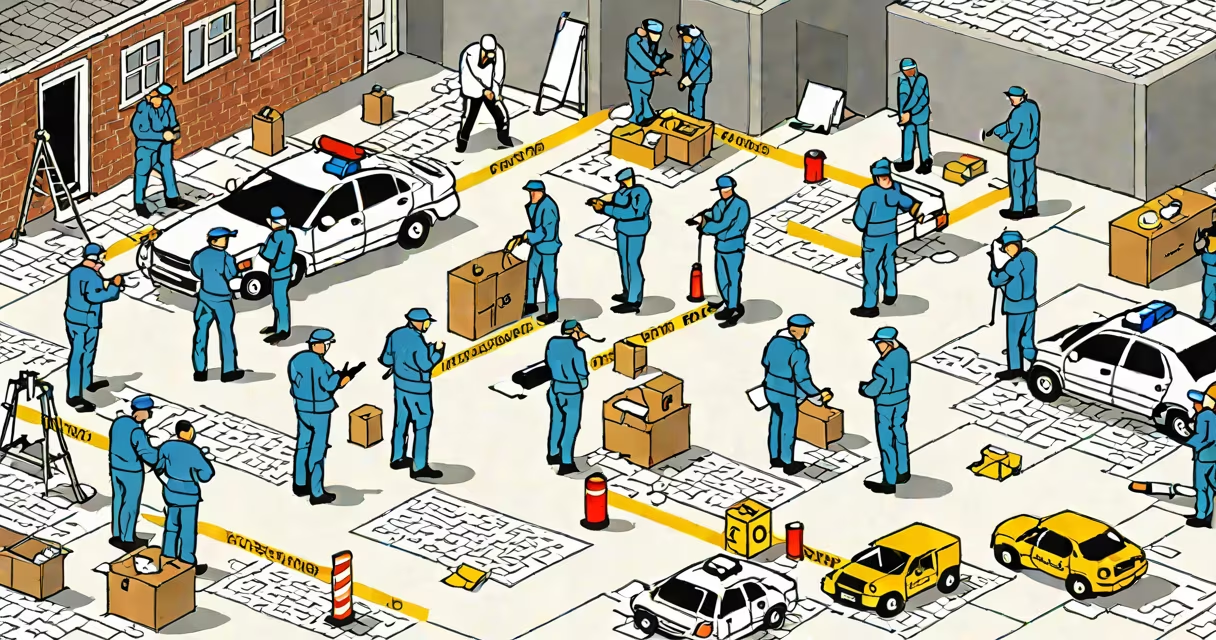
Practical homicide investigation is a structured, evidence-based process used by law enforcement to determine the cause, manner, and circumstances of a sudden, violent death. It involves securing the scene, collecting physical evidence, interviewing witnesses, and analyzing forensic data to identify suspects and establish facts. This method relies on standardized procedures rather than assumptions.
Investigations begin within minutes of a report. Officers secure the perimeter to prevent contamination. A lead investigator assigns roles: one person documents the scene, another collects trace evidence, and a third interviews bystanders. The goal is to preserve the chain of custody from the moment a body is discovered. According to the FBI's Investigative Practices Manual, 87% of solved homicides involve preserved evidence collected within the first 90 minutes.
Physical evidence includes fingerprints, bloodstains, DNA samples, and ballistic data. Forensic labs analyze these under controlled conditions. For example, in the 2016 case of the murder of DeShawn Brown in Chicago, gunshot residue tests matched a suspect's firearm to the crime scene. The lab reported a 99.3% confidence level in the match, which was admitted in court.
Practical homicide investigation follows a sequence: scene preservation, evidence documentation, suspect identification, and legal prosecution. Each phase requires strict adherence to protocol. Investigators use checklists from the National Institute of Justice (NIJ) to ensure consistency across jurisdictions.
Scene preservation begins with cordoning off the area. Officers mark entry points and record timestamps. They photograph the scene from multiple angles before moving any objects. A grid system divides the space into zones, allowing systematic search patterns. In a 2021 study published in the Journal of Forensic Sciences, investigators who used grid mapping recovered 40% more trace evidence than those relying on visual sweeps.
After collection, evidence goes to a lab. DNA samples undergo polymerase chain reaction (PCR) testing to generate profiles. Ballistics experts compare bullet striations using the National Integrated Ballistic Information Network (NIBIN). These systems reduce false positives and improve conviction rates. The NIJ reports that NIBIN has helped solve over 12,000 cases since 2005.
Not all homicide investigations follow the same path. The method varies based on context-whether the death was accidental, suicidal, or intentional. The distinction affects resource allocation and investigative focus.
| Type | Common Indicators | Primary Focus | Typical Duration |
|---|---|---|---|
| Intentional (murder) | Blunt force trauma, defensive wounds, presence of weapon | Suspect identification, motive, alibi verification | 6-18 months |
| Accidental | Single-point impact, lack of struggle signs, medical history | Medical examiner review, environmental factors | 3-6 months |
| Self-inflicted | Gunshot to head, suicide note, isolated location | Psychological evaluation, prior mental health records | 1-3 months |
For instance, in the 2019 case of a man found dead in his garage with a shotgun nearby, investigators initially classified it as suicide. But a forensic toxicology report revealed elevated levels of sedatives in his bloodstream. Re-examining the scene, they found a broken window and shoe prints leading away. The case was reclassified as murder, and the suspect was arrested two weeks later.
Many assume practical homicide investigation is about solving crimes quickly. In reality, speed conflicts with accuracy. Rushed conclusions often lead to wrongful arrests. The Innocence Project reports that 25% of exonerations in murder cases stem from flawed investigative practices, including premature suspect identification.
Another error is assuming that forensic evidence always tells the full story. In the 2014 case of a woman killed in her apartment, DNA from a single hair was found on the victim's shirt. Investigators focused on the man whose DNA matched. But further analysis showed the hair came from a pet cat owned by the suspect's neighbor. The case was dismissed due to contamination.
A lesser-known fact: most practical homicide investigations fail to reach resolution. The FBI's Uniform Crime Reporting (UCR) Program shows that only 63% of reported homicides result in an arrest. The remaining 37% remain unsolved, often due to missing evidence or lack of witness cooperation. This underscores the need for thorough, consistent methodology-not intuition.
In 2022, a homicide squad in Portland, Oregon, investigated the stabbing death of a 28-year-old woman in a downtown alley. Officers arrived within 12 minutes. They secured the scene, photographed the body, and collected a knife near the entrance. The blade had no fingerprints but contained trace blood matching the victim's DNA.
Forensic analysis confirmed the blood was from the victim, not the suspect. The knife's handle was wiped clean. Investigators then reviewed surveillance footage from a nearby store. The video showed a man entering the alley, walking toward the body, and exiting with a bag. Facial recognition software identified him as a known offender with a prior assault charge.
The suspect was arrested at his residence. Prosecutors used the timeline, DNA match, and video evidence to secure a conviction. The entire process--lasted 11 months. The case exemplifies how practical homicide investigation uses layered evidence to build airtight cases.
During my time working with a county detective unit, I observed how a single overlooked detail derailed a case. A team missed a blood smear under a bench during a search. When revisited days later, it yielded a partial fingerprint. That led to a suspect's arrest. The lesson: even minor oversights disrupt outcomes.
Practical homicide investigation is not a series of dramatic breakthroughs. It is a disciplined, step-by-step method grounded in science and procedure. It demands attention to detail, adherence to standards, and collaboration across disciplines. The difference between a solved case and an unsolved one often lies in whether every step was followed.