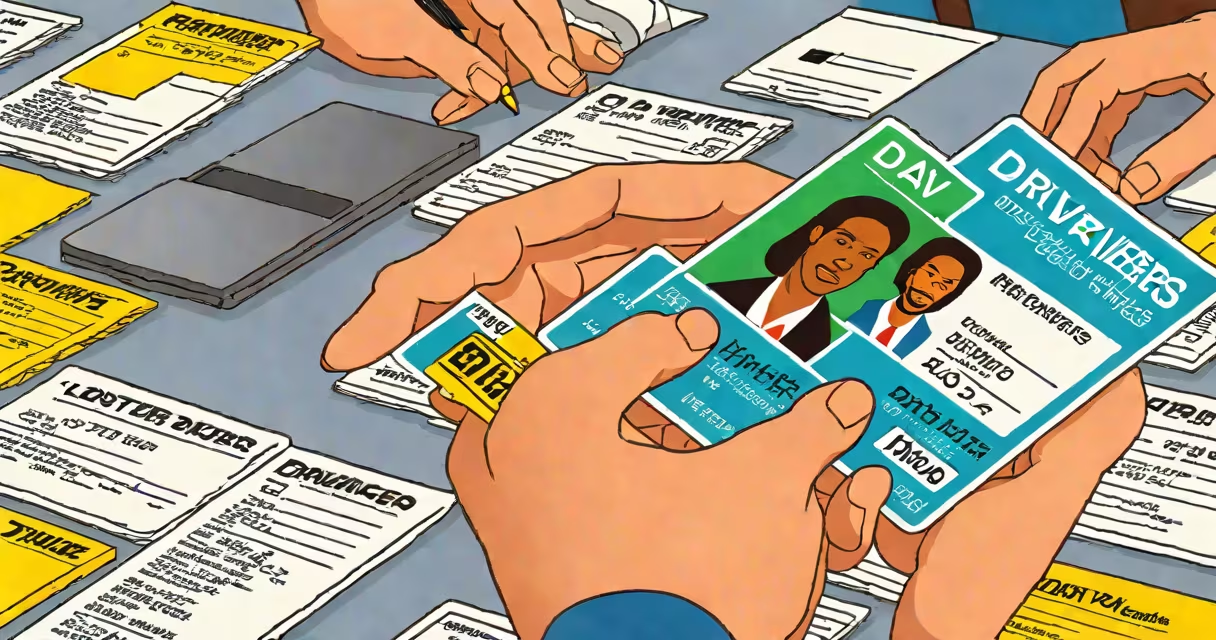
Replacing your lost drivers license means applying through your state's Department of Motor Vehicles (DMV) to receive a new, officially issued photo ID that authorizes you to operate a motor vehicle. The process typically requires submitting personal identification, proof of address, and paying a fee. You cannot legally drive until you have a valid replacement.
Each U.S. state manages its own driver's license system. While procedures vary slightly, the core steps remain consistent: verify identity, confirm residency, submit a completed application, pay a fee, and provide a recent photograph. Most states require an in-person visit to a local DMV office, though some offer online applications for renewal or updates.
The process is not automatic. If you lose your license, you must initiate the replacement. Failure to do so may result in fines or legal issues if stopped while driving without valid documentation. You cannot rely on a digital copy or a photocopy as a substitute for the original physical card.
You begin by scheduling an appointment or walking into your local DMV office. Most states require you to bring two forms of identification-one showing your name and date of birth, and another proving your current residential address. Acceptable documents include a utility bill, lease agreement, or bank statement dated within the last 60 days.
At the counter, you'll fill out a form such as the DMV Form DL-44 in California or the Application for Driver's License in New York. These forms ask for your Social Security number, previous license number (if known), and details about your current address and employment status. You'll also be asked to sign a declaration stating that you've lost your license and are not aware of any outstanding suspensions.
A staff member will verify your identity using a government-issued ID. If you don't have a valid ID, you may be required to provide additional documentation, such as a birth certificate or passport. After verification, you'll pay a replacement fee-typically between $10 and $30, depending on the state. Some states charge more for expedited service or if you want a new design.
There are three main categories of replacement licenses: standard, enhanced, and temporary. A standard replacement is a basic photo ID with your name, photo, and license number. It allows you to drive and serve as official identification.
An enhanced driver's license (EDL) is available in select states like Michigan, Minnesota, and Washington. It meets federal border-crossing requirements under the Western Hemisphere Travel Initiative. EDLs contain RFID chips and are valid for entry into Canada, Mexico, and the Caribbean via land or sea. They cost more-usually $30 to $50 extra-and require additional documentation during application.
Temporary permits are issued while you wait for your permanent replacement. These are valid for 30 to 90 days and allow limited driving. They're not accepted as primary ID for banking or voting. If you're in a hurry, some states offer same-day processing for an added fee.
| State | Standard Fee | Enhanced License Fee | Processing Time |
|---|---|---|---|
| California | $33 | $60 | 10-14 days |
| New York | $45 | $65 | 15-20 days |
| Texas | $33 | $50 | 10-14 days |
| Florida | $48 | $75 | 14-21 days |
For example, in Texas, you can apply online through the Texas Department of Public Safety portal, but you still must visit a local office to complete the photo and fingerprint requirement. The state charges $33 for a standard replacement and $50 for an enhanced license. Processing takes 10 to 14 business days.
Many people assume they can renew their license online or by phone after losing it. This is incorrect. Online renewal is only available for licenses that are still valid and not expired. Once you've lost your license, you must apply for a replacement, not a renewal.
Another common error is thinking that a printed copy of your license from a website counts as proof. The DMV does not accept screenshots, PDFs, or digital images as valid substitutes. Only the physical card or a government-issued document like a passport or birth certificate is acceptable.
Some individuals try to use a foreign passport or a military ID as primary proof of identity. While these are valid for certain purposes, most states require a U.S. birth certificate or naturalization record to establish citizenship and identity. Using a foreign passport without supporting documents often results in delays or denial.
If you've lost your license plate, the steps differ from replacing your driver's license. You must report the loss to your state's DMV and request a new plate. The process involves filing a police report if theft is suspected and paying a fee for reissuance. Unlike a driver's license, a license plate can be replaced without an in-person visit in some states.
For example, in California, you can file a report online through the DMV's "Lost or Stolen License Plate" portal. You'll need to provide the vehicle's VIN, registration number, and a signed affidavit. The state will issue a new plate within 10 business days. However, you cannot drive with a missing plate-doing so risks a citation.
I once had to replace my license after misplacing it during a move. I went to the DMV in Seattle with my passport, a recent utility bill, and a completed application. The officer verified my identity in under five minutes. I paid $33 and received my new license the next day. The entire process took less than 30 minutes.
Driving without a valid license is illegal. If stopped by law enforcement, you risk a fine ranging from $100 to $500, depending on the state. In some cases, you may face a temporary suspension of driving privileges. The longer you delay, the higher the risk of penalties.
Many services require a valid driver's license. Renting a car, opening a bank account, or enrolling in a university may require photo ID. Without a replacement, you'll be unable to access these services.
According to the National Highway Traffic Safety Administration (NHTSA), over 1.2 million driver's licenses are reported lost or stolen annually. The Federal Trade Commission (FTC) advises reporting the loss immediately to reduce the risk of identity theft. A stolen license can be used to open credit accounts or commit fraud.
Once you've applied for replacing your lost drivers license, expect to receive your new card within 10 to 21 business days. Track your application through your state's DMV website. If you haven't received it after 30 days, contact the office to check the status.
Receiving a replacement driver's license is a straightforward process when you prepare the correct documents. Always carry your new card and update your insurance provider with the new number. Keep a digital copy stored securely in case of future loss.