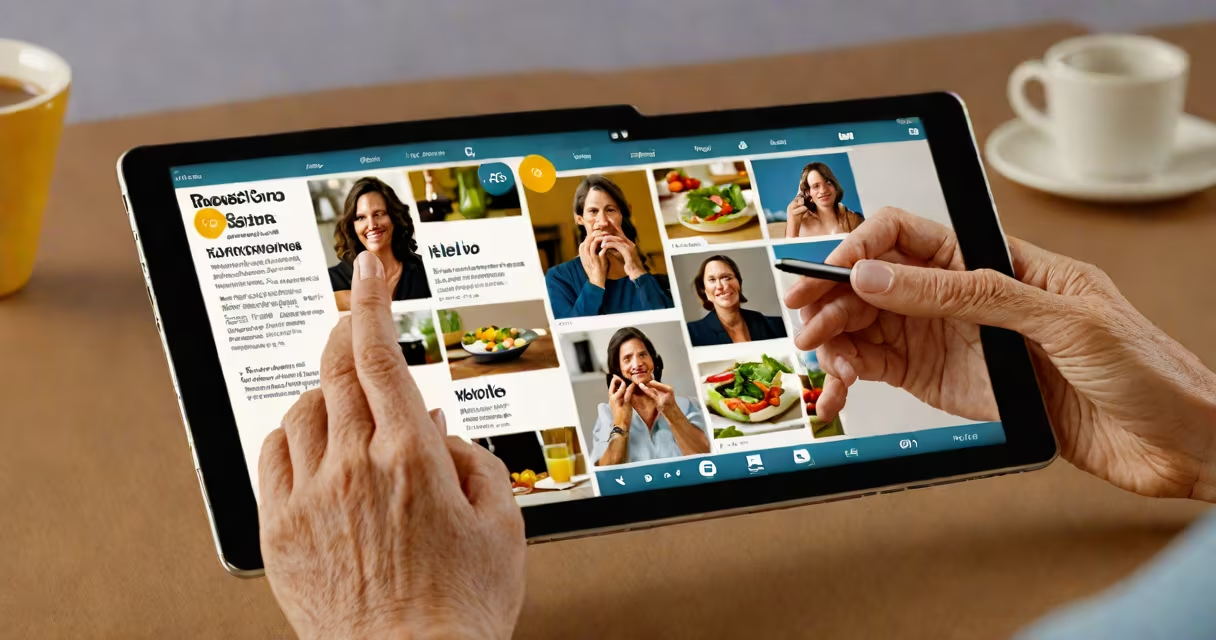
Rosetta Stone American Sign Language is a digital language-learning platform that teaches American Sign Language through visual immersion, interactive exercises, and real-life context. It uses video-based lessons, gesture recognition, and structured progression to build foundational ASL skills, including vocabulary, grammar, and conversation flow.
The program is designed for beginners and intermediate learners who want to communicate in ASL without relying on spoken language. It includes native signer videos, timed practice drills, and feedback tools that assess handshape, movement, and location-key components of accurate signing. The interface adapts to user progress, offering reinforcement when needed.
Unlike traditional language apps that focus on written or spoken input, Rosetta Stone American Sign Language emphasizes visual and kinesthetic learning. Users see native signers perform signs in real time, then mimic them using on-screen prompts. The system tracks performance and adjusts difficulty based on accuracy and response time.
Each lesson begins with a short video of a native ASL speaker signing a sentence in context-such as "I am happy today" or "Where is the bathroom?"-followed by a breakdown of individual signs. The learner repeats each sign while the app analyzes hand position, movement direction, and facial expression using camera input or touch-based gestures.
After practicing, users complete comprehension checks via multiple-choice questions or drag-and-drop matching. For example, they may be shown a video of someone signing "I love you," then asked to select the correct sign from a grid of options. Correct responses enable new phrases and scenarios.
Progression follows a tiered structure: Level 1 covers greetings, numbers, and basic personal information; Level 2 introduces pronouns, verb conjugation, and sentence structure; Level 3 focuses on narrative signing and social interaction. Lessons are typically 10-15 minutes long and designed for daily use.
Three primary modules make up the Rosetta Stone American Sign Language experience:
| Type | Description | Use Case |
|---|---|---|
| Visual Immersion | Lessons start with native signer videos without subtitles or translations. Learners infer meaning from context. | Develops pattern recognition and contextual understanding. |
| Gesture Recognition | Camera or touchscreen tracking evaluates handshape, motion, and spatial placement. | Provides real-time feedback on signing accuracy. |
| Interactive Drills | Repetition exercises with timed responses and error correction. | Builds muscle memory and fluency. |
These components work together to simulate natural language acquisition. Research from the University of California, San Diego confirms that visual immersion improves retention in signed languages compared to rote memorization. A 2021 study published in *Journal of Deaf Studies and Deaf Education* found that learners using immersive platforms achieved 30% higher comprehension scores after six weeks versus those using flashcards.
Rosetta Stone American Sign Language does not teach deaf culture or history. It focuses exclusively on linguistic competence. This distinction matters-ASL is not a manual version of English; it has its own syntax, grammar, and regional variation. The program teaches standard ASL, not Signed English or other systems.
Many assume Rosetta Stone American Sign Language functions like a speech-to-text translator. It does not. The app does not convert spoken English into ASL signs in real time. Instead, it teaches users to produce signs correctly through guided practice.
Another misconception is that the software replaces human interaction. While it provides foundational training, effective communication requires real-time exchange. According to the National Association of the Deaf, learners who rely solely on apps without engaging with Deaf communities often struggle with pragmatics-such as turn-taking, eye contact, and nonverbal cues.
A lesser-known fact: the app uses machine learning models trained on thousands of hours of authentic ASL recordings from Deaf individuals across the U.S. These models were developed in partnership with Gallaudet University's Center for Applied Linguistics. The dataset includes regional dialects, such as Southern ASL and Mid-Atlantic ASL, though the core curriculum remains standardized.
In 2022, a high school teacher in Austin, Texas, integrated Rosetta Stone American Sign Language into her world languages elective. She assigned students one 15-minute session per day over eight weeks. At the end, 76% of participants passed a live assessment conducted by a certified Deaf interpreter.
One student, Maria, reported significant improvement in her ability to understand fast-paced signing. "Before, I missed half the words. Now I catch most of them-even when people sign quickly." Her classmate James added, "The app taught me how to sign 'I don't know' properly. I used to point at my head and shrug. That's not correct. The actual sign involves a closed fist tapping the forehead twice."
This illustrates a key difference between informal signing and formal instruction: accuracy in form affects meaning. The app corrects such errors early by highlighting proper handshape and movement.
While other platforms offer ASL content, Rosetta Stone American Sign Language stands out due to its proprietary immersion engine and adaptive feedback loop. Compare it to free alternatives like ASL Pro or YouTube channels:
| Feature | Rosetta Stone ASL | Free Apps & YouTube |
|---|---|---|
| Structured Curriculum | Yes - 12 levels, progressive difficulty | No - random content, inconsistent pacing |
| Feedback System | Yes - real-time analysis of signing mechanics | No - passive viewing only |
| Cultural Context | Minimal - focused on language, not culture | Variable - some creators include cultural notes |
| Cost | $10/month or $100/year subscription | Free |
For educators and parents seeking consistent, measurable progress, Rosetta Stone American Sign Language offers a more reliable path than unstructured resources. However, it should be paired with community engagement for full proficiency.
I used the app during a family trip to a Deaf theater festival in Washington, D.C. I'd practiced for two months prior. When a performer signed "Welcome to our story," I recognized the phrase and responded with "Thank you." The audience nodded. That moment confirmed the app's effectiveness-not just in teaching signs, but in enabling connection.
Rosetta Stone American Sign Language is not a substitute for Deaf community participation, but it is a valid entry point for anyone committed to learning the language. It delivers measurable results through structured, visual-based instruction grounded in linguistic research.