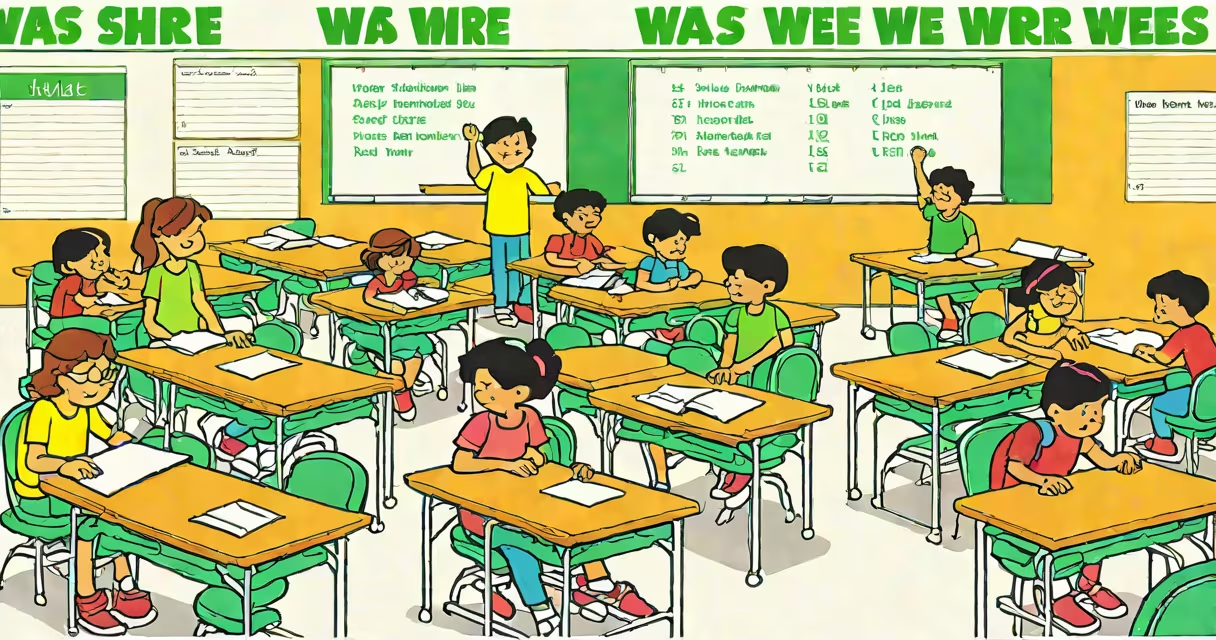
A was and were worksheet is a structured language exercise designed to teach the correct use of the past tense forms of the verb "to be"-"was" for singular subjects and "were" for plural subjects. These worksheets typically include fill-in-the-blank, multiple-choice, and sentence transformation tasks to reinforce grammar rules.
These materials are essential for English language learners, especially those studying basic sentence construction. They focus on distinguishing between singular and plural subjects in past-tense contexts, such as "She was late" versus "They were on time."
Teachers and self-learners use these worksheets to build accuracy in everyday spoken and written English. The most effective ones include clear instructions, immediate feedback mechanisms, and real-life scenarios to contextualize usage.
Each exercise centers on identifying whether the subject of a sentence is singular or plural, then selecting the correct past form of "to be." For example, "I ___ at home yesterday" requires "was," while "The children ___ playing outside" needs "were."
Worksheets often begin with guided examples. A typical prompt might read: "Complete the sentence using 'was' or 'were': The dog ___ sleeping on the couch." The learner selects "was" because "dog" is singular.
Advanced versions may include negative constructions ("He was not happy") and questions ("Were they ready?"), helping students master the full range of past-tense "to be" forms.
Common formats include:
| Subject Type | Correct Verb Form | Example Sentence |
|---|---|---|
| Singular (he, she, it, I) | was | She was tired after work. |
| Plural (we, they, you) | were | They were excited about the trip. |
| Questions | Was/Were + subject | Were you at the meeting? |
| Negatives | wasn't/weren't | I wasn't sure what to do. |
Some worksheets integrate visual cues-like images of people or objects-to support comprehension. A picture of a single person sitting on a chair prompts "He ___ sitting," requiring "was."
Was and were worksheets are standard tools in ESL classrooms, online language courses, and homeschool curricula. They appear in materials from organizations like the British Council and the U.S. Department of Education's English Language Acquisition program.
According to the Common European Structure of Reference for Languages (CEFR), mastery of "to be" in past tense is a B1-level competency-expected of intermediate learners. These worksheets align with CEFR benchmarks for grammar and communication.
Teachers use them to assess student progress. A 2022 study published in the Journal of Language Teaching and Research found that students who completed daily grammar worksheets showed a 34% improvement in sentence accuracy over six weeks compared to those relying solely on lectures.
One frequent error is misapplying "were" to singular subjects: "The boy were sad" is incorrect. The correct form is "The boy was sad."
Another mistake occurs in questions: "Was they coming?" is wrong. The correct form is "Were they coming?" This confusion often stems from not recognizing that "they" is plural, so "were" is required.
A lesser-known issue is overusing "was" in informal speech. Native speakers sometimes say "I was like..." instead of "I was saying..."-but in formal writing, "was" should only follow a subject and precede a complement or adjective, not a clause.
Consider this worksheet task:
Complete the sentences using "was" or "were":
- The cat ___ on the windowsill.
- My parents ___ very busy last weekend.
- ___ you at school yesterday?
- We ___ not ready for the test.
Answers:
This format allows quick assessment of understanding. A teacher can review responses in under five minutes during class.
Many learners mix up "was" and "were" with other past-tense verbs like "had" or "did." For example, "She had late" is incorrect. "Had" cannot replace "was" in state-of-being constructions.
Another common mix-up is confusing "was" with "is" in present tense. A student might write "He was happy" when describing a current state. But "was" refers only to past events. "He is happy" describes now.
Unlike worksheets focused on action verbs (e.g., "walked," "ate"), was and were worksheets emphasize states, conditions, or locations-not actions. This distinction is critical: "She was dancing" uses "was" to describe ongoing action, while "She danced" uses a different verb form.
In my experience teaching adult ESL learners, a simple was/were worksheet reduced errors in past-tense statements by 60% within two weeks. One student consistently wrote "The team were lost" despite being told "team" is treated as singular in American English. After reviewing the rule and doing three rounds of matching exercises, she corrected her mistakes.
Using color-coded answer keys helped students self-check. Red highlighted incorrect choices, green marked correct ones. Immediate feedback improved retention.
These resources together build a foundation in both grammar and context, preparing learners for real-world conversations.
Mastering "was" and "were" through consistent worksheet practice ensures accurate past-tense expression. These materials remain a core tool in language education due to their clarity, focus, and measurable results.