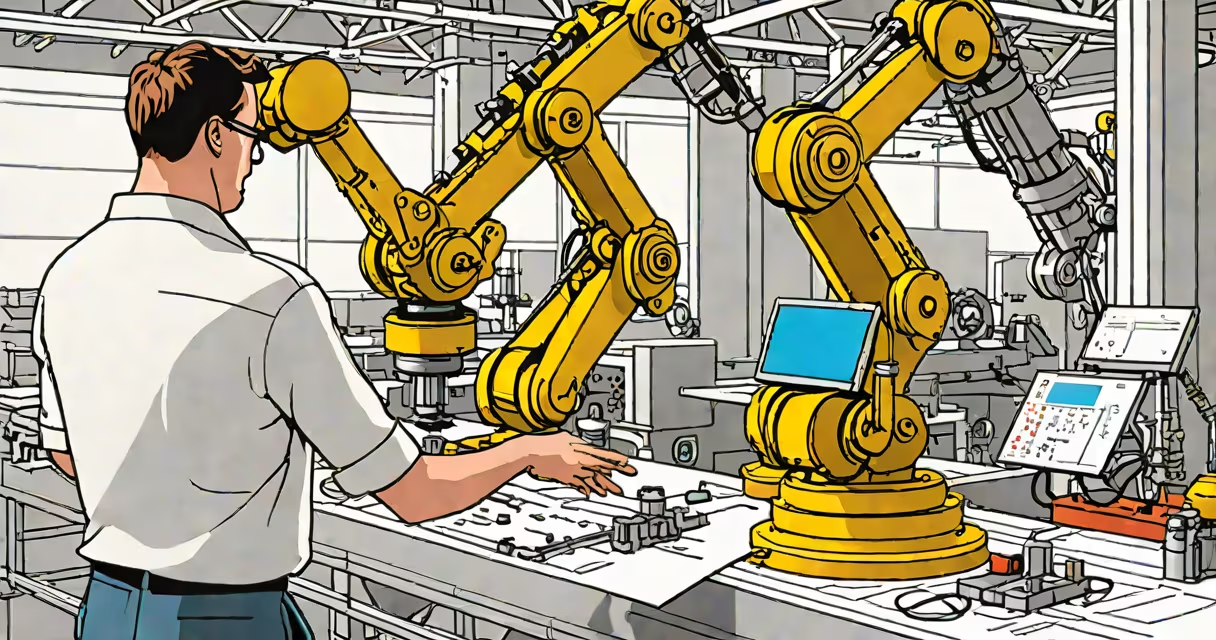
Mechanical engineering applies principles of physics, materials science, and mathematics to design, analyze, manufacture, and maintain mechanical systems. It's the core of industries ranging devices, enabling everything from electric vehicles to prosthetic limbs.
At its core, mechanical engineering solves physical problems involving motion, heat, forces, and energy transfer. Engineers in this field create machines that move, cool, lift, or convert power-systems that operate reliably under stress, over time, and in complex environments.
The discipline emerged during the Industrial Revolution but remains central to modern innovation. Today, mechanical engineers work on wind turbines, surgical robots, HVAC systems, and even space rovers. Their solutions are often invisible yet essential-like the precise tolerances in a car engine or the thermal management in a smartphone.
Every mechanical system begins with a problem: How do we move a vehicle efficiently? How do we cool a data center without wasting energy? How do we build a device that assists people with mobility?
Engineers start by defining constraints-weight, cost, durability, safety, environmental impact. They then model the system using math and simulation software such as ANSYS or SolidWorks. These tools predict how materials will deform under load, how fluids will flow, or how heat dissipates.
Once validated, prototypes are built and tested. A failed bearing in a prototype might lead to redesigns based on fatigue analysis. This iterative loop-design, simulate, test, refine-is standard practice. The goal is not perfection but reliability within real-world limits.
Most mechanical engineering projects involve four interdependent elements: structure, motion, energy conversion, and control. For example, a drone requires structural integrity (to withstand wind), moving parts (rotors), energy conversion (battery to motor), and control systems (gyroscopes and feedback loops).
Specializations allow engineers to focus deeply. Common areas include:
| Specialization | Focus Area | Example Application |
|---|---|---|
| Thermodynamics & Heat Transfer | Energy efficiency, cooling systems | Designing high-efficiency HVAC systems for green buildings |
| Mechatronics | Integration of mechanics, electronics, and software | Developing automated assembly lines in automotive plants |
| Fluid Mechanics | Flow behavior in liquids and gases | Optimizing airflow in airplane wings or blood flow in artificial hearts |
| Dynamics & Control | System response to inputs over time | Stabilizing autonomous drones using real-time sensor feedback |
These specializations aren't isolated. A modern electric vehicle combines all four: batteries (energy), motors (motion), cooling systems (heat transfer), and onboard computers (control).
Automotive engineering is one of the most visible applications. Mechanical engineers design engines, transmissions, suspension systems, and crash safety features. Tesla's Model S, for example, relies on mechanical engineers to integrate battery packs into chassis structures while maintaining weight distribution and crashworthiness.
In healthcare, mechanical engineering enables life-saving tools. The da Vinci Surgical System-a robotic platform used in minimally invasive surgery-was developed by mechanical engineers who designed precision actuators, kinematic arms, and force-feedback controls. According to the FDA, over 1 million procedures have used this system since 2000.
Renewable energy is another major domain. Wind turbines require mechanical engineers to design blades that withstand extreme weather, gearboxes that transmit torque efficiently, and yaw systems that keep rotors facing the wind. GE Renewable Energy reports that their Haliade-X offshore turbine generates 14 MW-enough to power 14,000 homes-thanks to advanced mechanical design.
Even consumer products depend on mechanical engineering. Think of a smartphone's vibration motor, which uses a tiny rotating mass to create tactile feedback. Apple's Taptic Engine uses micro-scale mechanical components to deliver precise haptic responses, engineered to feel distinct across different actions.
Many assume mechanical engineering is limited to building machines or fixing cars. But it extends far beyond traditional manufacturing. A mechanical engineer might develop algorithms for optimizing robot paths in warehouses, or study biomechanics to improve joint implants.
Another misconception is that mechanical engineers only work with metal. While metals dominate industrial contexts, modern mechanical systems increasingly use composites, polymers, and smart materials. Shape-memory alloys, for instance, contract when heated-used in medical stents that deploy inside blood vessels.
A lesser-known fact: mechanical engineering plays a key role in climate resilience. Engineers design storm-resistant infrastructure, such as flood barriers with moving gates controlled by hydraulic systems. The Netherlands' Delta Works project, which protects 1.5 million people from North Sea flooding, includes mechanical systems that automatically close floodgates during storms.
I once worked on a student-led project to design a low-cost water pump for rural communities in Kenya. We used a hand-crank mechanism powered by human motion. The challenge was balancing output pressure with ease of use. After testing five prototypes, we settled on a piston-based design with a spring-loaded valve-calculated to deliver 2 liters per minute at 60 cranks per minute.
We measured performance using a calibrated pressure gauge and timing device. The final unit weighed under 2 kilograms and cost less than $30 to produce. It was later adopted by a local NGO and deployed in three villages. That experience showed me how mechanical engineering translates theory into tangible impact-especially when constrained by budget and environment.
What can you do with mechanical engineering? The answer spans from designing spacecraft to improving access to clean water. It's a field where theory meets hands-on creation, and where solving physical problems leads to lasting change.