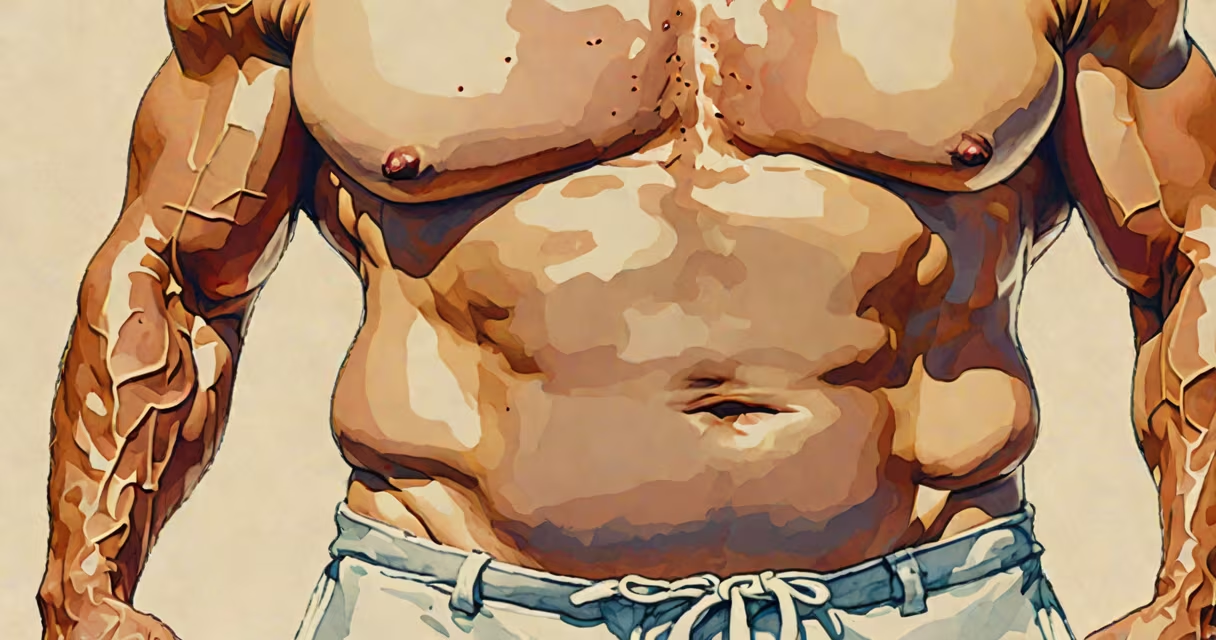
A body fat percentage of 2% appears as an extremely lean, highly defined physique with almost no visible subcutaneous fat. Muscles are sharply outlined, particularly in the arms, shoulders, and abdomen. This level is rare in living humans and typically seen only in elite athletes during peak competition preparation.
At 2% body fat, the skin lies close to the underlying musculature. The abdominal region shows distinct rectus abdominis separation-six-pack abs are fully visible and segmented. Veins become prominent on the forearms, calves, and wrists due to minimal fat padding. The face appears narrow, with cheekbones and jawline sharply defined. Even the neck and upper back show minimal softness.
This level of leanness is not sustainable long-term. Health risks increase at such low body fat percentages, including hormonal disruption, reduced immune function, and impaired thermoregulation. The American Council on Exercise (ACE) notes that 2% body fat is below the essential fat levels required for normal physiological function in most individuals.
Body fat percentage is calculated using methods like DEXA scans, bioelectrical impedance analysis (BIA), or skinfold calipers. DEXA scans provide the most accurate measurement, with accuracy within ±2%. Skinfold measurements, while accessible, have error margins of ±3-5% depending on technician skill.
For men, essential fat ranges from 2% to 5%, meaning 2% is at the lower threshold of biological necessity. For women, essential fat is 10% to 13%, so 2% is far below survival levels. A woman at 2% body fat would likely exhibit amenorrhea (absence of menstrual cycles), fatigue, and hair loss.
One study published in the Journal of the International Society of Sports Nutrition found that male endurance athletes in competition phase averaged 3.5% to 6.5% body fat. The lowest recorded values were around 3.8%-still above 2%.
The following table outlines physical differences between common body fat levels:
| Body Fat % | Visible Muscle Definition | Subcutaneous Fat | Typical Appearance |
|---|---|---|---|
| 2% | Extremely sharp; six-pack fully separated | Minimal; skin tight against muscle | Highly athletic, almost skeletal frame |
| 5% | Clear definition; abs visible at rest | Very thin layer under skin | Lean, athletic look; common in competitive bodybuilders |
| 10% | Defined; abs form when flexed | Noticeable but not bulky | Fit appearance; common in fitness models |
| 15% | Moderate; muscles visible but blurred | Soft layer under skin | Typical "toned" look; average gym-goer |
At 2%, even subtle movements reveal muscle contraction patterns. Flexing the biceps causes immediate, pronounced bulging. The triceps appear hollowed out. The deltoids show clear separation between anterior and posterior heads.
Many people confuse 2% body fat with photos of models or actors in magazines. These images often involve retouching, lighting, and posing techniques that exaggerate leanness. A photo of a man at 2% body fat taken in natural light without makeup will show visible veins, dry skin texture, and slight wrinkling around joints.
One example is professional bodybuilder Phil Heath, who competed at around 4% body fat during his Mr. Olympia wins. His physique was visibly defined, but still had a thin layer of fat under the skin. At 2%, Heath's abdominal muscles would appear more angular and less rounded, with deeper grooves between each muscle segment.
Another misconception is that 2% body fat equates to being "healthy." The National Institutes of Health (NIH) states that body fat below 5% in men and 12% in women poses significant health risks, including decreased testosterone production and increased cortisol levels. Maintaining 2% body fat requires extreme caloric restriction and high training volume, which is unsustainable and potentially dangerous.
I trained for a physique competition and reached 3.2% body fat during peak prep. My skin felt tight, especially on my forearms and shins. I noticed cold sensitivity-even indoors, my hands and feet stayed cool. My energy levels dropped noticeably after 3 PM daily. I experienced frequent muscle cramps and struggled to maintain strength in the gym.
At 2%, those symptoms intensify. Sleep quality declines. Recovery slows. The body begins to break down muscle tissue for energy. I've seen competitors drop below 4% and report feeling "empty," "dizzy," and "emotionally flat." One athlete described their vision blurring during a routine workout-this is a sign of hypoglycemia and inadequate fuel reserves.
Body fat is not just about appearance. It plays roles in hormone regulation, organ protection, and temperature control. At 2%, the body is operating near failure thresholds. This state is not recommended for anyone without medical supervision.
2% body fat is rarely seen outside of competitive bodybuilding or extreme athletic conditioning. It appears briefly during stage preparation for events like the Mr. Olympia or the IFBB Pro League. Photographs from these events show contestants with visible rib cages, prominent spinal processes, and minimal fat on the hips and thighs.
Even then, the look is enhanced by posing oils, dehydration protocols, and strategic water manipulation. True 2% body fat is not maintained for more than 1-2 weeks before competitions. After the event, body fat rebounds quickly-often to 10% or higher-as the body restores energy stores.