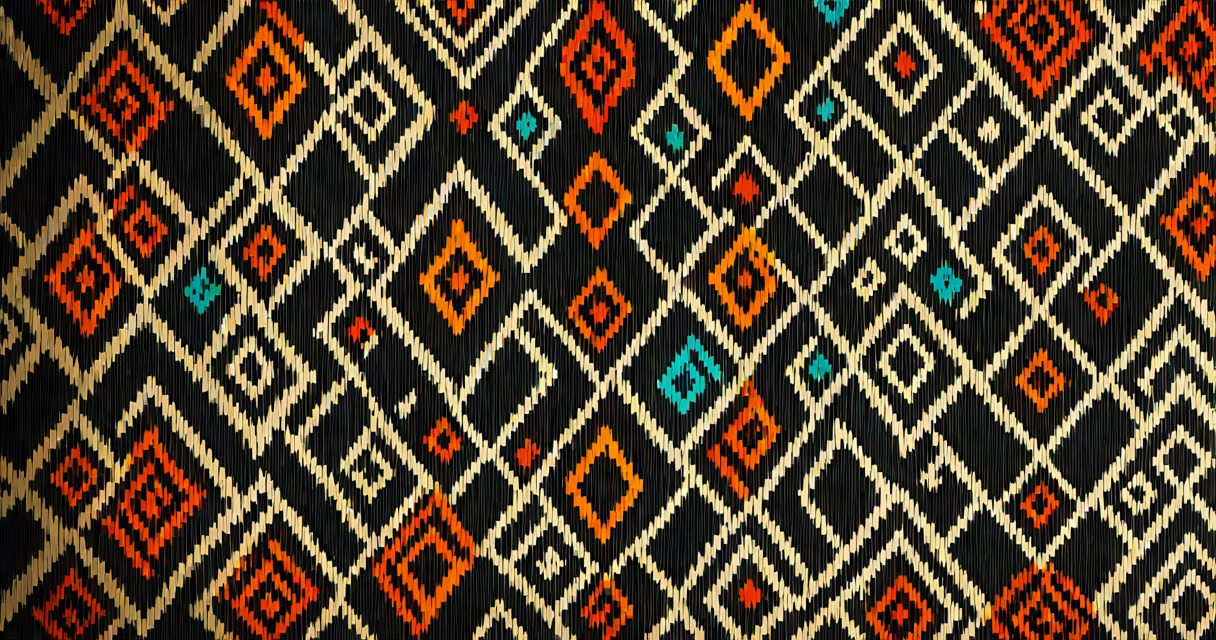
Ikat is a textile technique where threads are dyed before weaving to create complex, blurred patterns. The design emerges only after the fabric is woven, making each piece unique and visually striking.
The word "ikat" comes from the Malay word *mengikat*, meaning "to tie." This refers to the resist-dyeing process where yarns are bound with thread or wax before dyeing to prevent color absorption in specific areas. Multiple dye baths may be applied to achieve complex color gradients and layered motifs.
This method predates written records and has been practiced for over 1,000 years in regions including India, Indonesia, Central Asia, and parts of Latin America. Each culture developed distinct styles-Balinese ikat features symmetrical floral designs, while Uzbek ikat often uses bold, repeating geometric forms.
Ikat begins with selecting warp and weft threads. These are tied in precise locations using string or rubber bands to shield them from dye. After tying, the bundle is submerged in dye. Once dried, additional ties are added to create new patterns, and the process repeats for each color.
For example, a single ikat scarf might require three dye baths: indigo for blue, madder root for red, and natural black from iron-rich water. Each bath alters the yarn's appearance, and the final weave combines all layers into a unified image.
Because the pattern is formed by the alignment of dyed threads, even slight shifts during weaving cause blurring at the edges. This softness is intentional-it gives ikat its signature dreamlike quality, distinguishing it from sharply printed fabrics.
Different regions developed unique ikat traditions based on available materials, tools, and symbolism.
| Region | Common Patterns | Key Materials | Distinctive Feature |
|---|---|---|---|
| Indonesia (Bali) | Floral motifs, birds, sacred symbols | Cotton, batik-style dyes | High contrast between black and white; spiritual significance in design |
| Uzbekistan | Geometric stars, zigzags, medallions | Silk, cotton | Use of multiple colors; often worn in ceremonial dress |
| India (Andhra Pradesh) | Peacocks, lotus flowers, temple designs | Cotton, natural dyes | Known for fine weave and vibrant hues; traditionally made by women artisans |
| Mexico (Oaxaca) | Animal figures, suns, crosses | Wool, alpaca fiber | Combines indigenous motifs with Spanish colonial influences |
Each region's ikat reflects local identity. In Bali, certain patterns are reserved for religious ceremonies. In Central Asia, ikat designs were historically linked to social status and trade routes.
Ikat is frequently confused with other textile techniques like batik or embroidery. Batik involves applying wax to fabric before dyeing, while ikat dyes the threads before weaving. The resulting images differ: batik produces sharp, detailed scenes; ikat yields softer, flowing lines.
A common misconception is that ikat is mass-produced. In reality, authentic ikat requires hundreds of hours of labor. A single meter of Balinese ikat can take up to 60 hours to complete, involving tying, dyeing, and weaving by hand.
Another error is assuming all ikat is the same. The term "ikat" describes a family of methods, not a single style. Some versions use only one color, others combine up to five. The complexity varies widely-from simple stripes to multi-layered scenes.
In 2021, a Balinese artisan named Ibu Dewi created a shawl measuring 2.1 meters long and 1.2 meters wide. She used 1,400 individual threads, each tied by hand with banana fiber. Over six weeks, she completed three dye baths: indigo, turmeric, and cochineal red.
She wove the fabric on a traditional backstrap loom. When finished, the pattern showed a central peacock with outstretched wings, surrounded by lotus blossoms. The edges blurred slightly due to thread misalignment-a feature accepted as part of the craft's authenticity.
This shawl was later displayed at the National Museum of Asian Art in Washington, D.C., under the label "Handwoven Ikat from Ubud, Bali, c. 2021." It exemplifies how ikat preserves cultural memory through material practice.
In 2019, I visited a workshop in Bandung, Indonesia, where I watched a master weaver demonstrate ikat. She tied 400 threads in under 20 minutes using only her fingers and a small wooden stick. The precision amazed me-each knot had to be consistent to avoid distortion. When I asked about mistakes, she said, "A mistake is just a new design." That moment clarified how ikat values imperfection as part of its beauty.
The Smithsonian Institution notes that ikat has been documented in Southeast Asia since at least the 8th century CE, citing archaeological evidence from Java. According to their research, early ikat patterns often symbolized cosmological beliefs, such as the connection between earth and sky.
UNESCO recognizes several ikat traditions as intangible cultural heritage. In 2009, they inscribed the "Kasuri" ikat tradition of Japan and the "Pua Kumbu" weaving of Borneo as part of humanity's shared creative legacy. These listings affirm that ikat is not just a craft but a living expression of identity.
Understanding what ikat means includes recognizing its role beyond fashion. It serves as a record of migration, trade, and belief systems. The patterns tell stories passed down through generations.
When you see a fabric with softly blended lines and shifting colors, you're looking at a centuries-old method of storytelling. What does ikat mean? It means intention, patience, and the quiet power of handmade creation.