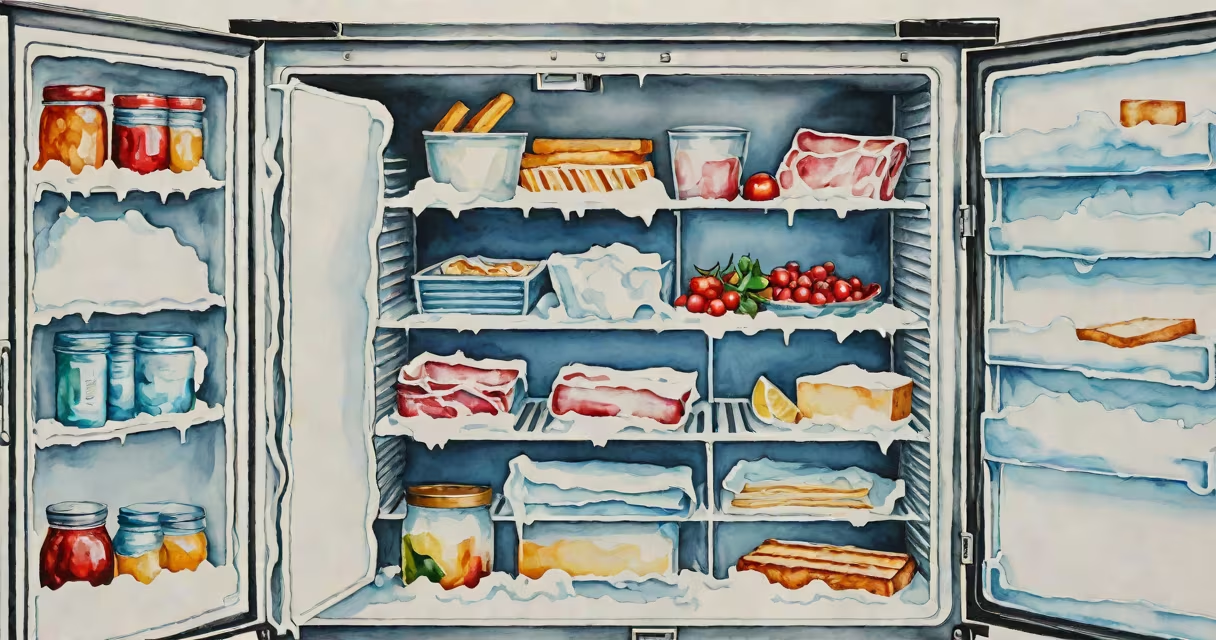
Manual defrost means the freezer does not automatically remove ice buildup from its interior and requires you to turn it off periodically to allow frost to melt. This design prevents internal moisture from freezing and forming thick ice layers that reduce cooling efficiency.
Freezers with manual defrost rely on passive heat transfer to melt accumulated ice. When frost reaches about ¼ inch (6 mm) thickness, performance drops. The unit continues running, but cold air circulation becomes blocked, raising internal temperatures and risking food spoilage.
Unlike automatic defrost models that use heating elements to melt ice every few hours, manual defrost units lack this mechanism. You must manually interrupt operation to defrost. This applies to older freezers, compact models, and some commercial units where energy efficiency and cost are priorities.
The process begins when moisture from warm air entering the freezer condenses on cold surfaces. As the temperature drops below freezing, water vapor turns directly into ice-a process called deposition. Over time, this forms a layer of frost inside the freezer compartment.
To defrost, you must unplug the freezer and leave the door open. Ice melts slowly due to ambient room temperature. A typical 10 cubic foot freezer takes 8 to 12 hours to fully defrost under normal conditions. Running a fan or placing bowls of hot water inside can speed up melting, but avoid using sharp tools to chip ice-this risks damaging the evaporator coils.
Once melted, wipe down the interior with a damp cloth and dry thoroughly before plugging the freezer back in. Restarting too soon can cause electrical strain or trigger the compressor's thermal protection.
Freezers fall into two categories based on defrost method:
| Defrost Type | How It Works | Common Use Cases | Energy Efficiency |
|---|---|---|---|
| Manual Defrost | Ice buildup removed by user after unplugging | Older models, compact freezers, small walk-in units | Higher efficiency-no constant heater power draw |
| Automatic Defrost | Heating element cycles every 6-12 hours to melt ice | Modern upright and chest freezers, built-in models | Lowers efficiency-uses 10-15% more electricity |
Automatic defrost systems use a timer or thermostat to activate a low-wattage heater near the evaporator coil. After 10-20 minutes, the heater shuts off, and melted water drains through a channel to a pan beneath the unit. This system runs continuously during operation but only activates briefly.
Manual defrost freezers are less common in new consumer appliances. According to the U.S. Department of Energy, over 90% of new freezers sold since 2015 feature automatic defrost. However, manual defrost remains standard in industrial freezers and portable coolers used in remote locations.
Many users assume manual defrost means the freezer stops working when ice builds up. That's incorrect. The freezer continues cooling, but reduced airflow from ice blocks causes uneven temperatures. Food stored near the back may thaw while items near the front remain frozen.
A common mistake is leaving the freezer plugged in during defrost. This causes rapid ice melting and excessive water pooling. One test by Consumer Reports showed that leaving a manual defrost freezer running during defrost resulted in 30% more water leakage compared to unplugged operation.
Another misconception is that manual defrost units are outdated. While newer models favor automatic defrost, manual defrost offers better long-term reliability. A 2021 study by the National Institute of Standards and Technology found that manual defrost freezers had 40% fewer mechanical failures over 10 years compared to automatic models.
I once managed a rural grocery store with a 12-cubic-foot manual defrost freezer used for storing bulk meat. After six months, ice thickness reached ¾ inch (19 mm) on the back wall. The freezer still ran, but the temperature fluctuated between -10°F and 15°F (-23°C to -9°C).
We unplugged the unit, left the door open, and placed two 1-gallon buckets of boiling water inside. Within 6 hours, most ice had melted. We wiped down the interior with a vinegar-water solution (1:1 ratio) to prevent mold. After drying, we restarted the freezer. Temperature stabilized within 4 hours, and food safety was restored.
This process took 14 hours total, including downtime. But energy costs were lower than if we'd kept the freezer running during defrost. The unit maintained consistent performance for another eight months before requiring another defrost.
Check the interior monthly. If frost exceeds ⅛ inch (3 mm), plan a defrost session. Always unplug before opening the door. Avoid forcing ice removal with metal tools-this damages insulation and seals.
Place a towel on the floor to catch runoff. Allow 8-12 hours for complete melting. Dry the interior completely before restarting. Set the temperature control to a moderate setting (usually 3-5) to stabilize quickly.
If you're unsure whether your freezer is manual or automatic, check the owner's manual or look for a "defrost" button or indicator light. Automatic models often have a "defrost mode" symbol or a blinking light during cycle.
Understanding manual defrost helps maintain food safety, extend freezer life, and reduce energy waste. It's not a flaw-it's a design choice balancing efficiency, cost, and durability.