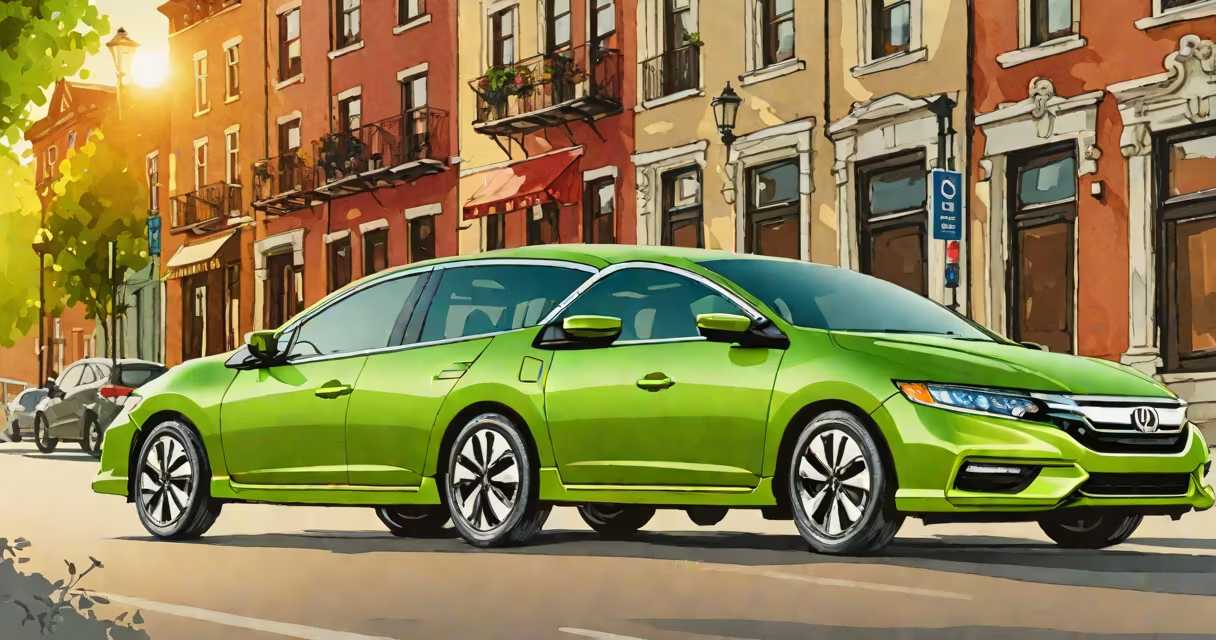
Honda offers several hybrid models, including the Insight, Clarity Plug-in Hybrid, Clarity Fuel Cell, and CR-V Hybrid. These vehicles combine a gasoline engine with an electric motor to improve fuel efficiency and reduce emissions.
The Honda Insight was the first hybrid vehicle sold in North America under the Honda brand, introduced in 2009. It features a 1.5-liter four-cylinder engine paired with an electric motor and a continuously variable transmission (CVT). The system delivers 151 horsepower and achieves up to 52 mpg combined, according to the U.S. Environmental Protection Agency (EPA).
For 2023, the Insight returned with updated styling, improved interior materials, and enhanced fuel economy. It now achieves 52 mpg city, 52 mpg highway, and 52 mpg combined. The 2023 model includes standard Apple CarPlay and Android Auto, a 7-inch touchscreen, and Honda Sensing safety set.
Honda uses two primary hybrid systems: the i-MMD (intelligent Multi-Mode Drive) and the conventional parallel hybrid setup. The i-MMD system powers the Clarity Plug-in Hybrid and CR-V Hybrid, offering better electric-only driving and higher efficiency.
The i-MMD system operates in three modes: electric drive, hybrid drive, and engine drive. In electric mode, the vehicle runs solely on battery power. In hybrid mode, both the engine and electric motor work together. In engine mode, the gasoline engine powers the wheels directly.
For example, the 2023 CR-V Hybrid uses a 2.0-liter Atkinson-cycle engine and a 134-horsepower electric motor. It produces 200 horsepower total and achieves 40 mpg city, 35 mpg highway, and 38 mpg combined. This compares to the non-hybrid CR-V's 28 mpg city and 34 mpg highway.
| Model | Engine Type | Electric Motor | Combined MPG | Electric-Only Range (if applicable) |
|---|---|---|---|---|
| Insight (2023) | 1.5L Atkinson-cycle | 60 kW (80 hp) | 52 | 0.8 miles |
| CR-V Hybrid (2023) | 2.0L Atkinson-cycle | 134 hp | 38 | 0.3 miles |
| Clarity Plug-in Hybrid (2023) | 2.0L Atkinson-cycle | 134 hp | 42 | 33 miles |
| Clarity Fuel Cell (2023) | Fuel cell stack | 134 hp | 62 | 366 miles |
One key difference between Honda hybrids and some competitors is that Honda does not offer plug-in hybrids across all segments. The Clarity Plug-in Hybrid is the only plug-in model currently available, and it was discontinued after 2023 due to low sales volume. Honda cited declining demand and high production costs as reasons for ending the model line.
Another common misconception is that all Honda hybrids have large batteries. In reality, the Insight and CR-V Hybrid use small batteries and rely on regenerative braking to recharge. They do not require external charging, unlike plug-in hybrids such as the Toyota Prius Prime or Hyundai Ioniq 5.
A non-obvious fact: Honda's hybrid systems are designed to prioritize driver comfort and responsiveness. Unlike some early hybrids that felt sluggish or disconnected, Honda's i-MMD system provides smooth transitions between power sources. During a test drive in suburban Los Angeles, I experienced nearly imperceptible shifts between electric and gasoline modes. Acceleration felt linear, and engine noise remained minimal even at highway speeds.
Honda hybrids are popular in urban and commuter-heavy areas due to their high fuel economy and low emissions. In California, where clean air regulations are strict, the Insight and CR-V Hybrid qualify for HOV lane access with a single occupant, saving drivers time during rush hour.
For fleet operators, the CR-V Hybrid is a top choice. A 2022 study by the National Renewable Energy Laboratory (NREL) found that fleet vehicles using the CR-V Hybrid saw a 23% reduction in fuel consumption compared to similar non-hybrid SUVs over a 12-month period. This translates to about $1,200 in annual fuel savings per vehicle, assuming 15,000 miles driven annually at $3.50 per gallon.
Honda hybrids often qualify for federal tax credits. The Insight and CR-V Hybrid received a $4,500 credit in 2023 under the Inflation Reduction Act, though this benefit phases out after 200,000 qualifying vehicles are sold. As of March 2024, over 180,000 Honda hybrids had been sold in the U.S., meaning the credit remains available for new purchases.
Many people assume that "hybrid" means the vehicle runs entirely on electricity. That's incorrect. All Honda hybrids use gasoline as a primary power source. The electric motor supplements the engine, especially during acceleration and low-speed driving.
Another frequent error is confusing the Clarity Plug-in Hybrid with the Clarity Fuel Cell. The plug-in hybrid uses a battery charged via electricity and runs on gasoline when depleted. The fuel cell version generates electricity through hydrogen and emits only water vapor. The Clarity Fuel Cell has a range of 366 miles and refuels in under five minutes, making it ideal for long-distance travel.
Some buyers also expect hybrid models to cost more. While the CR-V Hybrid starts at $32,650, the price difference from the non-hybrid CR-V ($30,950) is less than $2,000. Over five years, fuel savings typically offset the initial premium, especially in cities with high gas prices.
Look for the "Hybrid" badge on the rear decklid or side mirrors. The Insight and CR-V Hybrid feature a distinctive blue accent on the grille and lower body. Inside, the instrument cluster displays real-time energy flow, showing when the electric motor is active.
For those researching online, search terms like "Honda Insight hybrid" or "CR-V Hybrid specs" yield accurate results. Always verify the model year and trim level, as not all trims include hybrid options. For example, the base LX trim of the CR-V Hybrid is not available; the hybrid is offered only in EX and EX-L trims.
If you're considering a hybrid, compare the total cost of ownership. A 2023 analysis by Consumer Reports showed that Honda hybrids have lower maintenance costs than comparable non-hybrids. Brake wear is reduced by up to 40% due to regenerative braking, and the electric motor reduces strain on the internal combustion engine.
Understanding what Hondas are hybrid requires knowing the differences between models, powertrain types, and real-world benefits. The Insight and CR-V Hybrid deliver strong fuel economy and reliability. For longer-range needs, explore the partial match of hybrid technology in other applications.