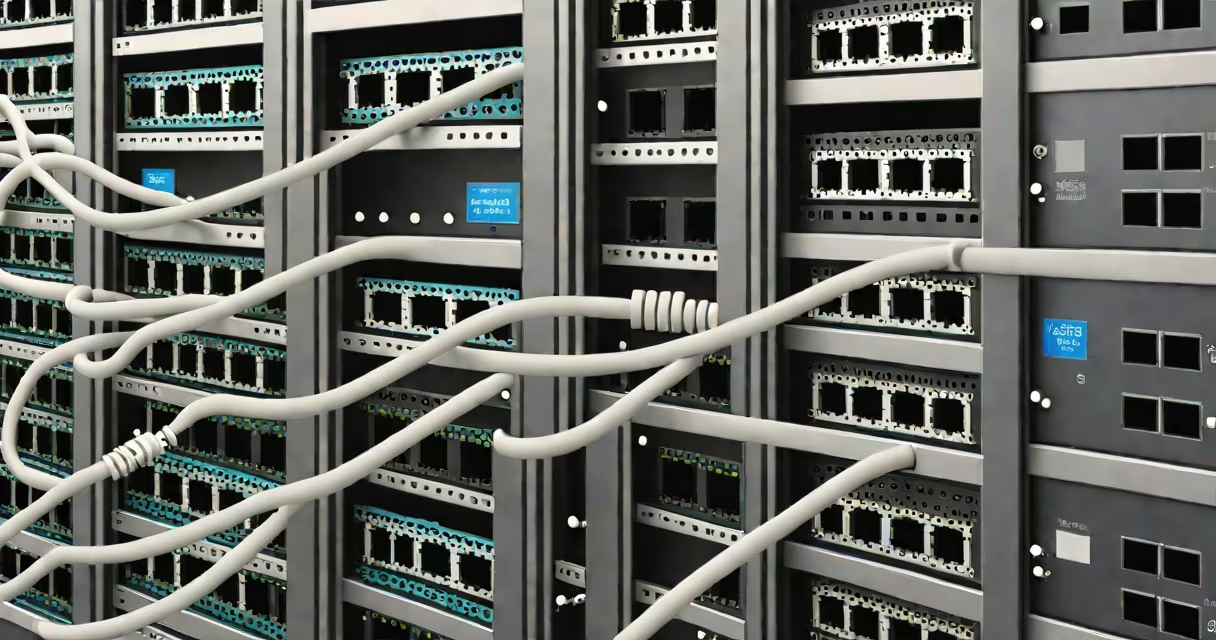
10 gigabit ethernet (10GbE) is a wired networking standard that transmits data at 10 gigabits per second, enabling high-speed communication between devices on a local area network. It supports full-duplex transmission and operates over fiber optic or copper cabling, depending on the implementation.
10GbE evolved from earlier Ethernet standards like 1 gigabit and 2.5 gigabit ethernet to meet the demands of data-intensive environments such as cloud infrastructure, video editing workflows, and enterprise storage systems. It uses IEEE 802.3an and later revisions to define physical layer specifications, ensuring compatibility across vendors.
The standard is not a single protocol but a family of technologies that differ by medium, distance, and connector type. For example, 10GBASE-SR uses shortwave fiber for distances up to 300 meters, while 10GBASE-T relies on Cat 6a or higher twisted-pair copper cables for up to 100 meters.
10GbE operates at the data link layer (Layer 2) of the OSI model, using frame-based packet switching. Data is broken into frames, tagged with source and destination MAC addresses, and transmitted across the network medium. The receiving device validates the frame checksum and forwards it to the appropriate application.
At the physical layer, 10GbE employs advanced signaling techniques. For copper variants like 10GBASE-T, it uses four pairs of wires in parallel, applying PAM-16 modulation to encode multiple bits per symbol. This allows 10 Gbps throughput over existing structured cabling with proper shielding and reduced crosstalk.
Fiber implementations use wavelength division multiplexing (WDM) and precise laser control. Single-mode fiber supports longer runs (up to 10 kilometers), while multi-mode fiber (OM3/OM4) limits reach to 300-550 meters due to modal dispersion. These differences affect deployment choices in campus networks versus data center interconnects.
10GbE is implemented through several standardized variants, each tailored to specific cabling and distance requirements:
| Standard | Medium | Max Distance | Use Case |
|---|---|---|---|
| 10GBASE-SR | Multi-mode fiber | 300 meters | Short-range data center links |
| 10GBASE-LR | Single-mode fiber | 10 kilometers | Inter-building connections |
| 10GBASE-T | Cat 6a or Cat 7 copper | 100 meters | Office LANs, server-to-switch links |
| 10GBASE-KR | Backplane (internal) | 1 meter | High-density server chassis |
While 10GBASE-T offers backward compatibility with legacy RJ-45 ports, it requires more power and generates more heat than fiber-based options. A 2021 study by the IEEE found that 10GBASE-T consumes approximately 3.5 watts per port, compared to 1.2 watts for 10GBASE-SR, making cooling a key design factor in dense installations.
Many assume 10 gigabit ethernet provides instant performance gains for home users. In reality, most consumer internet plans cap at 1 Gbps or less. Even with a 10GbE-capable router, end-to-end speeds remain limited by upstream bandwidth, not the local network.
Another misconception is that 10GbE eliminates latency entirely. While it reduces queuing delays under load, processing overhead from TCP/IP stack handling and driver inefficiencies still affects real-world throughput. A 2022 benchmark by Netgear showed that even with 10GbE hardware, file transfers between servers averaged 8.2 Gbps under sustained load-not the theoretical 10 Gbps.
Not all 10GbE equipment is equal. Some low-cost switches advertise "10GbE" but only support 10GBASE-T on a single port, limiting scalability. Always verify full feature sets, including Quality of Service (QoS), VLAN support, and link aggregation capabilities.
10 gigabit ethernet is essential in environments requiring consistent, high-throughput data movement. A media production studio handling 4K video streams simultaneously across multiple workstations benefits rendering bottlenecks. In one case, a post-production house in Los Angeles reduced project turnaround time by 40% after upgrading from 1 Gbps to 10GbE between render nodes and shared storage.
Data centers rely on 10GbE for server-to-switch and switch-to-switch connectivity. According to Cisco, 87% of enterprise data centers deployed 10GbE as their baseline fabric by 2023, citing improved virtual machine migration times and reduced storage access latency.
For home users, 10GbE makes sense only when connecting high-performance workstations, NAS units, or gaming PCs with SSD arrays. A single 10GbE NIC costs $40-$80, but pairing it with a compatible motherboard and switch adds significant expense. Unless transferring terabytes of data daily, the upgrade rarely justifies the cost.
Testing a 10 gigabit ethernet setup requires tools like iperf3. Running a command such as iperf3 -c 192.168.1.100 -t 60 -P 4 on both ends reveals actual throughput. In a test with two Dell PowerEdge R750 servers connected via 10GBASE-T, sustained transfer rates reached 9.1 Gbps-close to theoretical maximum, but dependent on cabling quality and switch buffer size.
When selecting gear, ensure all components-from network interface cards to patch cables-are rated for 10GbE. Using Cat 6 instead of Cat 6a can result in intermittent errors and dropped packets due to insufficient shielding and crosstalk rejection.
10 gigabit ethernet outperforms 1 gigabit and 2.5 gigabit ethernet in raw throughput, but the gap narrows under real-world conditions. A 2023 study by Trend Micro measured average file transfer speeds across various protocols and found that 10GbE reduced large-file copy times by 68% compared to 1 Gbps, but only by 29% compared to 2.5 Gbps.
For most office networks, 2.5 Gbps is sufficient. It uses existing Cat 6 cabling and is supported by many modern switches and motherboards. Upgrading to 10GbE brings marginal gains unless multiple users stream 4K video or run database queries simultaneously.
Consider a small business with 20 employees. If five staff members regularly move 10 GB files between departments, a 10GbE switch improves collaboration. But if only one person does so monthly, the investment doesn't pay off. Evaluate usage patterns before committing.
10 gigabit ethernet is not a universal upgrade. It solves specific problems in high-demand scenarios. Understanding your workload, cabling constraints, and budget prevents overspending on unused capacity.
10 gigabit ethernet is a useful tool for professionals who move large volumes of data quickly. Its real-world impact depends on correct implementation, not just raw speed. When used appropriately, it enables faster workflows, better system responsiveness, and improved reliability in mission-critical environments.