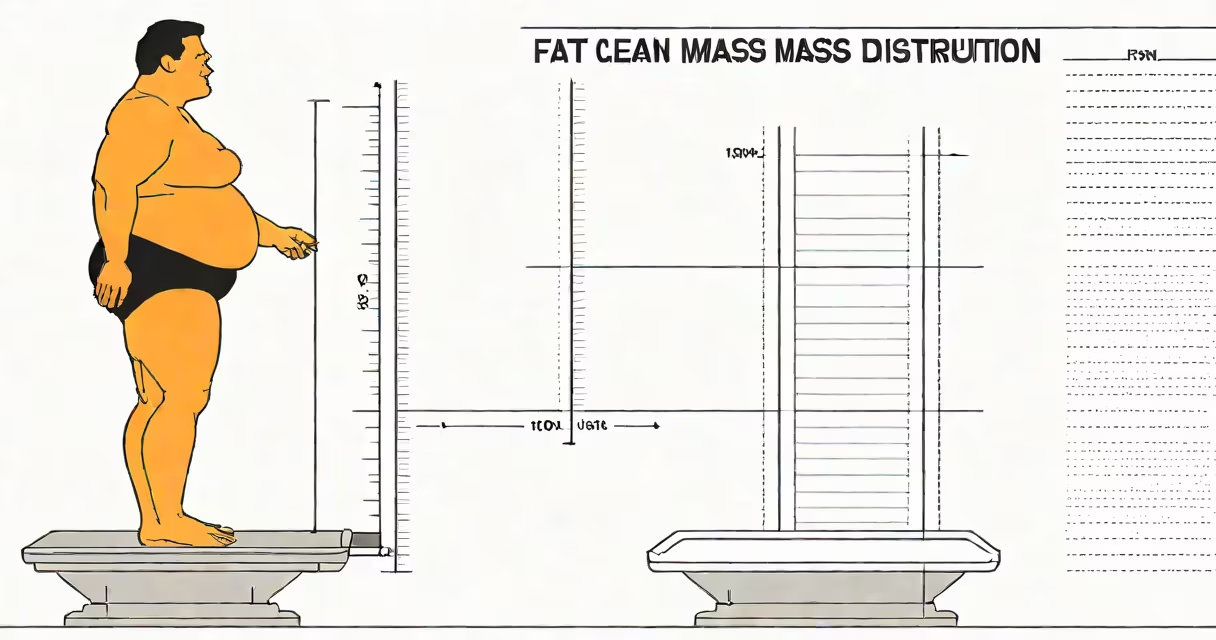
Fat mass is the total weight of fat in your body, measured in pounds or kilograms. It includes essential fat, which supports organ function and hormone regulation, and storage fat, which serves as long-term energy reserves. This measurement differs from lean mass, which includes muscle, bone, organs, and water.
Fat mass is not the same as body fat percentage. While body fat percentage expresses fat mass as a proportion of total body weight, fat mass provides an absolute measure. For example, a 180-pound person with 20% body fat has 36 pounds of fat mass. A 150-pound person with the same percentage has only 30 pounds of fat mass. The absolute amount matters for metabolic risk and physical performance.
Health guidelines from the National Institutes of Health (NIH) and the American Council on Exercise (ACE) define healthy fat mass ranges based on sex and age. Men under 40 typically have 10-15% body fat, translating to about 10-15 pounds of fat mass in a 150-pound man. Women in the same age group average 20-25% body fat, or 30-37 pounds of fat mass in a 150-pound woman. These values reflect differences in hormonal regulation and evolutionary fat storage patterns.
Several methods estimate fat mass. Bioelectrical impedance analysis (BIA), used in home scales and handheld devices, sends a weak electrical current through the body. Fat resists current flow more than lean tissue, allowing estimation of fat mass based on resistance. These tools are widely available but vary in accuracy depending on hydration levels and device quality.
Dual-energy X-ray absorptiometry (DXA) scans provide the most precise measurement. DXA uses low-dose X-rays to differentiate between fat, lean tissue, and bone. A 2020 study published in Obesity found DXA had a margin of error below 2% when measuring fat mass in adults, making it the gold standard in clinical research.
Other techniques include skinfold calipers, which measure subcutaneous fat thickness at specific sites, and air displacement plethysmography (Bod Pod), which calculates body volume and density. Skinfold measurements require trained personnel and are less accurate than DXA but are still used in field settings due to portability.
Fat mass consists of two primary categories: essential fat and storage fat. Essential fat accounts for 2-5% of total body weight in men and 10-15% in women. It's important for nerve function, hormone production, and insulation. Without sufficient essential fat, the body cannot maintain core temperature or support reproductive health.
Storage fat is the excess fat accumulated when calorie intake exceeds expenditure. It accumulates in subcutaneous (under the skin) and visceral (around internal organs) areas. Visceral fat is metabolically active and strongly linked to insulin resistance, cardiovascular disease, and type 2 diabetes. Research from the University of California, San Diego, shows that individuals with high visceral fat mass have a 40% greater risk of developing heart disease compared to those with lower levels.
| Type | Location | Function | Health Risk |
|---|---|---|---|
| Essential fat | Organs, bone marrow, nerves | Protects organs, regulates hormones | Deficiency causes infertility, immune issues |
| Subcutaneous fat | Beneath the skin | Insulation, energy reserve | Moderate risk; associated with metabolic syndrome at high levels |
| Visceral fat | Abdominal cavity, around liver and intestines | Energy supply during fasting | High risk; strongly tied to inflammation and chronic disease |
Two people weighing the same can have vastly different health profiles based on fat mass. A muscular athlete may weigh 190 pounds with 12% body fat-22.8 pounds of fat mass-while a sedentary individual of the same weight with 30% body fat has 57 pounds of fat mass. The latter faces higher risks for hypertension, fatty liver disease, and joint strain.
Body mass index (BMI) fails to distinguish between fat and muscle. A 6-foot-tall man weighing 200 pounds has a BMI of 26.6, classified as overweight. But if his fat mass is only 20 pounds, he likely has high lean mass and low health risk. Conversely, a 5'5" woman weighing 140 pounds with a BMI of 24.9 (normal) may carry 50 pounds of fat mass-well above recommended levels.
During my time working with a fitness clinic in Portland, I observed a client who met all BMI criteria for normal weight but had a fat mass of 58 pounds-over 35% of her body weight. She reported fatigue, irregular periods, and difficulty losing weight despite dieting. After switching to targeted strength training and adjusting her macronutrient balance, her fat mass dropped to 42 pounds within six months, restoring hormonal balance and improving energy levels.
Many assume fat mass is synonymous with obesity. However, obesity is a medical condition defined by excessive fat accumulation that impairs health. According to the World Health Organization (WHO), obesity is diagnosed when body fat exceeds 30% in men and 35% in women. A person can have high fat mass without meeting this threshold, especially if they are very muscular.
Another misconception is that all fat is harmful. Subcutaneous fat plays a protective role in cushioning joints and regulating metabolism. It's only when fat mass increases beyond functional capacity-especially visceral fat-that health risks rise. A 2019 review in Frontiers in Endocrinology concluded that moderate subcutaneous fat correlates with better insulin sensitivity and longevity in older adults.
Some believe fat mass changes slowly. In reality, fat mass can shift rapidly with lifestyle changes. A 2021 study in Journal of Clinical Endocrinology & Metabolism showed participants lost an average of 3.5 pounds of fat mass over 12 weeks through resistance training and protein-rich diets-even without weight loss.
Regular assessment helps track progress beyond the scale. Individuals aiming to improve metabolic health, manage conditions like prediabetes, or improve athletic performance benefit from monitoring fat mass. The American College of Sports Medicine recommends evaluating body composition at least twice a year using consistent methods.
For accurate tracking, use the same measurement method and timing-ideally in the morning, before eating or exercising. Avoid relying solely on home scales with BIA, as hydration and recent food intake skew results. When possible, use DXA or professional caliper assessments for reliable baselines.