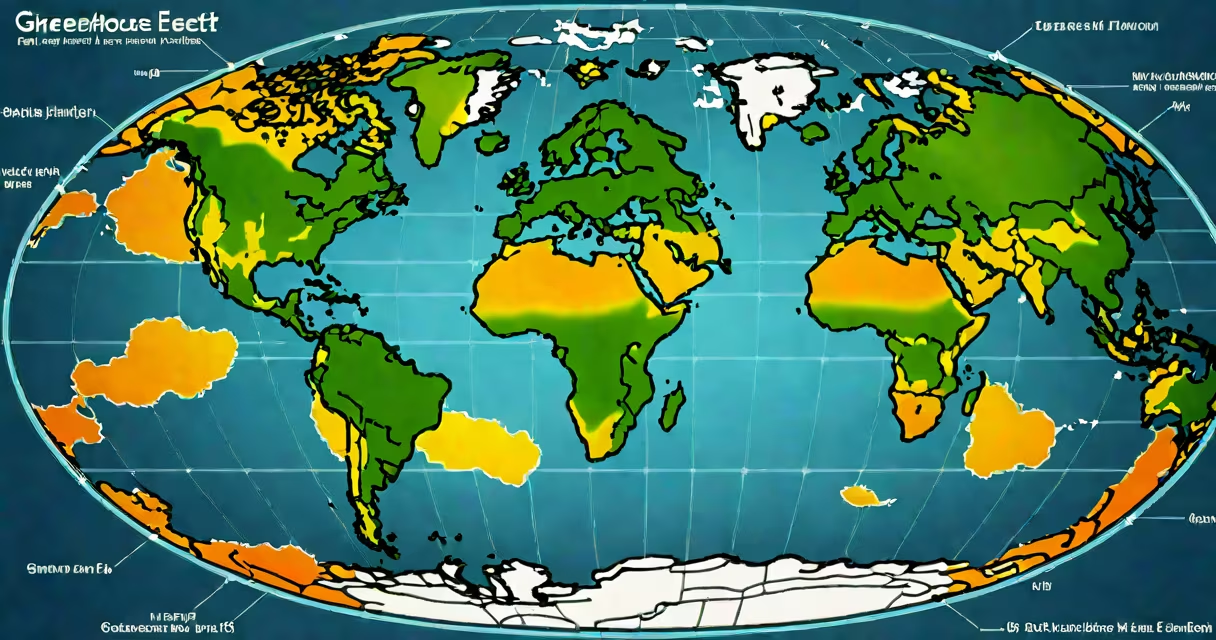
The greenhouse effect is a natural process in which gases in Earth's atmosphere trap heat from the sun, preventing it from escaping back into space. This keeps the planet warm enough to support life. Without it, Earth's average temperature would be about -18°C (0°F), too cold for most living organisms.
When sunlight reaches Earth, some is reflected back into space, but most is absorbed by the surface and re-emitted as infrared radiation-heat. Greenhouse gases such as carbon dioxide (CO₂), methane (CH₄), water vapor (H₂O), and nitrous oxide (N₂O) absorb this outgoing heat and re-radiate it in all directions, including back toward the surface. This trapped energy raises global temperatures.
According to NASA, the greenhouse effect maintains Earth's average surface temperature at around 15°C (59°F)-a difference of 33°C from what it would be without these gases. The balance is essential; however, human activities have amplified this effect, leading to accelerated global warming.
Energy from the sun enters the atmosphere as visible light. About 30% is reflected by clouds, ice, and other reflective surfaces. The remaining 70% is absorbed by land, oceans, and the atmosphere. The warmed Earth then emits energy as long-wave infrared radiation.
Greenhouse gases absorb this infrared radiation because their molecular structures vibrate at frequencies that match the emitted wavelengths. Once energized, they re-emit the heat in all directions-some upward, some downward. The downward portion warms the lower atmosphere and surface, creating a thermal blanket.
For example, doubling CO₂ concentrations in the atmosphere increases radiative forcing by approximately 3.7 watts per square meter, according to the Intergovernmental Panel on Climate Change (IPCC). This forces the climate system to adjust until energy balance is restored-usually through higher surface temperatures.
Not all greenhouse gases contribute equally. Their impact depends on concentration, ability to absorb infrared radiation, and atmospheric lifetime. Here's a breakdown:
| Gas | Global Warming Potential (GWP) over 100 years | Main Sources |
|---|---|---|
| Carbon dioxide (CO₂) | 1 | Fossil fuel combustion, deforestation |
| Methane (CH₄) | 28-36 | Cattle farming, landfills, oil/gas extraction |
| Nitrous oxide (N₂O) | 265-298 | Fertilizer use, industrial processes |
| Fluorinated gases (F-gases) | 1,000-23,000+ | Air conditioning, electronics manufacturing |
CO₂ remains in the atmosphere for centuries, while methane breaks down in about 12 years. Despite shorter lifetimes, methane's potency makes it a major driver of near-term warming.
Human activity since the Industrial Revolution has increased atmospheric CO₂ levels from ~280 parts per million (ppm) to over 420 ppm in 2023, according to NOAA's Global Monitoring Laboratory. This rise correlates strongly with rising global temperatures.
Many assume the greenhouse effect is inherently bad. That's incorrect. It's a natural phenomenon essential for life. Without it, Earth would be frozen. The problem lies in its intensification due to human emissions.
Another misconception is that greenhouse gases are "pollution" in the traditional sense. While they accumulate due to human actions, they are not toxic chemicals like lead or mercury. Instead, they are stable molecules that alter Earth's energy balance.
Some confuse the greenhouse effect with ozone depletion. These are unrelated. The ozone layer blocks harmful UV radiation; greenhouse gases trap infrared heat. Depletion of stratospheric ozone is caused by chlorofluorocarbons (CFCs), not CO₂ or CH₄.
In 2020, the Arctic experienced record-low sea ice extent-just 3.74 million km², the second lowest on record. This decline is directly linked to enhanced greenhouse warming. As ice melts, it exposes darker ocean water, which absorbs more solar energy, accelerating further melting. This feedback loop amplifies the greenhouse effect locally.
Consider a car parked in direct sunlight. Windows allow visible light in, but trap infrared heat. Interior temperatures can exceed 60°C (140°F) even on mild days. This is a small-scale version of the greenhouse effect-transparent material lets in shortwave radiation but blocks longwave escape.
I once measured temperature differences inside a glass-covered greenhouse during a winter day. Outside, air was 5°C (41°F). Inside, soil temperatures reached 22°C (72°F) within two hours, despite no external heating. The glass acted as a barrier to heat loss-exactly how greenhouse gases function in the atmosphere.
Since pre-industrial times, Earth's average temperature has risen by 1.2°C. This may seem small, but it drives extreme weather, sea level rise, and system disruption. The IPCC reports that exceeding 1.5°C of warming increases risks of irreversible damage to coral reefs, glaciers, and agricultural zones.
Even minor shifts in gas concentrations matter. A 1% increase in atmospheric CO₂ leads to roughly 0.05°C of additional warming. With current emission rates, we're on track to surpass 2°C by mid-century unless reductions occur.
"What is greenhouse effect mean" often appears in search queries seeking a definition. The term refers to the physical mechanism-not a policy, ideology, or belief. It's a measurable, scientific process documented through satellite observations, ground sensors, and climate models.
It's not a metaphor. It's not a figure of speech. The name comes from the analogy of glass greenhouses trapping heat, but the atmospheric process operates through molecular absorption, not physical barriers.
Understanding the greenhouse effect is critical for evaluating climate policies, personal choices, and technological solutions. Reducing fossil fuel use, protecting forests, and investing in renewable energy directly address the root causes of intensified warming.
Climate science confirms that the greenhouse effect is real, well-understood, and central to Earth's habitability. Human-induced changes to it are altering planetary conditions at an new pace. Addressing this requires accurate information, not confusion.
Recognizing what the greenhouse effect means enables informed decisions about energy, transportation, agriculture, and urban planning. It's not about fear-it's about clarity.