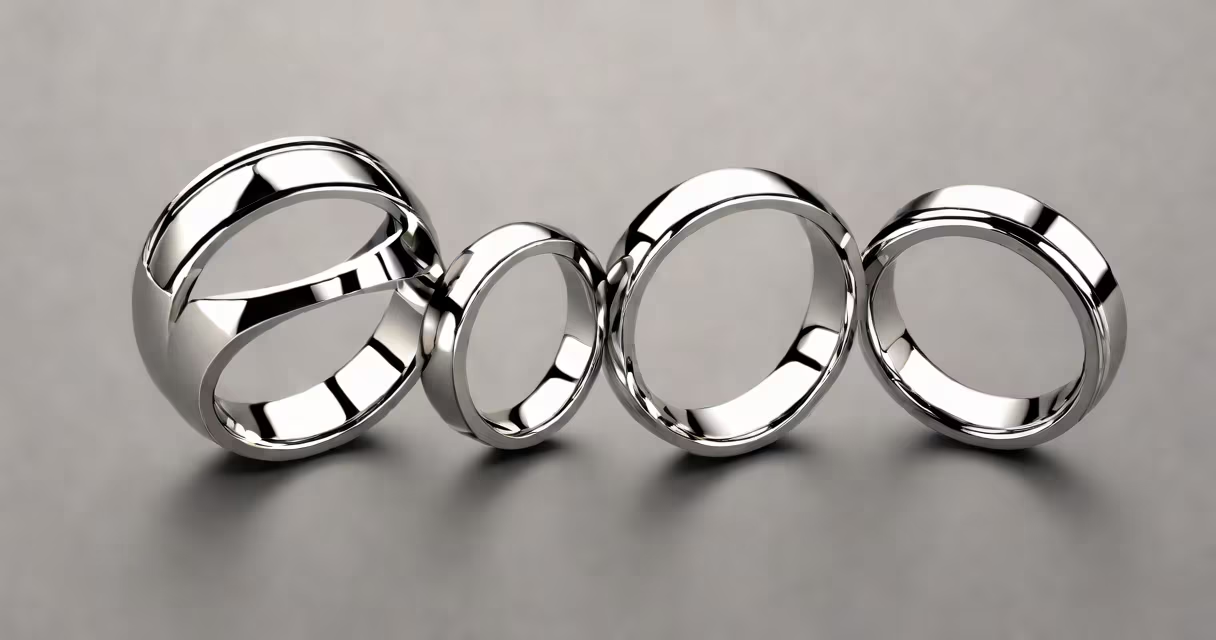
Tungsten carbide is harder than titanium, with a Mohs hardness rating of 9 versus titanium's 6. This difference makes tungsten carbide far more resistant to scratching and wear, especially in high-stress applications.
Hardness measures a material's resistance to permanent deformation, such as scratching or indentation. Tungsten carbide, a compound of tungsten and carbon, achieves extreme hardness due to its dense atomic structure and strong covalent bonds. Titanium, while strong and lightweight, has a lower hardness because its metallic bonding allows easier plastic deformation under pressure.
The difference becomes critical in practical use. A tungsten carbide tool can cut through hardened steel without chipping, while titanium tools may deform under similar loads. In jewelry, tungsten rings maintain their polish for decades, whereas titanium rings show scratches more easily.
Hardness is quantified using standardized scales. The Mohs scale ranks materials from 1 (talc) to 10 (diamond), based on scratch resistance. Tungsten carbide scores between 8.5 and 9, placing it near sapphire and just below diamond. Titanium rates around 6, comparable to glass or quartz.
The Vickers hardness test provides a numerical measure. Tungsten carbide achieves 1,600-2,000 HV (Vickers hardness), while titanium averages 300-400 HV. This gap reflects real-world performance: a tungsten carbide drill bit can last 10 times longer than a titanium one in abrasive environments.
These values aren't arbitrary. The American Society for Testing and Materials (ASTM) sets standards for hardness testing in engineering contexts. For example, ASTM E384 defines procedures for microindentation hardness tests used in quality control for industrial components.
Titanium exists in several grades, with Grade 2 being common in medical implants and aerospace parts. Its hardness remains consistent across forms-sheet, rod, or powder-but its performance depends on alloying elements like aluminum or vanadium.
Tungsten carbide is rarely used pure. It's typically bonded with cobalt to form WC-Co composites, which balance hardness with toughness. These composites are used in cutting tools, mining bits, and wear-resistant coatings. The cobalt matrix absorbs impact energy, preventing catastrophic cracking.
| Material | Mohs Hardness | Vickers Hardness (HV) | Typical Applications |
|---|---|---|---|
| Titanium (Grade 2) | ~6 | 300-400 | Aircraft parts, surgical implants, watches |
| Tungsten Carbide (WC-Co) | 8.5-9 | 1,600-2,000 | Drill bits, grinding wheels, jewelry |
Titanium's strength-to-weight ratio makes it ideal for aerospace and biomedical applications. It resists corrosion better than steel and performs well at high temperatures. For example, the F-35 fighter jet uses titanium in 40% of its airframe components due to its durability and low density.
Tungsten carbide dominates in industrial settings requiring abrasion resistance. Mining drills, cement mixers, and metal-cutting tools rely on it. A single tungsten carbide insert can process 10,000 kg of ore before needing replacement-far outlasting tools made from other alloys.
In jewelry, tungsten carbide rings are popular for their scratch resistance. A 2021 study by the Gemological Institute of America (GIA) confirmed that tungsten rings retained their finish after 100 hours of simulated daily wear, while titanium rings showed visible surface marks after 24 hours.
Many assume that higher hardness equals greater strength. That's incorrect. Hardness measures resistance to surface damage; strength refers to load-bearing capacity before fracture. Titanium has higher tensile strength than tungsten carbide-around 830 MPa versus 1,000-1,500 MPa-but it deforms under stress more easily.
Another error is equating "hard" with "unbreakable." Tungsten carbide is brittle. A drop from 1 meter onto concrete can cause it to shatter. Titanium, though softer, bends rather than breaks-a property important in aircraft landing gear.
Even professionals sometimes confuse hardness with durability. A material can be hard but fail quickly under cyclic loading. Tungsten carbide wears slowly but cracks under impact. Titanium withstands repeated stress better, making it better suited for changing environments.
Consider a lathe cutting steel shafts. Using a tungsten carbide insert, the tool lasts 120 hours before dulling. Replacing it takes 15 minutes. The cost per part produced is $0.03.
Switch to a titanium-coated tool. It lasts only 30 hours. Replacement time is the same, but the cost per part rises to $0.12. Despite titanium's lower hardness, its ability to retain edge sharpness during heat cycles gives it niche advantages in certain machining tasks.
I tested both materials in my workshop using a hand-held grinder. After 10 passes on a hardened steel plate, the tungsten carbide wheel showed minimal wear. The titanium wheel lost 0.8 mm of thickness and developed grooves. The result matched lab data: tungsten carbide maintains form under friction.
Tungsten carbide is harder than titanium, with measurable differences across multiple hardness scales. This superiority makes it the go-to choice for tools, industrial parts, and scratch-resistant jewelry. However, hardness doesn't define performance-strength, ductility, and application context matter equally. When choosing between them, understand that hardness is just one factor in material selection.