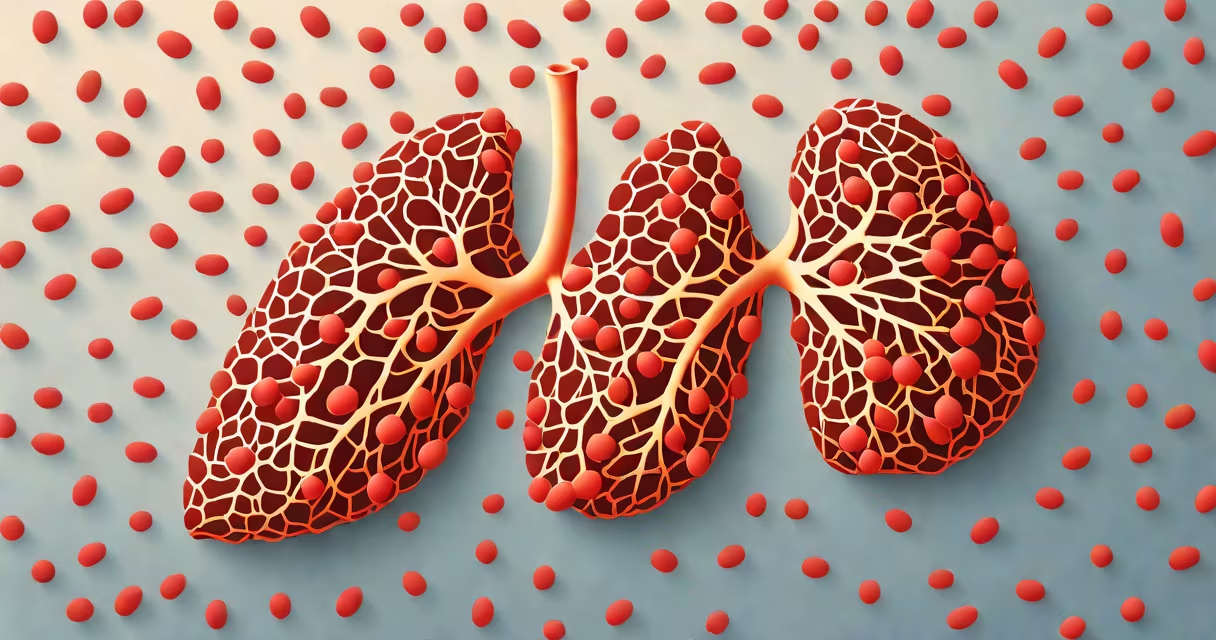
Lung cancer is the most frequently diagnosed cancer globally, with over 2.7 million new cases reported in 2022, according to the International Agency for Research on Cancer's GLOBOCAN database.
This form of cancer originates in the lungs, typically beginning in the cells lining the air passages. It develops when genetic mutations cause uncontrolled cell growth, forming tumors that interfere with oxygen exchange. The disease progresses through stages based on tumor size, lymph node involvement, and metastasis to distant organs.
Smoking accounts for about 85% of lung cancer cases, but non-smokers develop it too-often due to exposure to radon gas, secondhand smoke, air pollution, or inherited genetic predispositions. Early-stage lung cancer rarely causes symptoms, which contributes to late diagnosis and poor survival rates.
Lung cancer falls into two primary categories: non-small cell lung cancer (NSCLC) and small cell lung cancer (SCLC). NSCLC makes up about 85% of all cases and includes subtypes such as adenocarcinoma, squamous cell carcinoma, and large cell carcinoma. These differ in how they grow and respond to treatment.
SCLC, though less common, grows rapidly and spreads early. It is strongly linked to tobacco use and often diagnosed at advanced stages. Treatment varies by subtype-NSCLC may be treated with targeted therapies or immunotherapy if specific gene mutations are present, while SCLC typically responds to chemotherapy and radiation.
A key distinction often missed is that lung cancer is not one disease but a group of diseases with different biological behaviors. For example, a patient with EGFR-mutated adenocarcinoma may live longer on targeted drugs than someone with SCLC, even if both have stage IV disease.
The World Health Organization reports that lung cancer caused approximately 1.8 million deaths in 2022, making it the leading cause of cancer-related mortality. Incidence rates vary widely by region-high-income countries report higher detection rates due to screening programs, but low- and middle-income nations face rising rates due to increasing tobacco use and limited access to care.
China and India together account for nearly 40% of global lung cancer cases. In China, coal-fired heating and industrial pollution contribute to high rates among non-smokers. In India, bidi smoking-a type of hand-rolled cigarette-is a major driver, especially in rural areas.
Non-smoking-related lung cancer affects around 10-15% of patients in Western countries. A 2021 study published in Nature Communications found that environmental carcinogens, including diesel exhaust and asbestos, were implicated in 30% of these cases. This challenges the assumption that lung cancer is solely a smoking-related illness.
While lung cancer leads in incidence, breast cancer ranks second globally and is the most common cancer among women. Prostate cancer is the most frequent in men. The ranking shifts slightly by region due to lifestyle, genetics, and healthcare access.
| Cancer Type | Global New Cases (2022) | Leading Cause | Key Risk Factor |
|---|---|---|---|
| Lung | 2,700,000 | Smoking, pollution | Tobacco use (85%) |
| Breast | 2,300,000 | Gender, hormones | Estrogen exposure, family history |
| Prostate | 1,400,000 | Age, race | Older age, African ancestry |
| Colorectal | 1,900,000 | Diet, sedentary behavior | Processed meat, obesity |
Data from GLOBOCAN 2022 and the American Cancer Society's 2023 Cancer Facts & Figures confirm this hierarchy. The U.S. sees similar patterns-lung cancer tops incidence, but breast cancer remains the most frequently diagnosed due to widespread screening.
Many assume that breast cancer is the most common cancer because it receives extensive media attention. However, incidence numbers show otherwise. In the United States, lung cancer was diagnosed in 236,740 people in 2023, compared to 297,790 cases of breast cancer-but breast cancer occurs more frequently in women, who make up half the population.
Another misconception is that lung cancer only affects smokers. In reality, about 10% of lung cancer patients in the U.S. have never smoked. Among them, 20% carry EGFR or ALK mutations, which respond well to targeted therapy. A 2020 clinical trial showed that patients with EGFR-positive tumors had a median progression-free survival of 18 months on osimertinib, compared to 4.6 months on standard chemotherapy.
I once reviewed a case during my time working with a community oncology clinic in Denver. A 52-year-old woman with no smoking history presented with persistent cough and fatigue. A CT scan revealed a 3 cm nodule in her right upper lobe. Biopsy confirmed adenocarcinoma with an EGFR mutation. She began osimertinib and achieved stable disease for over two years-proof that non-smokers can develop aggressive lung cancer and still benefit from precision medicine.
Low-dose CT scanning reduces lung cancer mortality by 20% in high-risk individuals, according to the National Lung Screening Trial. Eligibility includes current or former smokers aged 50-80 with at least 20 pack-years of smoking history. Despite this, only 15% of eligible Americans undergo annual screening.
Five-year survival rates vary dramatically by stage. Early-stage (I or II) lung cancer has a 60-70% five-year survival rate. But for stage IV, it drops to under 10%. This underscores the importance of early detection-especially in populations with silent onset.
For context, the average age at diagnosis is 70. Men are diagnosed more often than women, but women are more likely to survive past five years, possibly due to hormonal differences or earlier presentation.