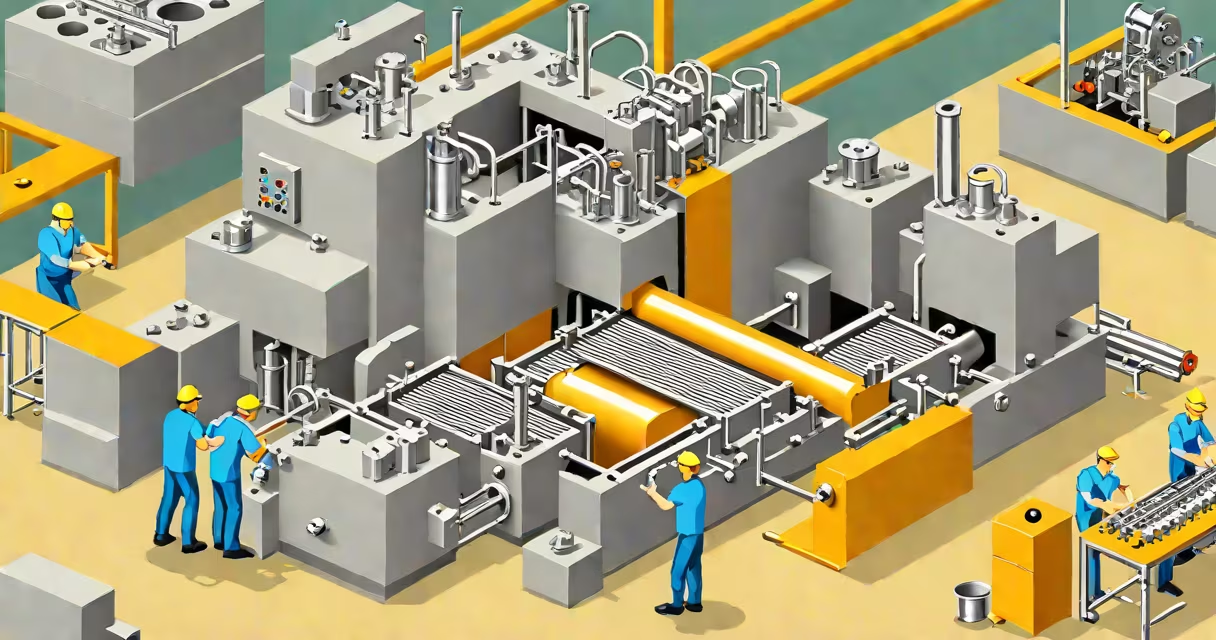
The process of extrusion forces raw material through a shaped die to create long, continuous profiles with consistent cross-sections. It's used to make everything from PVC pipes and aluminum window frames to pasta and candy bars.
Extrusion begins with raw material-typically thermoplastic, metal, or food-grade paste-fed into a heated barrel. A rotating screw pushes the material forward, melting it or softening it under pressure. The molten or pliable material then passes through a die-a custom-shaped opening-that gives it the final profile. After exiting the die, the extruded shape is cooled rapidly, often with air or water, to set its form. The finished product is cut to length and inspected for consistency.
This method enables high-volume production of complex shapes with minimal waste. Unlike machining, which removes material, extrusion adds shape by flow. The process works best with ductile materials that can deform without cracking under pressure. Common materials include polyethylene, PVC, aluminum alloys, and doughs.
Material enters a barrel via a hopper and is conveyed toward the die by a screw. As the screw rotates, friction and external heating raise the temperature. For thermoplastics, this melts the polymer into a viscous fluid. For metals, the material is heated to a malleable state-often above 300°C for aluminum-but remains solid enough to resist collapse under pressure.
Once the material reaches the die, it is forced through a precisely machined opening. The die's shape determines the final cross-section: round for tubes, L-shaped for window frames, or multi-cavity for electrical conduits. Pressure builds behind the die-up to 100 MPa in industrial systems-to maintain steady flow. The extrudate exits the die and enters a cooling zone, where it stabilizes in shape.
After cooling, the extrusion moves through a haul-off system-a set of rollers that pull the material at a controlled speed. This ensures uniform thickness and prevents sagging. The final step is cutting the continuous strand into standard lengths using a rotary cutter or saw. Quality control checks for dimensional accuracy, surface defects, and wall thickness variance.
Extrusion varies by material, temperature, and equipment design. The most common types are hot extrusion, cold extrusion, and co-extrusion.
| Type | Material | Temperature Range | Common Uses |
|---|---|---|---|
| Hot extrusion | Aluminum, steel, thermoplastics | 300-600°C | Pipes, window frames, automotive parts |
| Cold extrusion | Steel, copper, aluminum | Room temperature | Fasteners, small-diameter rods, precision components |
| Co-extrusion | Plastics (e.g., PE, PP) | 150-250°C | Multi-layer packaging, insulated cables, flexible hoses |
Co-extrusion stands out because it combines two or more materials in a single pass. For example, a cable might have a conductive core surrounded by a protective sheath made of different polymers. This allows for tailored performance-such as flexibility, insulation, and abrasion resistance-in one smooth product.
Another variation is profile extrusion, used in building materials. Aluminum window profiles are formed in long runs with internal chambers for strength and thermal insulation. These profiles are then cut and assembled into windows. The process reduces material waste and supports mass customization-changing the die allows new designs without rebuilding the entire line.
Extrusion enables cost-effective, high-speed production of uniform parts. A single extrusion line can run 24 hours a day, producing thousands of meters of material daily. For example, a 150 mm diameter PVC pipe extruder can produce up to 200 meters per hour, with tolerances within ±0.2 mm.
One key advantage is geometric complexity. A die can create hollow sections, multiple arms, or complex channels-all in one operation. Machining such shapes would require multiple steps and significant scrap. Extrusion minimizes tool changes and labor, reducing cycle time and energy use.
A lesser-known fact: extrusion can improve material properties. During extrusion, polymers undergo shear and elongation, aligning molecular chains. This increases tensile strength and impact resistance. For instance, HDPE pipes extruded at high shear rates show 15% higher burst strength than those made by injection molding.
People often confuse extrusion with injection molding. Both involve shaping plastic with heat and pressure, but they differ fundamentally. Injection molding injects material into a closed mold cavity, filling the entire shape in one shot. Extrusion continuously pushes material through a die, creating infinite length. Injection molding excels at complex, short-run parts; extrusion wins in long, repetitive profiles.
Another misconception is that extrusion only applies to plastics. While plastic extrusion dominates consumer goods, metal extrusion is important in aerospace and construction. Aircraft landing gear components, for example, are forged from titanium billets then extruded to precise dimensions. The U.S. Department of Energy notes that aluminum extrusion accounts for over 30% of all aluminum used in buildings due to its structural efficiency and recyclability.
I once observed a custom aluminum extrusion line at a manufacturing plant in Ohio. The team was producing architectural railings with a complex, twisted profile. The die had 12 separate flow channels. Despite the intricacy, the line ran at 1.8 meters per minute with no defects. The operator explained that the die's internal geometry balanced flow distribution-critical to avoid warping. That moment confirmed how engineering precision makes extrusion both predictable and useful.
Extrusion transforms raw material into shaped products through continuous pressure and die shaping. It's efficient, scalable, and adaptable across industries. Understanding the process helps clarify how everyday objects-from garden hoses to airplane parts-are made.