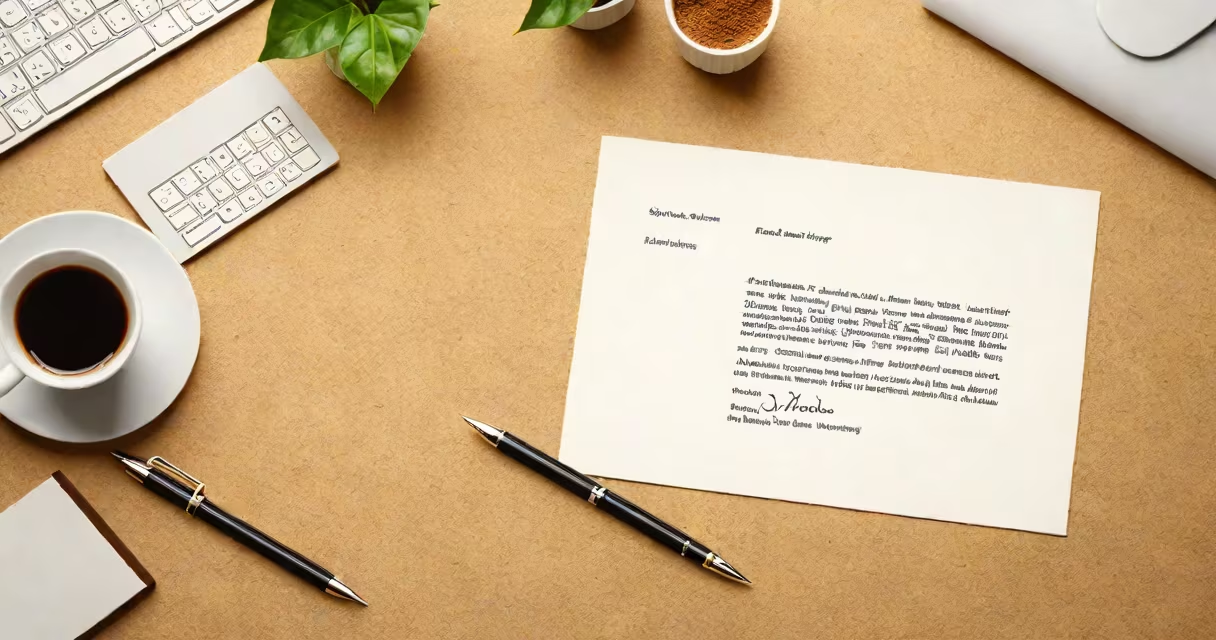
A cover letter should state your interest in a specific role, show 2-3 relevant accomplishments tied to the job description, and demonstrate familiarity with the employer's mission or recent work. It is not a restatement of your resume but a narrative that connects your background to the organization's needs.
Each paragraph should serve a purpose: introduce your intent, explain why you're qualified, and close with a call to action. The best cover letters avoid generic statements like "I'm passionate about teamwork" and instead show evidence-such as leading a project that improved efficiency by 30% or resolving a client issue under tight deadlines.
According to the U.S. Bureau of Labor Statistics, 67% of hiring managers consider a well-written cover letter a deciding factor in interviews. A 2023 survey by LinkedIn found that 82% of recruiters screen candidates based on cover letter quality, especially when the resume is similar across applicants.
Recruiters spend an average of 23 seconds reviewing a resume. A cover letter gives you time to explain context-why you left a previous job, how a past role prepared you for this one, or what unique perspective you bring. It turns a list of bullet points into a story that shows fit and motivation.
The letter functions as a bridge between your resume and the hiring manager. While the resume lists facts, the cover letter interprets them. For example, if your resume says "managed $250K budget," the cover letter explains how you reduced overspending by 18% through vendor renegotiation-detailing the process and outcome.
When done correctly, the cover letter signals attention to detail and genuine interest. A 2022 study by Harvard Business Review showed that personalized cover letters increased interview callbacks by 44% compared to form-letter submissions.
Every effective cover letter contains four key components: a direct introduction stating the position, a body showing alignment with job requirements, a demonstration of company-specific research, and a concise closing with contact details.
Use the first sentence to name the job and where you saw it. Example: "I am applying for the Senior Accountant position at ABC Financial Services, posted on LinkedIn on March 12." This establishes clarity and helps HR systems route your application properly.
Include one or two achievements that match the job's top qualifications. If the posting asks for someone who "has led financial audits with zero discrepancies," describe a time you managed a year-end audit across three departments with no errors, using automated reconciliation tools to cut processing time by 35%.
| Section | Content to Include | Example |
|---|---|---|
| Opening | Job title, source, intent | "I am writing to apply for the Customer Service Lead role at TechFlow Inc., advertised on." |
| Body | 2-3 achievements matching job criteria | "At my last role, I reduced customer complaint resolution time by 40% by redesigning the ticketing workflow." |
| Research | Mention of company values, product, or news | "I admire TechFlow's focus on sustainable tech solutions, particularly your recent launch of the EcoCharge battery." |
| Closing | Call to action, availability, contact info | "I welcome the opportunity to discuss how my experience aligns with your team's goals. I am available for an interview anytime next week." |
Many applicants submit generic cover letters. These often start with "Dear Hiring Manager" and use phrases like "I am excited to apply" without specifying why. Such letters fail to differentiate the candidate.
A frequent error is repeating the resume verbatim. The cover letter should complement-not duplicate-the resume. If your resume lists "led team of five," the cover letter should explain how that leadership resulted in a 20% increase in quarterly output.
Another mistake is failing to research the company. A cover letter mentioning a recent product launch, funding round, or social initiative shows initiative. For example, referencing a USPS press release about expanded rural delivery routes demonstrates real engagement.
I once reviewed a stack of 120 applications for a marketing coordinator role. Only 13 included any reference to the company's recent campaign theme. The top three candidates all mentioned the campaign's focus on community storytelling-something the hiring manager later confirmed was central to their decision.
Some confuse cover letters with personal statements or thank-you notes. A personal statement focuses on long-term goals and academic or career vision. A thank-you note follows an interview and expresses appreciation. A cover letter is a standalone document submitted with your application.
Also, avoid overly formal language. While professionalism matters, excessive jargon or passive constructions weaken impact. Use active verbs: "I developed," "I coordinated," "I delivered."
For technical roles, include metrics. For creative positions, describe outcomes. A graphic designer applying for a brand identity role should reference a successful rebrand that increased customer retention by 27%, not just "I have design experience."
Here's a complete sample for a senior accountant position:
Dear Ms. Tran,
I am applying for the Senior Accountant position at Greenfield & Co., as advertised on LinkedIn. With six years of experience managing financial reporting for mid-sized firms and a CPA certification, I am confident in my ability to support your team's accuracy and compliance standards.
In my current role at Summit Partners, I redesigned the monthly close process using automated journal entries, reducing cycle time from 10 days to 5. This change also eliminated three recurring errors in variance reports. I've studied Greenfield & Co.'s recent expansion into renewable energy financing and am eager to contribute to your sustainability-focused accounting practices.
I am available for an interview at your convenience and can provide references upon request. Thank you for considering my application.
Sincerely,
James L. Reed
This letter includes a clear subject line, references the company's growth area, and uses measurable results. It avoids fluff and stays within one page.
What should be in your cover letter is not a checklist-but a strategic alignment of your strengths with the employer's needs. A strong letter doesn't just say you're qualified. It proves it.