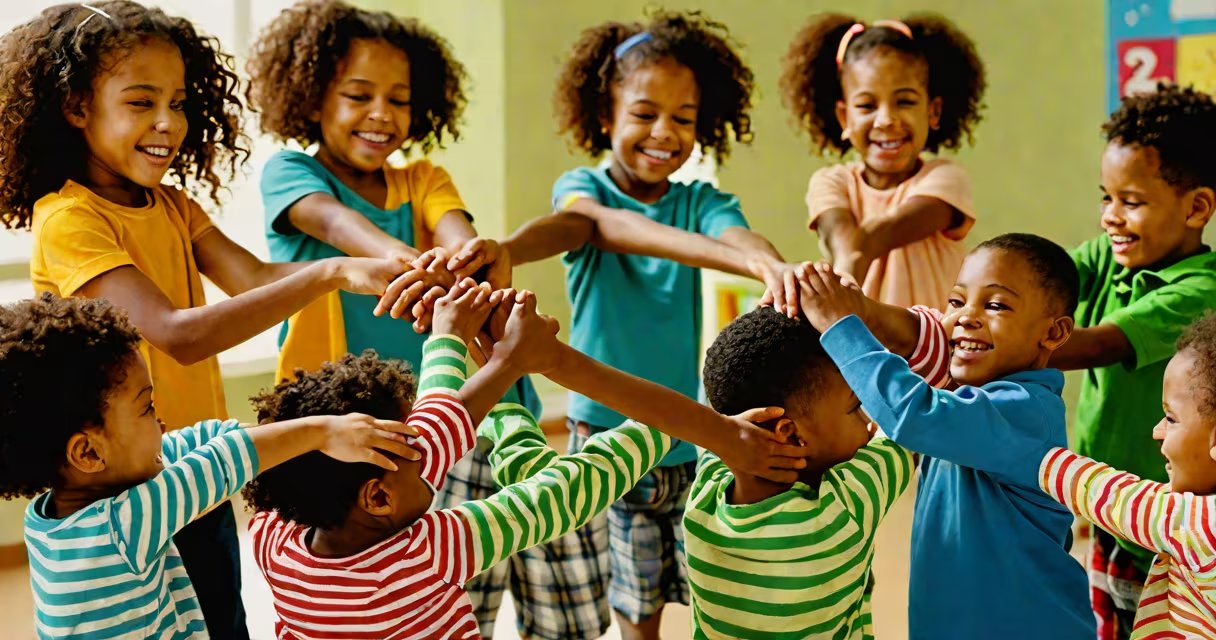
By the time your child enters kindergarten, they should recognize letters and numbers, follow multi-step instructions, express emotions appropriately, and interact positively with peers. These skills form the foundation for academic and social growth in formal schooling.
Kindergarten is not about advanced reading or math drills. Instead, it's a transitional phase where children develop core competencies through play, structured routines, and guided interaction. The goal is to build confidence, curiosity, and the ability to focus and cooperate.
Research from the National Association for the Education of Young Children (NAEYC) confirms that children who enter kindergarten with strong social-emotional and language skills are more likely to succeed academically. This includes recognizing their name, identifying basic colors and shapes, and understanding simple concepts like "big" and "small."
Children entering kindergarten typically demonstrate abilities across five domains: language and literacy, numeracy, physical development, social-emotional awareness, and executive function.
Language and literacy involve recognizing uppercase and lowercase letters, knowing the sounds they make, and being able to retell a simple story. A child might identify the letter "A" and say "ah" while pointing to an apple in a picture book. By age 5, most children can name at least 10 letters and match them to their corresponding sounds.
Numeracy begins with counting to 20, recognizing numbers 1-10, and sorting objects by size, color, or shape. For example, a child might count out 7 red blocks and place them in a row, then compare them to 5 blue ones. They may also understand basic spatial relationships like "on," "under," and "next to."
These milestones fall into four categories: cognitive, motor, emotional, and social. Each supports the others in building a well-rounded learner.
| Category | Key Skills | Example Activity |
|---|---|---|
| Cognitive | Recognizes letters, counts to 20, sorts by attribute | Matching uppercase and lowercase letters on flashcards |
| Motor | Uses scissors safely, draws a person with 4 parts | Tracing outlines of shapes with crayons |
| Social-Emotional | Shares toys, takes turns, asks for help | Playing a cooperative board game with peers |
| Executive Function | Follows 2-step directions, waits patiently | Putting away toys after a storytime session |
One non-obvious distinction: many parents assume that reading fluently is necessary before kindergarten. But according to the U.S. Department of Education's Early Childhood Longitudinal Study, only 16% of kindergarteners read independently at entry. What matters more is phonological awareness-the ability to hear rhymes, blend sounds, and identify beginning sounds in words.
A child who can clap out syllables in "butterfly" (buh-tur-fly) or sing the alphabet song is demonstrating early literacy readiness. These skills predict later reading success better than rote memorization of letters.
Parents often confuse readiness with academic performance. A child who can recite the alphabet or count to 10 isn't automatically prepared for kindergarten. What matters is how they engage with tasks, respond to feedback, and manage frustration.
For example, a child who says "I can't do it" and walks away from a puzzle is showing emotional regulation challenges. A child who says "Let me try again" and returns to the task demonstrates resilience-a skill more predictive of long-term academic achievement than early math scores.
Another misconception is that all children progress at the same pace. The National Institute for Early Education Research (NIEER) reports that children from low-income families enter kindergarten with a 12-month gap in vocabulary compared to peers from higher-income households. This gap widens without targeted support. Early exposure to rich language, storytelling, and conversation is critical.
Consider Maya, a 5-year-old who attends a public kindergarten in Portland, Oregon. She can identify her name in print, sort buttons by color and size, and describe her morning routine using full sentences. When asked to draw a family member, she includes eyes, mouth, arms, and legs-details that show fine motor control and conceptual understanding.
During circle time, she raises her hand before speaking and listens quietly when others talk. She shares her snack with a classmate who forgot theirs. These behaviors reflect social-emotional competence, which researchers at the University of Michigan link to improved classroom engagement and reduced disciplinary incidents.
I observed this in action during a visit to a dual-language preschool in Austin, Texas. Children were given a challenge: build a tower using only paper cups and straws. Some tried stacking immediately. Others paused, discussed strategies, and adjusted their plan. The teacher didn't intervene. The children solved problems through collaboration-exactly the kind of unstructured problem-solving that prepares kids for real classroom challenges.
Parents don't need expensive materials. Simple daily routines build key skills. Reading aloud for 10 minutes a day improves vocabulary and comprehension. Asking open-ended questions like "What do you think happens next?" encourages prediction and inference.
Play-based activities reinforce learning. Sorting laundry by color teaches classification. Measuring ingredients while baking introduces math concepts. Even asking a child to explain how they cleaned up their toys builds narrative and reasoning skills.
Most, model emotional regulation. When you say, "I'm frustrated because the car won't start, but I'll take a breath and call the mechanic," you're teaching coping mechanisms. Children learn by watching adults manage stress.
There's no single checklist for kindergarten readiness. But research from the American Psychological Association shows that children who enter school with strong executive function skills-like attention control and working memory-are more likely to graduate high school on time. These aren't taught in isolation-they grow from consistent, nurturing experiences.
Understanding what should my kindergartener know isn't about checking boxes. It's about recognizing the signs of growth, supporting curiosity, and fostering resilience. When children feel safe, seen, and capable, they're ready to learn-not just in kindergarten, but for life.