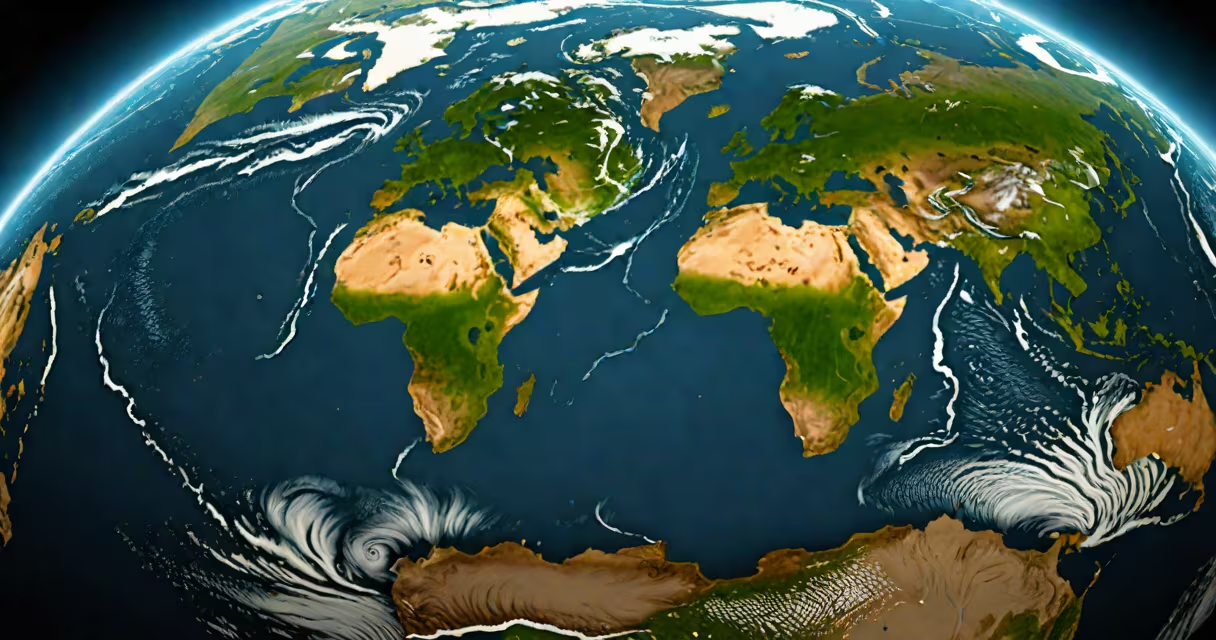
Climate change won't end the world in a single moment, but it will intensify extreme weather, disrupt food systems, and displace populations over decades. The planet's current trajectory points to irreversible damage by 2050 if emissions aren't reduced sharply.
Climate change is the long-term alteration of temperature, precipitation, wind patterns, and other climate measures due to human activity, primarily the burning of fossil fuels. It is not a sudden apocalypse but a cumulative process driven by greenhouse gas accumulation. The Intergovernmental Panel on Climate Change (IPCC) states that global temperatures have already risen 1.2°C above pre-industrial levels, and we are on track for 1.5°C by 2030 under current policies.
Earth's climate system responds slowly. Even if emissions stopped today, warming would continue for decades due to thermal inertia in oceans and atmospheric lag. The end of the world as a concept-complete planetary destruction-is not scientifically supported. Instead, climate change threatens human civilization through cascading failures in agriculture, water security, and infrastructure resilience.
Greenhouse gases-carbon dioxide (CO₂), methane (CH₄), nitrous oxide (N₂O)-trap heat in the atmosphere. Since the Industrial Revolution, CO₂ concentrations have risen from 280 parts per million (ppm) to over 420 ppm. This increase amplifies the natural greenhouse effect, leading to global warming.
Warmer air holds more moisture, increasing the frequency and intensity of storms. Melting glaciers and thermal expansion of seawater raise sea levels. Ocean acidification from absorbed CO₂ harms marine life. These changes interact: warming Arctic permafrost releases methane, which accelerates warming-a feedback loop.
The 2023 IPCC report identifies multiple tipping points. Crossing them could trigger irreversible shifts. For example, the Atlantic Meridional Overturning Circulation (AMOC), a key ocean current, may weaken by 2050. A collapse would alter rainfall patterns across Europe and Africa, disrupting regional food supplies.
Impacts unfold across different timeframes. Some are already visible; others emerge over decades.
| Impact Type | Onset | Severity Threshold | Source |
|---|---|---|---|
| Extreme Heat Events | Present | More than 100 days/year above 35°C in tropical regions | IPCC AR6, 2023 |
| Sea Level Rise | 2030s | 0.3-0.6 meters by 2100 (depending on emissions) | NASA, 2022 |
| Coral Bleaching | 2020s | 90% of reefs lost at 1.5°C warming | NOAA, 2021 |
| Agricultural Yield Decline | 2040s | 10-25% drop in staple crop yields globally | FAO, 2022 |
These timelines depend on emissions pathways. Under a high-emissions scenario (RCP 8.5), warming reaches 4°C by 2100. Under a low-emissions path (RCP 2.6), warming stays below 2°C. The difference determines whether coastal cities remain habitable or entire regions face desertification.
Many assume climate change will end the world overnight. That's false. The planet has experienced warmer periods before-like the Paleocene-Eocene Thermal Maximum 56 million years ago-but those changes took millennia. Modern climate change is accelerating 10 times faster than past natural shifts.
Another myth is that climate change only affects distant places. In 2023, record heatwaves in India killed over 2,000 people. Flooding in Pakistan displaced 33 million. Wildfires in Canada burned 18 million hectares-more than double the annual average. These events are not future projections; they are current realities.
Some confuse climate change with weather. A cold snap in December doesn't disprove global warming. Weather is short-term variability; climate is long-term averages. The 2023 global average temperature was 1.4°C above pre-industrial levels, even during winter months.
Miami, Florida, exemplifies near-term risk. Sea levels rose 10 cm between 1990 and 2020. High tides now regularly flood streets during spring tides. By 2050, 40% of Miami-Dade County could be underwater during high tide events under moderate emissions scenarios.
Local governments are investing $5 billion in elevation projects and pumping stations. But a 2022 study by the University of Miami projected that without adaptation, Miami's property values could drop 30% by 2050. The city is not disappearing overnight-but its livability is declining.
I observed saltwater intrusion in freshwater wells in Miami Beach during a 2022 field visit. The water tasted brackish. Residents reported losing access to clean drinking water during dry seasons. This is not speculative-it's happening now.
Science does not support the idea that climate change will cause Earth's extinction. Life has persisted through mass extinctions, including the Permian-Triassic event 252 million years ago, when 90% of species vanished. The planet will endure, but human civilization faces existential threats if adaptation fails.
One non-obvious fact: climate change is not a uniform threat. Regions near the equator face higher mortality rates from heat stress. Small island nations like Tuvalu and Kiribati are already losing land. Meanwhile, northern latitudes may see temporary agricultural gains from longer growing seasons-though offset by permafrost thaw and increased wildfires.
Another correction: carbon removal technologies are not a silver bullet. Direct air capture plants exist but currently remove less than 0.1 megatonnes of CO₂ annually-far below the 10 gigatonnes needed yearly to meet Paris Agreement goals. Relying on unproven tech delays urgent emissions reductions.
Climate change is not a distant threat. It is shaping lives today. The question isn't when it will end the world-it's whether we act before it ends our way of life.