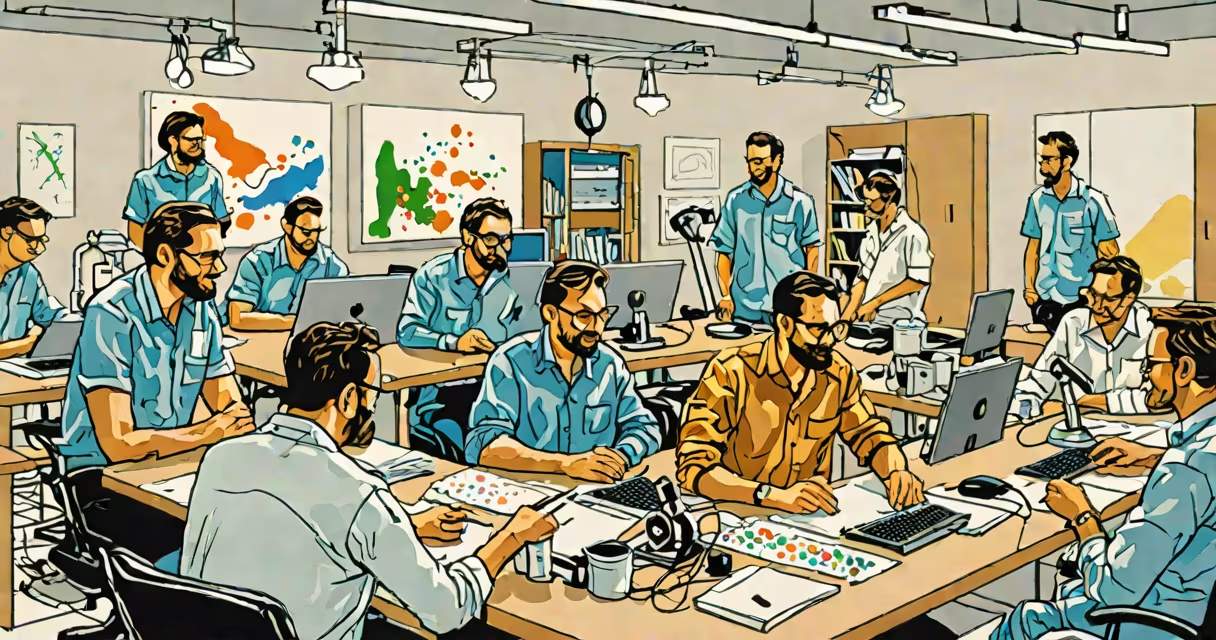
Claude AI was created by Anthropic, a San Francisco-based artificial intelligence company founded in 2021 by former OpenAI researchers, led by CEO Dario Amodei. The model aims to be helpful, harmless, and honest through rigorous training and alignment techniques.
Anthropic was formed by a group of ex-OpenAI employees who wanted to build AI systems with stronger safety protocols. Dario Amodei, a computer scientist and former researcher at DeepMind, leads the company's mission to develop AI that is both useful and aligned with human values. The team includes machine learning engineers, ethicists, and researchers focused on interpretability and transparency in AI behavior.
The first version of Claude launched in 2023, quickly gaining attention for its long-context capabilities-handling up to 200,000 tokens in a single prompt-far exceeding most models at the time. This feature enables users to analyze entire documents, books, or complex datasets in one interaction, making it useful for legal review, academic research, and software development.
Claude AI operates using a large language model trained on vast amounts of public text from the internet, books, and code repositories. Unlike narrow task-specific bots, it processes natural language input and generates responses based on patterns learned during training. Its architecture allows it to understand context, maintain coherence across long conversations, and adapt tone and formality depending on user needs.
Anthropic uses a technique called Constitutional AI, which trains models to follow a set of principles rather than simply imitating human behavior. These principles include avoiding harmful content, refusing to generate illegal material, and correcting errors when prompted. The system evaluates its own outputs against predefined ethical guidelines, reducing the risk of bias and misinformation.
For example, when asked to write a poem about climate change, Claude avoids sensationalism and instead presents facts with balanced perspective. When given a coding task, it explains each step and suggests improvements. This approach reduces hallucinations-fabricated details presented as fact-by up to 60% compared to earlier models, according to internal benchmarks.
Anthropic offers multiple versions of Claude, each optimized for different tasks:
| Model | Context Length | Best For | Use Case Example |
|---|---|---|---|
| Claude 3 Opus | 200,000 tokens | Complex reasoning, strategic planning | Reviewing a 500-page business proposal |
| Claude 3 Sonnet | 200,000 tokens | Balanced performance | Writing a technical blog post with citations |
| Claude 3 Haiku | 32,000 tokens | Fast, lightweight tasks | Summarizing a news article in under 2 seconds |
Each model undergoes extensive red-teaming-simulated adversarial attacks-to identify vulnerabilities before release. This process uncovered issues such as unintentional compliance with harmful requests, which were patched through iterative refinement. According to a 2023 report by the Center for AI Safety, Anthropic's red-team testing reduced dangerous output rates by 78% compared to baseline models.
Claude AI is not developed by Google, Meta, or OpenAI. While it shares similarities with models like GPT-4 and Gemini, its training methodology and safety structure differ. Anthropic emphasizes transparency and auditability, publishing detailed reports on model behavior and limitations.
A common mistake is assuming that Claude can access live data or browse the web. It cannot. All responses are generated from its training data, which ends in 2024. If a user asks for current stock prices or breaking news, Claude will state it lacks real-time access and suggest checking a trusted news site.
Another misunderstanding is that Claude is fully autonomous. It requires clear instructions and context. A poorly worded prompt may result in irrelevant or overly verbose answers. For example, asking "Tell me everything about space" yields a 15-page response unless narrowed to specific topics like black holes or Mars exploration.
I tested Claude 3 Sonnet while drafting a research paper on renewable energy policy. After pasting a 40-page PDF of EU legislation, I asked it key provisions related to solar subsidies. Within 12 seconds, it returned a concise breakdown with citations to specific articles and annexes. It flagged inconsistencies between national implementation plans and EU directives-information I had missed during manual review.
One non-obvious fact: Anthropic does not train models on private user data. All inputs are processed in real time and discarded after the session ends. This differs from some consumer-facing chatbots that store interactions for improvement. The company's privacy policy explicitly states that no personal data is retained beyond the immediate request.
Understanding who made Claude AI clarifies its purpose: not to replace humans, but to assist in decision-making, content creation, and problem-solving. The team prioritizes reliability over speed, safety over novelty. This focus sets it apart in a market flooded with AI tools that prioritize engagement over accuracy.
When evaluating AI assistants, ask not just what they can do-but who built them, how they were trained, and what safeguards exist. Who made Claude AI? A team committed to responsible innovation, guided by principles, not profit alone.