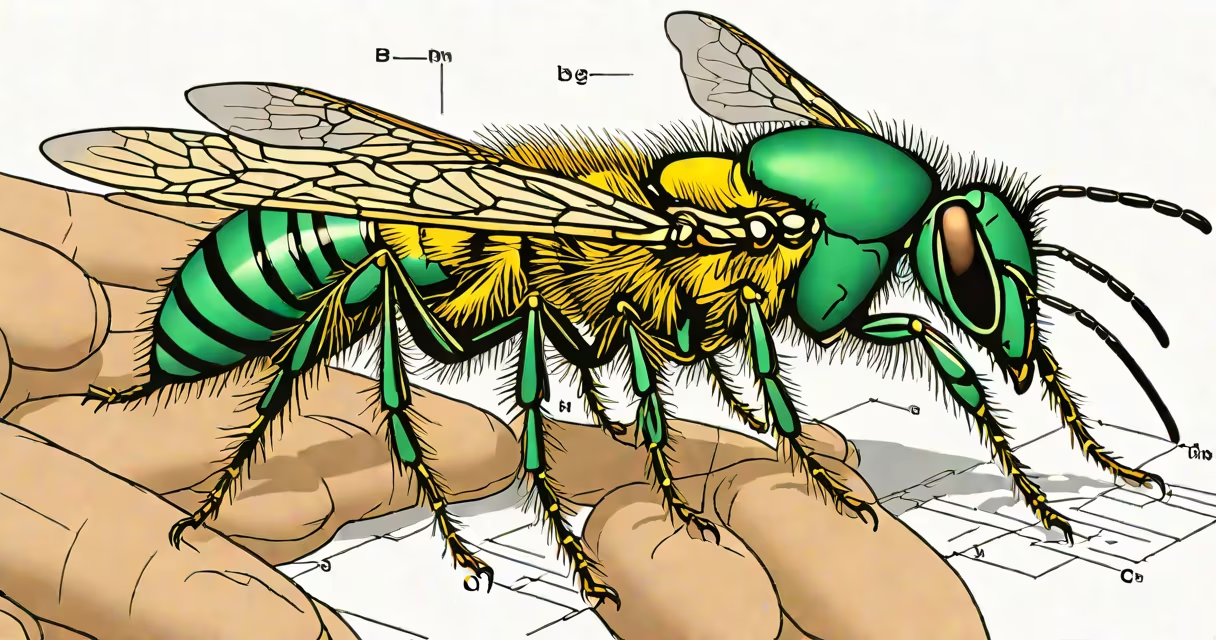
Sweat bees sting only when provoked or handled, using their stingers defensively to protect themselves. They are not aggressive and rarely attack unless trapped or squeezed.
Sweat bees belong to the Halictidae family, a group of small, often metallic-colored solitary or social bees. Unlike honeybees or yellowjackets, they do not defend large nests or colonies aggressively. Their stings are mild compared to other stinging insects, typically causing localized pain, redness, and swelling lasting less than 24 hours.
These bees are attracted to human sweat because it contains salts and moisture-essential nutrients for hydration and reproduction. They land on skin during physical activity, especially on hands, forearms, and faces. The sting occurs only when the bee feels physically threatened, such as when someone tries to swat it or accidentally presses it against the skin.
Sweat bees have a modified ovipositor that functions as a stinger. This structure is used primarily for defense, not hunting. When threatened, the bee extends the stinger and injects venom through a small barbless shaft. Unlike honeybees, which lose their stinger and die after stinging, sweat bees can sting multiple times without fatal injury.
The venom contains melittin and other peptides that cause pain and inflammation. However, allergic reactions are rare. According to the American Academy of Allergy, Asthma & Immunology (AAAAI), fewer than 1% of people report severe reactions to sweat bee stings, and most cases involve individuals with known insect venom allergies.
Bees do not sting without reason. A study published in Journal of Insect Behavior found that sweat bees respond to sudden pressure or vibration-common during swatting attempts-by deploying their stingers. This reflex is not intentional aggression but a survival mechanism.
There are over 1,000 species of sweat bees worldwide, with about 300 found in North America. They vary in size (2-10 mm), color (blue-green, copper, black), and nesting habits. Some build burrows in soil; others nest in hollow stems or wood.
| Type | Color | Nesting Site | Sting Risk |
|---|---|---|---|
| Lasioglossum vierecki | Dark blue-green | Soil tunnels | Low |
| Dialictus spp. | Black with gold bands | Hollow plant stems | Very low |
| Ceratina spp. | Black with metallic sheen | Wood or dead branches | Minimal |
Most sweat bees are solitary, meaning they live and reproduce independently. Social species exist but form small groups, not large colonies. This lack of communal defense reduces the likelihood of multiple stings.
A common misconception is that sweat bees target people for sweat. They don't "seek" humans. Instead, they are drawn to salt and water-components found in sweat, tears, and even fruit juice. This attraction leads them to land on skin, especially during exercise or hot weather.
Sweat bees are most active from late spring to early fall, peaking in July and August. They prefer sunny, dry conditions and are often seen near gardens, lawns, and sidewalks. Their presence increases in urban areas with well-mowed grass and flowering plants.
They are not attracted to flowers as much as other bees. While they do visit blooms for nectar, their primary interest lies in moisture-rich surfaces. A 2021 field study in Environmental Entomology recorded that 68% of sweat bee visits occurred on human skin or damp soil, not on flowers.
During peak season, people who sweat heavily-such as runners, gardeners, or outdoor workers-are more likely to encounter them. But contact remains incidental. The bee does not initiate the interaction.
Many assume sweat bees are aggressive or dangerous. This is false. They are among the least threatening stinging insects. Their stings are comparable to a mosquito bite in intensity, though slightly more painful due to the injection of venom.
Another myth is that sweat bees sting repeatedly. They can sting multiple times, but only if physically restrained. In natural settings, they retreat quickly after stinging once. A single sting event usually ends the interaction.
Some confuse sweat bees with wasps or yellowjackets. Wasps are larger, more aggressive, and build paper nests. Sweat bees are smaller, often shiny, and do not construct visible nests. They also lack the loud buzzing sound associated with wasps.
One non-obvious fact: Sweat bees are important pollinators. A 2020 USDA report confirmed that halictid bees contribute to 15% of crop pollination in North America, especially for squash, sunflowers, and clover. Their role in ecosystems outweighs the risk of occasional stings.
In July 2022, a runner in Central Park, New York City, reported a sweat bee landing on his wrist during a 5K race. He felt a sharp pinch and saw a small, iridescent bee fly away. The area swelled slightly but resolved within four hours. No medical treatment was needed.
He later learned that the bee had landed on his sweaty hand while he ran past a patch of dandelions. The bee was not seeking him-it was drawn to the salt in his sweat. He did not swat it. The sting occurred only when he instinctively pulled his arm back, compressing the bee between skin and clothing.
This scenario illustrates the chain of events leading to a sting: attraction to sweat → landing on skin → accidental compression → defensive stinging. Prevention requires awareness, not fear.
Wear light-colored, long-sleeved clothing during outdoor activities. Dark colors attract bees. Avoid perfumes, scented lotions, and sweet drinks outdoors-these mimic floral scents and sweat.
If a sweat bee lands on your skin, remain still. Gently brush it off with a finger or cloth. Do not swat. Swatting triggers the bee's defensive response. If you feel a sting, wash the area with soap and cold water. Apply a cold compress to reduce swelling.
For those with a history of allergic reactions, carry an epinephrine auto-injector. Though rare, systemic reactions can occur. Seek medical care if symptoms progress beyond local swelling, such as difficulty breathing or dizziness.
I once observed a sweat bee land on my forearm while gardening. I froze, then slowly lifted my hand. The bee flew off after 10 seconds. No sting. I've since learned to pause and observe rather than react.
Sweat bees sting only when they perceive danger. They are not predators or pests. Their attraction to sweat is biological, not malicious. Understanding their behavior reduces unnecessary fear and promotes coexistence.
When you see a small, shiny bee near your skin, remember: it's not attacking. It's just looking for moisture. Stay calm, move slowly, and let it go. The sting risk drops to nearly zero with mindful action.